Hepper is reader-supported. When you buy via links on our site, we may earn an affiliate commission at no cost to you. Learn more.
10 Shocking Pet Shipping Safety Statistics: Updated in 2026

In this article
Our pets are part of our families, and as such, there may come a time when you need to travel with your beloved animal companion. Unfortunately, traveling by car can only get you so far, and it's not necessarily the fastest mode of transportation. That's why millions of domestic animals travel on commercial flights every year.
There's a lot to prepare for, and consider whether you're traveling with your pet or shipping them somewhere. Of course, their safety should be your number one priority, so we've compiled this list of 10 pet shipping and transportation statistics that every pet owner needs to know before they embark on a trip with their beloved family pet.

Top 10 Pet Shipping Safety Statistics
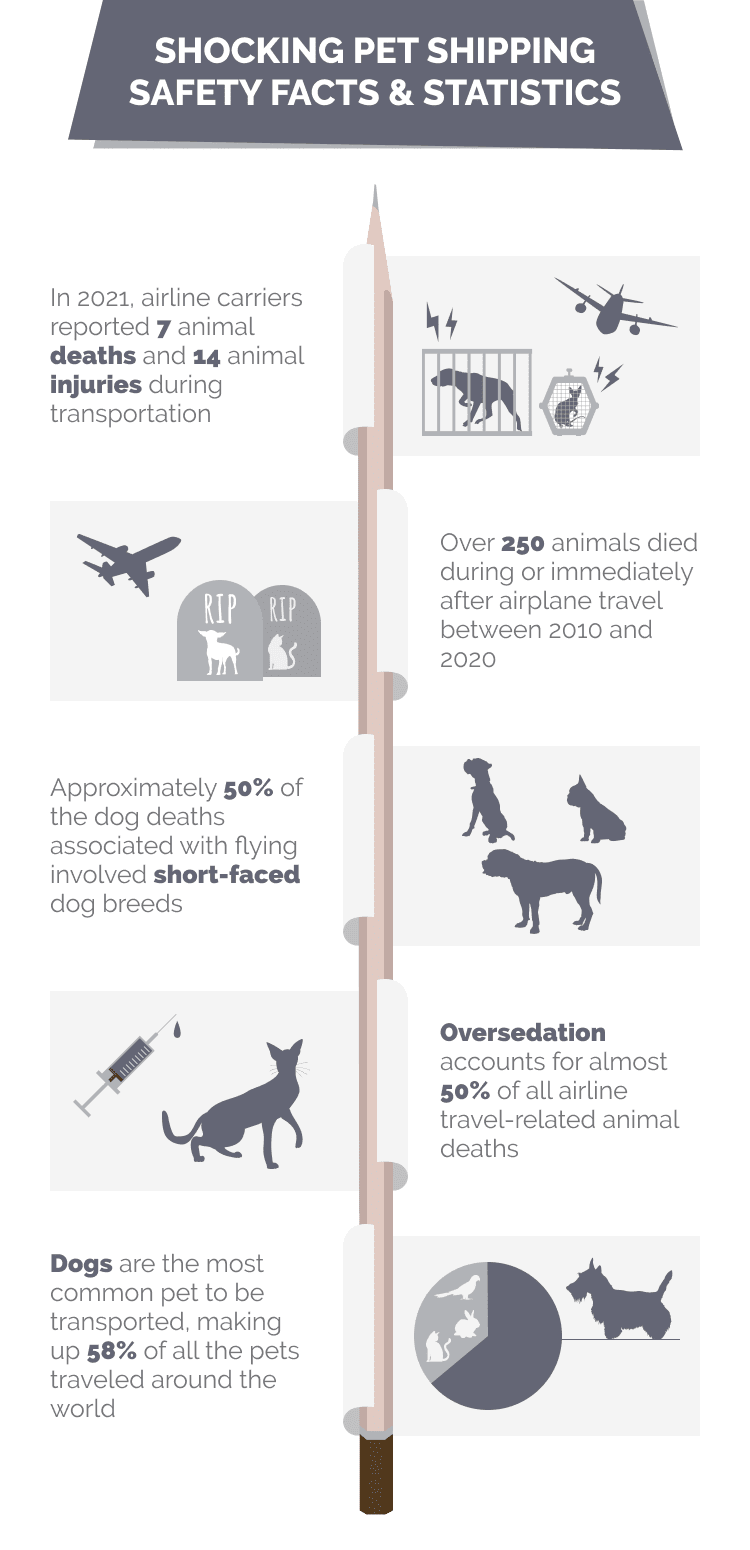
In 2021, airline carriers reported seven animal deaths and 14 animal injuries during transportation.
Over 250 animals have died during or immediately after airplane travel between 2010 and 2020.
Of all the animal incidents reported between 2010 and 2020, 38% were related to animal injuries.
Approximately one-half of the 122 dog deaths associated with flying involved short-faced dog breeds.
Oversedation accounts for almost half of all airline travel-related animal deaths.
In a five-year period, Hawaiian Airlines had the highest incident rate at 2.03%.
In December 2020, Alaskan Airlines had an incident rate six times lower than the average incident rate of United Airlines.
Delta Airlines accounts for 30% of all recorded airline pet deaths in the United States.
Dogs are the most common pet to be transported, making up 58% of all the pets traveled around the world.
A dog's heart rate can reach 180 beats per minute or more during the loading process of airplane travel.

Transportation Injuries & Deaths
1. In 2021, airline carriers reported seven animal deaths & 14 animal injuries during transportation.
(Bureau of Transportation Statistics)
In 2021, American airline carriers reported seven deaths and 14 injuries to other animals for a total of 21 incidents. This number is up from the ten reported incidents in the previous year and the 19 in the year prior.
Over 255,000 animals were transported via airlines in 2021, for a total incident rate of 0.82 per 10,000 animals. This incident rate was up significantly from 0.32 in 2020 and 0.47 in 2019.
There were zero lost animals reported during the 2021 calendar year.

2. Over 250 animals have died during or immediately after airplane travel between 2010 & 2020.
(Honest Paws)
Two-hundred and fifty-four animal passengers died during or immediately after air travel in a ten-year period. This statistic only applies to animals considered pets and doesn't encompass animals shipped via air travel for research, resale, or those on their way to sanctuaries. This may mean that the actual number of animal deaths is much higher.
In addition to the 254 animal deaths, 20 pets were lost altogether by airlines in this same ten-year span.
(Honest Paws)
Over 38% of animal-related incidents that airlines reported between 2010 and 2020 were related to animal injuries sustained during transportation.
Incidents reported in 2019 include oral abrasions, broken nails, and self-inflicted injuries from chewing at the carrier. Even the crate the pet is in can become damaged, resulting in injuries and lost pets when the airport personnel opens the cargo hold and the animal takes off. In fact, lost pets account for over 4% of reported incidents between 2010 and 2020.

4. Approximately one-half of the 122 dog deaths associated with flying involved short-faced dog breeds.
(AVMA)
In 2010, the U.S. Department of Transportation released statistics that show that some breeds are more likely to die during air travel than others. Of the 122 dog deaths associated with airline travel over the last five years, approximately one-half involved at-risk dog breeds.
Dogs considered at-risk are brachycephalic breeds – or those with short heads. This includes breeds such as Boston Terriers, Pugs, Pekingese, Lhasa Apso, Shih Tzus, and bulldogs. These dogs are generally more prone to respiratory issues, even during daily activities.
(IPATA)
Transporting sedated pets via air can be extremely dangerous as over-sedation is the most frequent cause of animal death during air transport. Not much is known about sedatives' effects on animals under the stressful conditions of transportation while they're enclosed in crates thousands of feet high.
An animal's ability to balance and maintain equilibrium will be altered under the effects of sedation. When the crate it's in moves, a sedated pet may not be able to brace and prevent injury.
Airline Statistics
6. In a five-year period, Hawaiian Airlines had the highest incident rate at 2.03%.
(Veterinarians.org)
Hawaiian Airlines had the worst incident rate of any other airline between January 2015 and December 2020. The company's incident rate was 2.03. In that period, Hawaiian Airlines transported just 55,906 animals.
Looking at just 2020, Hawaiian Airlines still topped the list of airlines with the highest incident rate of 2.15, with a total of 9,302 animals transported.
7. In December 2020, Alaska Airlines had an incident rate six times lower than the average incident rate of United Airlines.
(Veterinarians.org)
Between January 2015 and December 2020, Alaska Airlines had an incident rate six times lower than the average rate of United Airlines during the same period. Alaska Airlines transported over 730,000 pets in that time, keeping their average incident rate at 0.26. In that time frame, United Airlines transported over 448,000 animals with an average incident rate of 1.6. The incident rate refers to the number of pet-related incidents, including deaths, injuries, or losses per 10,000 animals that were transported.
In 2020 alone, Alaska Airlines transported over 105,000 animals with zero incidents to report.

8. Delta Airlines accounts for 30% of all recorded airline pet deaths in the United States.
(Honest Paws)
More companion pets have died while flying on Delta Airlines flights than with any other airline since 2010. Delta Airlines accounts for 30% of all reported airline pet deaths in the United States.
That doesn't mean other airlines are innocent, though. For example, more animals have become injured on United Airlines flights than on any other airline. United Airlines accounts for over 32% of all the recorded airline pet injuries in America.
Other Transportation Statistics
9. Dogs are the most common pet to be transported, making up 58% of all the pets traveled around the world.
(PBS Pet Travel)
Dogs make up 58% of the pets being transported, with cats coming in second, constituting 22% of all pets transported. The pet in third place by the number of annual journeys is pet birds, coming in far ahead of small mammals, horses, or other animals.
10. A dog's heart rate can reach 180 beats per minute or more during the loading process of airplane travel.
(Bergeron, et al.)
A study from 2002 looked at the physiological state of 24 beagles in reaction to air transportation. The study found that the average heart rate of traveling dogs hovered around the 80 to 90 beats per minute area, though peak values of over 180 beats per minute were recorded at times.
The loading and unloading process caused the biggest spikes in heart rate. The dogs' heart rates were significantly higher during loading than during take-off, landing, or flying.
FAQ
Can all pets fly in planes?
Traveling by plane can be dangerous for pets with heart or kidney disease and other pre-existing conditions. In addition, pets with short faces (e.g., English Bulldogs, Boston Terriers, Pugs, Persian cats) may have respiratory difficulty when placed in confined carriers or if they're put into the cargo compartment of a plane.
We recommend having your pet examined before you leave, especially if there are any health conditions present. Your vet may need to provide a health certificate depending on who you're flying with and where you're going.

Is sedation really that bad for pets?
Yes, sedation is not recommended for traveling pets as it has a profound effect that causes drowsiness.
Tranquilization, however, may be beneficial for some pets traveling by air. Instead of causing drowsiness and a hypnotic-like state, it works well for reducing anxiety and inducing tranquility.
Ultimately, sedating or tranquilizing your pet for travel is a conversation you need to have with your vet before your travel date.
How do pets pass away or become injured during airline travel?
There are several dangers that pets may encounter during transportation.
Humans consider airline travel a highly efficient and safe mode of transportation. Animals, unfortunately, are unable to understand the purpose of airline transportation and can't comprehend why they've been put into a dark and terrifying space for hours. This may be why many animal incident reports cite heart failure or anxiety-related incidents as causes of death (Honest Paws).
Stress is another very real experience pets can deal with during flights. Stress can mess with insulin levels, weakening the immune system and putting traveling pets into a flight or fight state. In at least one documented case, stress was listed as the cause of death for a traveling pet.
Weather conditions can play a role in the safety of pet transportation. For example, extreme temperatures can be very dangerous for pets traveling in the plane's cargo hold. Thankfully, the USDA has strict animal transport guidelines that will not allow pets in the cargo unless proper temperature requirements are met. There are also rules regarding providing shelter from extreme weather and cargo area conditions.
Hearing loss is another concern for pets transported via airlines. The sound pressure of a jet engine is 130dB, just 10dB lower than fireworks, which any dog owner can tell you can be terrifying for their pets. More than that, dogs can even suffer from irreversible hearing loss caused by proximity to loud noises.
How can I protect my pet during airline travel?
There are several things you need to do to keep your pet safe when transporting them, including:
Final Thoughts
Though we touched on many scary statistics in our article, transporting your pet is usually safe and problem-free. Allow yourself plenty of time to research the most pet-friendly airlines and familiarize yourself with safe transportation practices to reduce your risk of encountering any issues during transport.
Sources
Featured Image Credit: Andrea Izzotti, Shutterstock
Get Hepper In Your Inbox


Pet care tips from our vets and experts, straight to your inbox.
You may opt-out at any time. View our Privacy Policy for more information.

Chantelle's life revolves around two passions: writing and animals. Raised on the prairies of Canada amidst a menagerie of pets, she now lives with five cats, two guinea pigs, and a bearded dragon. Together with her husband and child, Chantelle delights in being an exemplary animal parent, going as far as installing wall-mounted cat shelves to give their cats an indoor playground. When she's not cozying up with her cats or snapping their amusing antics, she enjoys venturing into the Rocky Mountains, binge-watching her favorite Netflix shows, and indulging in spontaneous reading adventures.
Join the conversation
Ask a question, share your story, or send private feedback.