Hepper is reader-supported. When you buy via links on our site, we may earn an affiliate commission at no cost to you. Learn more.
12 Facts & Statistics on Becoming a Veterinarian in Canada: Updated in 2026
In this article
Note: This article’s statistics come from third-party sources and do not represent the opinions of this website.
If you’ve ever owned a pet, you know firsthand how essential veterinarians are. If you’re an animal lover and have been debating on becoming a veterinarian yourself, you might have a few questions about how it all works.
It’s a rewarding career path, but it takes a great deal of perseverance and many years to achieve. Here, we look at how much vets make in Canada and the job outlook for this profession. We also go over what it takes to become a vet in this country.

Top 12 Veterinarians in Canada Statistics
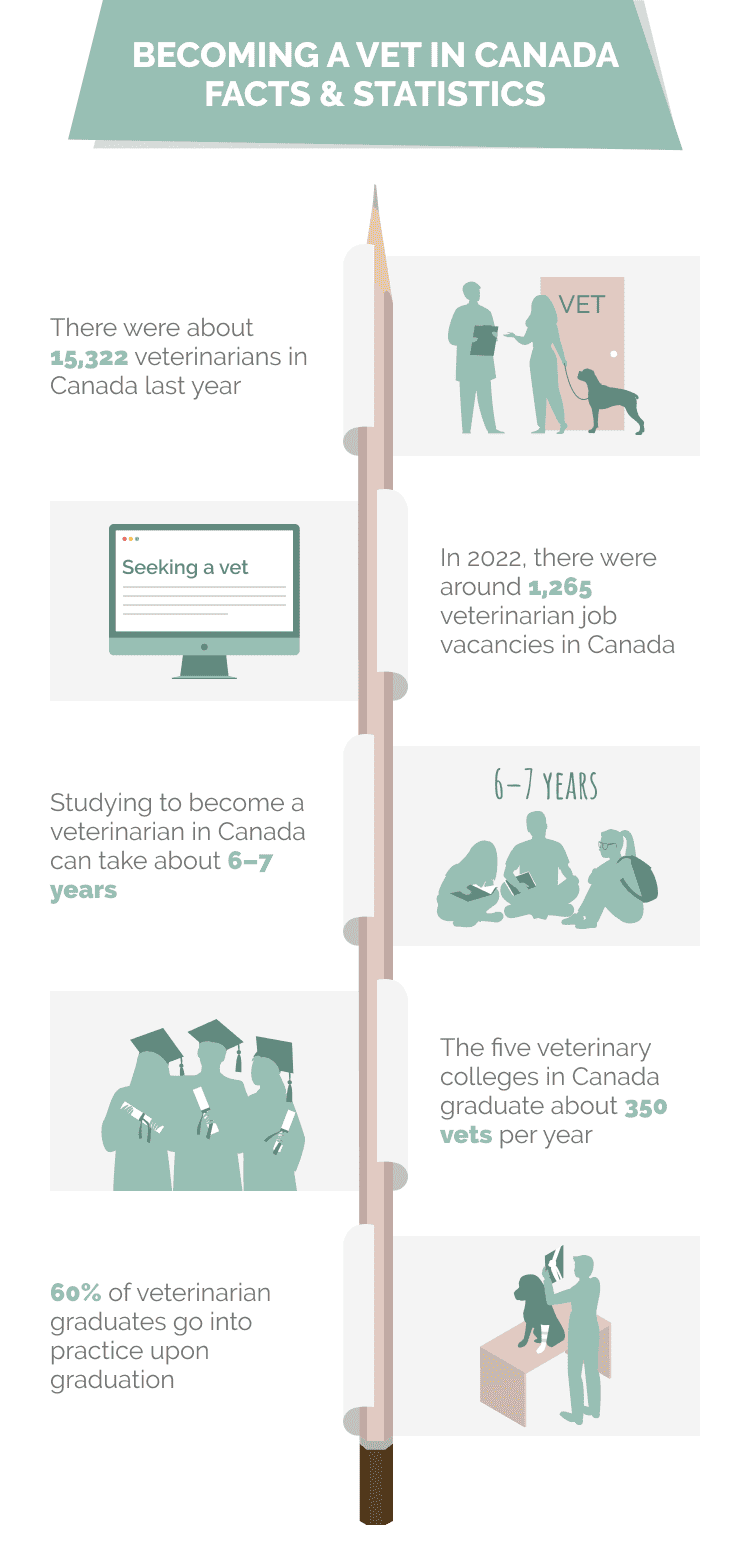
There were about 15,322 veterinarians in Canada in 2025.
Ontario has 5,383 veterinarians, which was the highest number out of the provinces in Canada in 2025.
There were approximately 3,825 veterinary practices in Canada in 2025.
As of July–August 2025, there were 1,265 veterinarian job vacancies in Canada.
The average pay for a veterinarian in Canada in 2025 was $85,000.
Future job prospects for veterinarians in Canada over the next 3 years run from “good” to “very good.”
Studying to become a veterinarian in Canada can take about 6 to 7 years.
To become a veterinarian in Canada, students must attend one of five schools.
The five veterinary colleges graduate about 350 vets per year.
The Ontario Veterinary College of the University of Guelph is ranked fifth in the world.
60% of veterinarian graduates go into practice upon graduation.
75% of Canadian veterinarians work in private practices.

Canadian Veterinarian Industry Statistics
1. There were about 15,322 veterinarians in Canada in 2025.
(CVMA)
Of these veterinarians, 62% were female and 37% were male, and 1% didn’t disclose their gender identity. The provinces with the most vets are B.C., with 4.8%, followed by New Brunswick and Newfoundland, with 4.7%. (CVMA)
2. Ontario has 5,383 veterinarians, which was the highest number out of the provinces in Canada in 2025.
(CVMA)
Following Ontario, Quebec has the second most vets with 2,851, followed by Alberta with 2,376.
3. There were approximately 3,825 veterinary practices in Canada in 2025.
(CVMA)
In June 2022, there were about 6,080 businesses in Canada in the veterinary services industry, which includes clinics, animal hospitals, testing labs, surgery services, and veterinary livestock services. (Statistics Canada)

4. As of July–August 2025, there were 1,265 veterinarian job vacancies in Canada.
(Statistics Canada)
This number has increased by 18.8% from the same time frame in 2021. Additionally, there were 1,325 vacancies for animal health technologists and veterinary technicians.
Fortunately, specialized job sites like Vet Jobs Canada now exist to help connect qualified candidates with veterinary opportunities.
5. The average pay for a veterinarian in Canada in 2025 was $85,000.
(Job Bank)
On the low end of the scale, the average wage was $30,000, and on the high end, it was $140,000. The highest salaries were in Alberta, with an average of $97,000, and the lowest rate of pay was in Nova Scotia at $73,000.
However, there wasn’t any available data from New Brunswick, Newfoundland and Labrador, the Northwest Territories, Nunavut, Prince Edward Island, or the Yukon.
How much a vet is paid depends on where they work, both in terms of the type of the practice and the size of the community served.

6. Future job prospects for veterinarians in Canada over the next 3 years run from “good” to “very good.”
(Job Bank)
Alberta, British Columbia, Ontario, PEI, and Quebec have good outlooks, while Manitoba, Nova Scotia, and Saskatchewan are listed as having very good prospects.
But there is no information on the job prospects for New Brunswick, Newfoundland and Labrador, the Northwest Territories, Nunavut, and the Yukon.
Veterinary Students in Canada Statistics
7. Studying to become a veterinarian in Canada can take about 6 to 7 years.
(Job Bank)
Typically, a student needs 2 years of pre-veterinary university studies or a health science degree from college. Then, a 4- to 5-year university degree in veterinary science must be completed.
The number of years could be more if you’re doing part-time studies. You’ll also be expected to acquire a national certification through an examination once you’ve received your veterinarian degree and to gain experience working with animals through a job and volunteer work.
Every college will have different requirements. If you’re in high school, research the college that you wish to apply to so you can have everything in order when you’re ready.

8. To become a veterinarian in Canada, students must attend one of five schools.
(CBC)
These schools are:
9. The five veterinary colleges graduate about 350 vets per year.
(CVMA)
Regarding admissions, Canadian veterinary colleges get an average of about 600 applications, but only about 100 are actually accepted. This makes the competition to get into one of the schools quite fierce! (Ross University)

10. The Ontario Veterinary College of the University of Guelph is ranked fifth in the world.
(QS Top Universities)
The top university in the world is the Royal Veterinary College of the University of London. The ranking of the University of Guelph places it as the leading veterinary school in Canada.
11. 60% of veterinarian graduates go into practice upon graduation.
(CVMA)
29% of graduate students continued furthering their education, 2% looked for employment outside of a practice, 1% decided to not seek employment for the time being, and 7% weren’t sure what their next steps would be.

12. 75% of Canadian veterinarians work in private practices.
(CVMA)
These include small and large private practices, either with mixed animals or in a specialized setting. 10% work for the government, 6% work in the veterinary industry, 5% in teaching and research, and 4% work in related fields.
Frequently Asked Questions About Becoming a Vet in Canada
Why is there a veterinarian shortage in Canada?
Part of the reason Canada has a shortage of veterinarians is that pet ownership is on the rise. In 2022, there were 7.9 million dogs and 8.5 million cats, which was an increase from 2020 of 200,000 more dogs and 400,000 more cats.
Additionally, pet owners are becoming more aware and concerned about their pets’ health. When you take into account how few vets graduate every year (about 350), there just aren’t enough to meet the demand. (Globe Newswire)

What are the different fields that a veterinarian graduate can work in?
What is pre-veterinary medicine?
Opting into pre-veterinary medicine isn’t necessarily required, and it’s also not a guarantee to get into veterinary school. It’s an undergraduate program designed to help prepare potential vet students. It features animal anatomy, biology, parasitology, and physiology courses, to name a few. (CHRON)
Why is it so difficult to be accepted into veterinary school?
This is primarily because of the competition to get in. In Ontario, there are four applications received for every seat offered, while the rest of Canada tends to accept 10 applications for every seat. The average admitting grade to get into the University of Guelph’s OVC was 93% as of 2021.
Beyond excellent grades, students need to have a wide range of experience in animal care. (University Affairs)
How much is tuition for veterinary school?
This depends on the school and whether the student is international, but it can range from about $50,000 to $70,000 for the degree. (University Affairs)

Conclusion
Deciding to become a veterinarian is an exciting yet challenging decision. It will require a great deal of hard work and determination just to even get accepted into the program. Following this, you’ll have a minimum of 4 years of study ahead of you and upon graduation, substantial debt.
However, Canada is in such dire need of veterinarians that you’re practically guaranteed to get a job immediately after graduation.
All the blood, sweat, and tears involved in becoming a veterinarian will give you an amazing and rewarding career working with animals, and it doesn’t get much better than that!
Sources
Related Reads:
Featured Image Credit: LightField Studios, Shutterstock
Get Hepper In Your Inbox


Pet care tips from our vets and experts, straight to your inbox.
You may opt-out at any time. View our Privacy Policy for more information.

Kathryn was a librarian in a previous lifetime and is currently a writer about all things animals. When she was a child, she hoped to work in zoos or with wildlife in some way, thanks to her strong love for animals. Unfortunately, she's not strong in the sciences, so she fills her days with researching and writing about all kinds of animals and spends time playing with her adorable but terribly mischievous tabby cat, Bella. Kathryn is hoping to add to her family in the near future – maybe another cat and a dog.
Join the conversation
Ask a question, share your story, or send private feedback.