Hepper is reader-supported. When you buy via links on our site, we may earn an affiliate commission at no cost to you. Learn more.
8 Common Mastiff Health Issues to Watch Out For (Vet Answer)


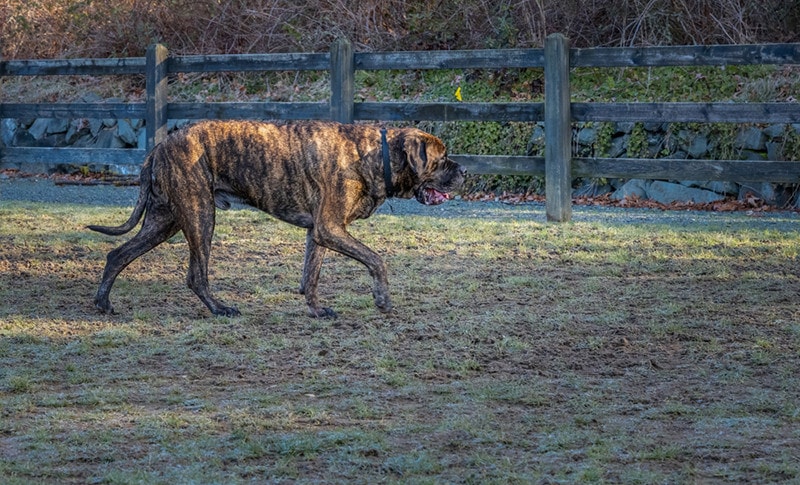
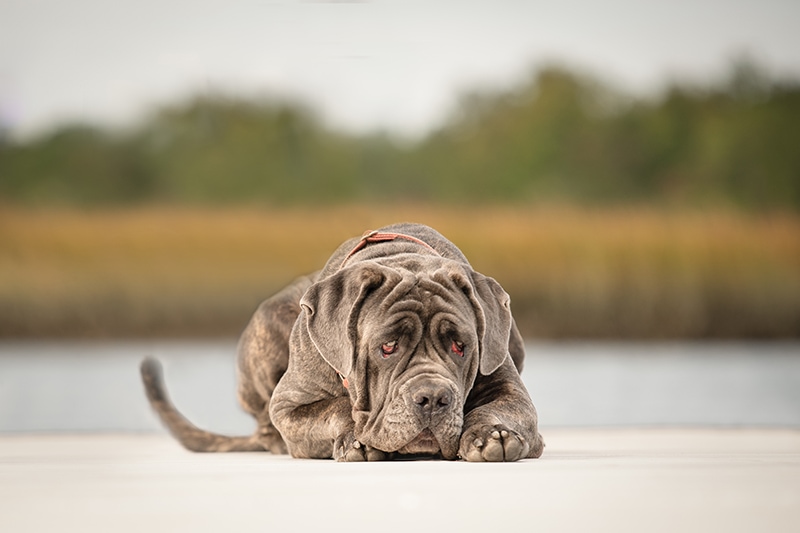
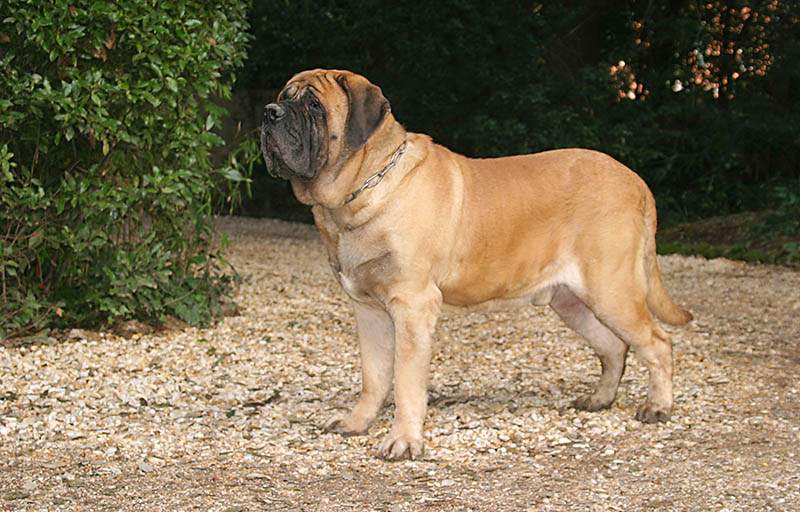
Any Mastiff lover will tell you that this dog is a gentle giant, with a predilection for slobber and charismatic facial expressions. However, these large breed dogs (which can weigh 60–90kg!) can be prone to various health issues that owners should watch out for.
Read on to learn more about common Mastiff health issues and when you should see your veterinarian about them.

The 8 Common Mastiff Health Issues
1. Gastric Dilatation Volvulus (GDV)
Large breed, deep-chested dogs are unfortunately prone to GDV, also known as “bloat.” It results in a distended gaseous stomach twisting on itself so the stomach becomes blocked. You may notice a sudden onset of the following clinical signs: a distended and hard abdomen, obvious discomfort, retching, shock, and collapse. While the cause of GDV is unknown, there are several predisposing factors: the breed and conformation of the dog, exercise after eating a large meal, eating too fast, and a family history of bloat. It is a life-threatening emergency that requires immediate surgical intervention to correct; the surgeon will decompress and untwist the stomach.
In high-risk breeds, a preventative surgery can be performed called a “gastropexy,” where the stomach is surgically tacked to the body wall. This is usually done at the time of a neuter or spay procedure, and it should always be performed during a GDV surgery to prevent the future risk of the stomach displacing from its normal position and twisting on itself again. Otherwise, the recurrence rate is as high as 75%.
2. Cardiomyopathy
Cardiac disease is reported to be a common health issue within Mastiff breeds, with dilated cardiomyopathy (DCM) being the most prevalent cause of heart failure. This is a common cause of heart failure in large breed dogs, involving the degeneration of the heart muscle, resulting in a thin, weakly muscled heart that becomes inefficient at pumping blood through the body. Dogs with DCM will usually demonstrate signs of weakness, lethargy, weight loss, exercise intolerance, coughing, and sometimes, collapse. Several medications can help with stabilizing the disease. However, DCM is a serious heart condition that is life limiting, with the prognosis ranging between 3 and 24 months after diagnosis.
3. Cancer
Despite the data being limited for Mastiffs, cancer among large breed dogs is a prominent cause of death. A 2013 paper that reviewed cancer prevalence in dogs suggested that Mastiffs have an underlying predisposition to specific cancers and estimated that 50% of all Mastiffs have cancer, which is a significant number.1 Statistically, it is estimated that osteosarcoma (bone cancer) is the most diagnosed cancer, affecting up to 10,000 dogs in the U.S.A. every year, followed by lymphoma and hemangiosarcoma, which are numbers reproducible for Mastiffs. Signs of osteosarcoma usually include acute and sudden lameness, swelling of a limb, difficulty eating, and swelling of the jaw.
4. Eye Disorders
Signs of eye disorders involve:
- Eye redness, irritation, and discharge
- Pawing at the eye
- Indications of vision loss, such as bumping into objects, changes in behavior (like uncharacteristic anxiety), being easily startled, and having trouble locating everyday items, such as toys or food
- Clouding of the eye
Mastiffs are prone to several eye disorders, including:
- Conformational eyelid defects - (entropion and ectropion), where the eyelid rolls toward or away from the eye, irritating the cornea
- Distichiasis - where eyelashes are located on the inside of the eyelid margin, causing irritation and inflammation in the eye
- Progressive retinal atrophy - an inherited degenerative disease of the retina that can cause vision loss in dogs as young as 6 months old
- Cataracts - a clouding of the lens that leads to impairment of vision in one or both eyes
5. Hip and Elbow Dysplasia
Hip and elbow dysplasia are two separate conditions that both result in the abnormal conformation of the joints. Over time, this leads to degenerative arthritic change. In some cases, this can result in chronic pain and reduced mobility and can be debilitating in the long term. However, other cases can be managed well with lifestyle changes and medications. In fact, it is reported that 76% of dogs with arthritis secondary to hip dysplasia can live comfortable lives with medical management.
If your dog doesn’t fall into this category, there are surgical intervention options that you can discuss with your veterinarian. For hip dysplasia, this can include a “triple pelvic osteotomy” in a young growing dog that has no evidence of secondary arthritis, a femoral head and neck excision (removing the ball and socket joint of the hip), or a total hip replacement. For elbow dysplasia, it often involves removing damaged tissues to ease pain.
6. Epilepsy
Epilepsy is the most common long-term neurological disorder in dogs. The term is used to describe repeat seizures of an unknown cause. They usually involve several signs, including:
- Stiffening and collapsing
- Shaking, paddling motions of the legs
- Loss of conscious awareness
- Loss of bladder and bowel control
- Hypersalivation
- Fatigue and disorientation after an episode
Epilepsy is usually diagnosed after a dog has had two or more seizures within a 6-month period, and other causes have been ruled out. The condition can be controlled with anticonvulsant therapy, usually for life.
7. Atopy/Allergies
An allergy is where the immune system becomes hypersensitized to a particular substance, termed an allergen. Usually, these substances exist innocuously in the environment. However, for some reason, exposure to these substances over time can cause a heightened and somewhat unnecessary bodily response, resulting in an immune system attack and inflammation.
Allergies tend to cause itchy and inflamed skin, which can result in sore paws and infected ears. They can also manifest as gastrointestinal signs, such as vomiting, bloating, or diarrhea. In Mastiffs, you may find that the creases of their skin become yeasty and inflamed, so always monitor and clean out their skin folds. Speak to your vet if your Mastiff is suffering from any signs of allergies, as the condition can be controlled through a combination of medication, shampoos, lifestyle adjustments, and dietary management.
8. Spinal Problems (Degenerative Myelopathy)
Degenerative myelopathy involves the erosion and degeneration of the myelin sheath, which insulates nerve cells. As the nerves become steadily more damaged, signals are interrupted between the brain and the rest of the body, resulting in a progression of clinical signs that ultimately result in severe weakness and paralysis of the hindlimbs and urinary and fecal incontinence. Most dogs are euthanized within 6–12 months due to the loss of quality of life and the owner’s wish to ease the suffering of their pet.
Unfortunately, there is no cure for this devastating disease. Their clinical progression can be managed through providing daily support (such as undergoing physiotherapy, using a sling to assist with standing and toileting, and addressing other physiologic factors like weight, arthritis, and other comorbidities) and keeping them as comfortable and pain-free as possible.

Summary
As a responsible pet owner, you always want to be on the watch for health problems so you can get your dog onto appropriate treatment and improve outcomes. In the end, you just want to offer them the best and most comfortable life during their time on this planet. If you have any concerns about your Mastiff, please book an appointment with your veterinarian.
Sources
Featured Image Credit: Michelle Cavanagh, Shutterstock
Get Hepper In Your Inbox


Pet care tips from our vets and experts, straight to your inbox.
You may opt-out at any time. View our Privacy Policy for more information.
Meg is a veterinary surgeon and writer originally from Australia, who currently is living and working in Scotland with her family. She is a passionate advocate of preventative medicine, client education and believes medicine never has a one size fits all approach. When not practicing veterinary medicine, her happy place is out walking the hills with her baby daughter and over-excited Labrador, and writing.
Dr. Meg is from Australia and currently lives with her family in Scotland. When she's not working, you can find her taking her clan out on the hills, writing, and consuming books. She enjoys the variety of general practice and the feeling that there is always something new to learn. There is never a boring day behind the doors of a veterinary clinic!
Education
Meg graduated in 2015 from James Cook University, Australia.
Experience
Dr. Meg has been in practicing veterinary medicine for over seven years. Before traveling and working in the United Kingdom, she spent her formative years after graduating from university obtaining a wide variety of experience in rural Australia, with a focus on both small animal and equine medicine. She has developed a keen interest in client education, learning over the years that once the patient has had the surgery or the medicine to "fix" an issue, it is ultimately awareness that improves patient outcomes.
Join the conversation
Ask a question, share your story, or send private feedback.