Hepper is reader-supported. When you buy via links on our site, we may earn an affiliate commission at no cost to you. Learn more.
12 Veterinary Telehealth Statistics & Facts (Updated in 2026)

In this article
Note: This article’s statistics come from third-party sources and do not represent the opinions of this website.
Veterinary telehealth, or telemedicine, is a rapidly growing field in the veterinary world. Telehealth brands have become increasingly popular among pet owners who are looking for convenient and cost-effective ways to provide their animals with quality healthcare services. Convenience is key. Telehealth allows pet owners to access specialized veterinary advice and consultation from the comfort of their own homes using communication technology such as phone calls, video calls, emails, and text messages.
But why now? As a result of the COVID-19 pandemic and the need for social distancing measures, telehealth in veterinary medicine has become increasingly popular in recent years. Telemedicine provides pet owners with a quick and straightforward way to access veterinary services for their beloved animals, especially in remote or rural areas.
Many health checks can be taken care of online. Veterinary telehealth can be used to diagnose illnesses, review lab work or X-ray results, discuss medications or treatments, provide nutritional advice, answer questions about behavior issues, or provide general guidance on how best to care for your pet. Best of all, it’s easy and cheaper when compared to traditional in-person visits at a veterinary office.
In order to get a better understanding of how popular veterinary telehealth has become worldwide, let's review the industry dynamics, data, and statistics from the last few years.

Top 12 Veterinary Telehealth Statistics
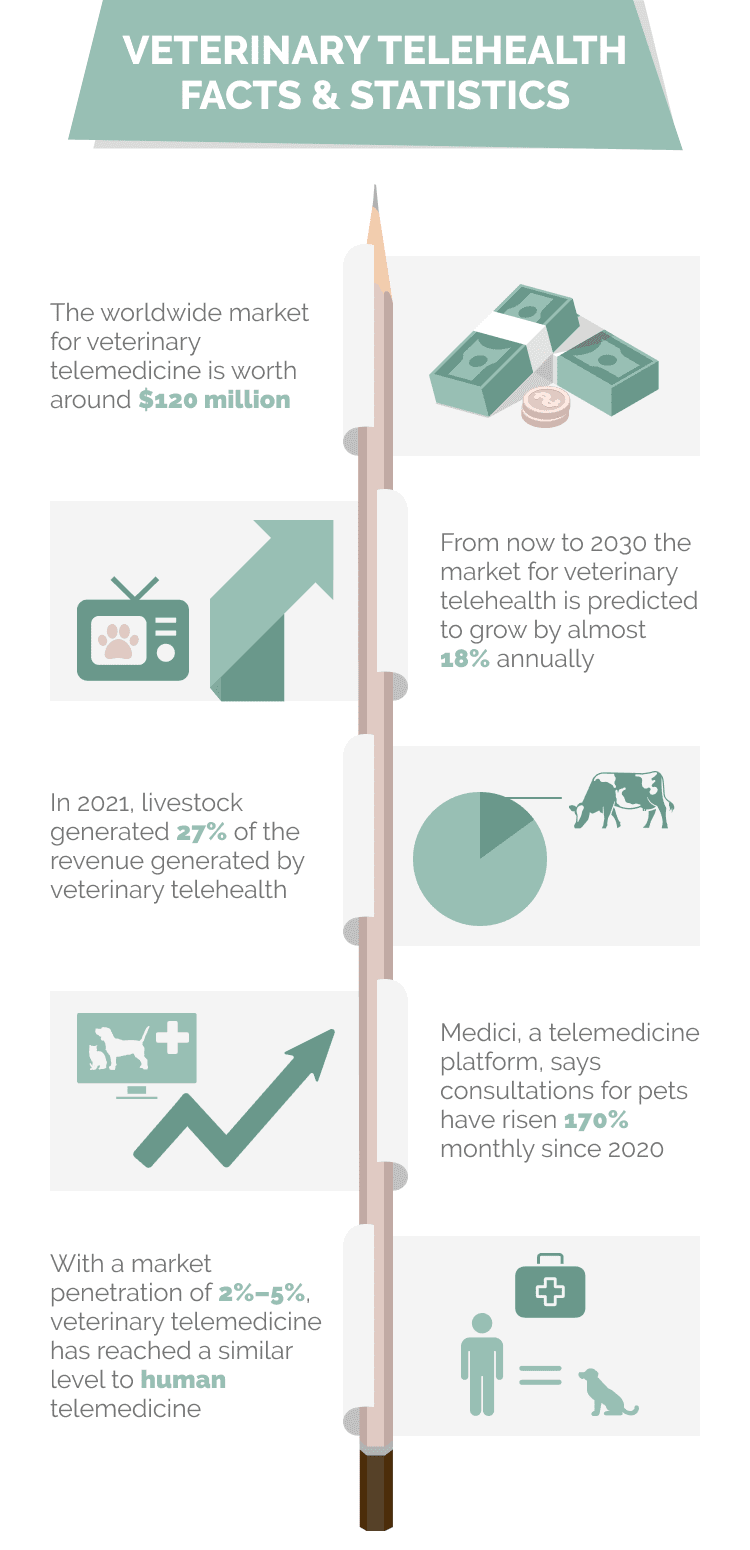
In 2021, the worldwide market for veterinary telemedicine was worth almost $120 million.
From 2022 to 2030, the market for veterinary telehealth is predicted to grow by almost 18% annually.
In 2021, livestock generated 27% of the revenue generated by veterinary telehealth.
As of 2021, veterinary telehealth is dominated by North America with a 37% market share.
Between 2022 and 2030, veterinary telehealth in Asia-Pacific is projected to grow by 18.7% annually.
By 2030, the veterinary telehealth industry in the United States is on track to be worth more than $546 million.
With 29% of total revenue, teleconsulting dominated the market in 2021.
In March 2020, the number of downloads per day for virtual pet apps surged by 40%.
Medici, a telemedicine platform, says consultations for pets have risen 170% monthly since 2020.
With a market penetration of 2 to 5%, veterinary telemedicine has reached a similar level to human telemedicine.
Nearly half of pet owners said their veterinarian offered online consultations in 2020.
According to a 2020 survey, 75% of owners were satisfied or extremely satisfied with telemedicine consultations.

Veterinary Telehealth Statistics & Facts
1. In 2021, the worldwide market for veterinary telemedicine was worth almost $120 million
(Grandview Research)
The COVID-19 pandemic has certainly played a significant role in the growth of the veterinary telehealth industry, as it provided an alternative solution for pet owners to access veterinary care while also ensuring social distancing measures. A large portion of the abrupt increase in the industry's size can be explained by the restrictions placed on public health in the wake of COVID-19. Other things are going on, too.
During this time period, a greater number of households acquired pets—resulting in a spike in the need for veterinary services.
2. From 2022 to 2030, the market for veterinary telehealth is predicted to grow by almost 18% annually.
(Grandview Research)
There has been a steady increase in interest in veterinary telehealth since it was introduced in the primary care setting. There are many advantages to using telehealth in the treatment of livestock. Getting cumbersome livestock to the vet can be a complicated process, and vets have traditionally visited farms in order to provide treatment to such animals. Farmers and veterinarians alike can benefit from the use of telehealth, which is time- and cost-efficient.
Veterinary medicine is experiencing an acute crisis that is also contributing to market expansion. Pet ownership is on the rise despite an ongoing veterinarian shortage. With the expansion of veterinary telehealth, practitioners can see more clients in a shorter amount of time.

3. In 2021, livestock generated 27% of the revenue generated by veterinary telehealth.
(Grandview Research)
In the context of telehealth appointments, livestock account for the majority of the species treated via telehealth care—there is no question about that. It is a convenient and time-saving method for vets to be able to conduct assessments on a large volume from a remote location rather than having to travel to individual animals. Livestock can account for a significant portion of the animals seen through telehealth appointments, and as a result, a significant portion of telemedicine revenue. The convenience and efficiency of telehealth appointments for livestock can be especially important for farmers and ranchers, who may have large herds of animals spread out over a wide area.
(Grandview Research)
North America, with its large number of livestock and widespread geography, is well-positioned to take advantage of the benefits of veterinary telehealth. The vast distances between farms and veterinary clinics in North America can make it challenging for farmers and ranchers to access veterinary care for their animals, making telehealth a valuable solution.
North America's dominant position in the veterinary telehealth market is also due to its infrastructure. It’s set up to succeed. Due to the fact that North America has widespread access to high-speed internet and telecommunications technology, veterinary telehealth can be easily delivered.

5. Between 2022 and 2030, veterinary telehealth in Asia-Pacific is projected to grow by 18.7% annually.
(Grandview Research)
In the coming years, the veterinary telehealth market in Asia-Pacific is forecast to grow significantly. In the region, advancements in health infrastructure, including investments in telecommunication technology, have made veterinary telehealth more accessible. Quality of life is improving. There are more opportunities for pet owners and livestock farmers to access veterinary care in the Asia-Pacific region thanks to the proliferation of hospitals and clinics that provide veterinary care.
Veterinary telehealth in the Asia-Pacific region will be driven largely by India and China. They both have huge populations. Veterinary care is in high demand in these countries as cattle populations are growing and pet ownership is on the rise. Within India alone, an example of the growing demand for telehealth services in the region is the launch of a telemedicine center for animals in Andhra Pradesh. Access to veterinary care for large populations can be provided through telehealth.
6. By 2030, the veterinary telehealth industry in the United States is on track to be worth more than $546 million
(Market Research)
The market for U.S. veterinary telehealth market is anticipated to continue to be strong in the coming years. Several factors contribute to this growth: the increasing use of telemedicine by pet owners and livestock farmers; an increasing number of animal diseases; and the improvements in tech. Vets are responding. As more people become aware of the benefits of telehealth and the convenience it provides, it is likely that the demand for veterinary telehealth services will continue to grow.

7. With 29% of total revenue, teleconsulting dominated the market in 2021.
(Market Research)
One of the key drivers of the growth of teleconsulting is the increasing demand for professional consultations. Veterinary general practitioners seek consultations from specialists more frequently, and the use of telehealth makes consultations available remotely, reducing the need for in-person visits and increasing access to expert advice.
Teleconsulting is also becoming increasingly popular for second opinions, as pet owners and livestock farmers look for additional perspectives on their animals' health. This allows them to get multiple opinions on a health issue, which can provide a more comprehensive understanding of the issue and help guide decisions about treatment.
8. In March 2020, the number of downloads per day for virtual pet apps surged by 40%.
(Forbes)
Pet health is moving to mobile. This increase in demand for virtual veterinary care services reflects the growing awareness of the benefits of telehealth in the veterinary industry—the increasing willingness of pet owners to use virtual services to access veterinary care for their pets. Let’s look at one example.
Since launching its mobile app service—Fuzzy Pet Health, a San Francisco-based pet healthcare company—has seen its monthly customer base increase by 15%, and usage of its wellness tools has increased by 75%. This highlights the growing demand for virtual pet health care services and the increasing use of mobile apps and other technology-based tools to access veterinary care.
9. Medici, a telemedicine platform, says consultations for pets have risen 170% monthly since 2020.
(Forbes)
The growth of virtual pet healthcare services has been significant in recent years, and the telemedicine platform Medici is a good example of this trend. Virtual visits of over 750,000 were recorded by Medici between April 2020 and August 2020, and the company has seen its revenue grow about 30% each month. That’s fast. This growth is a reflection of the increasing demand for virtual pet healthcare services and the growing awareness of the benefits of telehealth in the veterinary industry.
The rapid growth of virtual pet health care services—as seen with Medici—highlights the growing demand for telehealth in the veterinary industry and the increasing willingness of pet owners to use virtual services to access veterinary care for their pets.
10. With a market penetration of 2 to 5%, veterinary telemedicine has reached a similar level to human telemedicine.
(HealthForAnimals)
This is a significant development. It highlights the growing recognition of the benefits of telehealth in the veterinary industry and the increasing demand for virtual pet healthcare services. We trust it for us—so we trust it for them. The similarities in market penetration between veterinary telemedicine and human telemedicine also suggest that veterinary telemedicine is poised for significant growth in the coming years. More pet owners and livestock farmers are becoming aware of the benefits of telehealth and the convenience it provides. And the market for veterinary telehealth is huge as there are many more animals than humans.
Overall, the similarities in market penetration between veterinary telemedicine and human telemedicine are a reflection of the growing demand for telehealth in the veterinary industry and the increasing recognition of the benefits of telehealth for both pets and humans.
11. Nearly half of pet owners said their veterinarian offered online consultations in 2020.
(HealthForAnimals)
The results of a HealthforAnimals survey conducted in the fall of 2020 highlight the growing availability of digital and remote consultations in the veterinary industry. According to the survey, 47% of owners of pets indicated that their veterinarian offered digital or remote appointments, an increase of 20% prior to the COVID-19 pandemic.
This increase in the availability of digital and remote consultations is a reflection of the growing demand for telehealth in the veterinary industry and the increasing recognition of the benefits of telehealth for both pets and their owners. The COVID-19 pandemic has certainly accelerated the adoption of telehealth in the veterinary industry, as it provided a convenient and safe alternative to in-person visits while also ensuring social distancing measures.

12. According to a 2020 survey, 75% of owners were satisfied or extremely satisfied with telemedicine consultations.
(HealthForAnimals)
This high level of satisfaction with telemedicine consultations highlights the growing recognition of the benefits of telehealth in the veterinary industry and the increasing willingness of pet owners to use virtual services to access veterinary care for their pets. The convenience, accessibility, and efficiency of telemedicine consultations have all contributed to their growing popularity among pet owners.
Overall, the high level of satisfaction with telemedicine consultations, as reported by the HealthforAnimals survey, is a reflection of the growing demand for telehealth in the veterinary industry and the increasing recognition of the benefits of telehealth for both pets and their owners.

Frequently Asked Questions
What is the impact of telemedicine on veterinary work?
(VCA Hospitals)
Telemedicine enables veterinarians to diagnose and treat common ailments without requiring pets to leave the comfort of their homes. This helps reduce stress on the animal while also increasing convenience and cost savings for the pet owner. With remote monitoring technologies, vets are now able to evaluate vital signs such as temperature, pulse rate, blood pressure, and oxygen saturation levels from afar—allowing them to identify potential illnesses before they worsen.
In your area, you may have access to different types of care depending on local laws.
Veterinary telehealth: Is it legal?
(AVMA)
It's legal to provide veterinary care via telehealth. As far as legality is concerned, telehealth prescriptions vary. Your regular vet may be able to offer telemedicine prescriptions if your vet has set up a Veterinarian-Client-Patient-Relationship (VCPR) with you and has information on your pet's medical records. A VCPR is a relationship between a veterinarian, a client (pet owner), and a patient (animal), in which the veterinarian has sufficient knowledge of the patient to diagnose and treat medical conditions. A veterinarian who hasn't created a VCPR with you can still consult via telehealth but can't prescribe your animal medication via telehealth visits.
What is the cost of a virtual vet visit?
(Wired)
The cost of a virtual vet visit through your regular vet may be comparable to a traditional walk-in visit to the clinic. Telehealth services vary in cost according to the service provided. Some companies charge per visit, while others charge a monthly subscription fee. Veterinary telehealth visits generally cost from $30 to $50, which is in line with the cost of a face-to-face appointment.
Conclusion
In conclusion, veterinary telehealth is a powerful tool with the potential to revolutionize animal care. And it is developing fast. Veterinarians can use technology to reach far beyond the confines of their practice and provide quality, convenient care for an array of animals. Telehealth impacts everyone. Owners benefit from the convenience of always having a vet available, and veterinarians benefit from being able to use their skills to help more animals in need.
Pet parents love it. Not only does telehealth increase access to care, but also it can reduce the cost of transportation, loss of time, and the emotional stress associated with in-person visits.
Get Hepper In Your Inbox


Pet care tips from our vets and experts, straight to your inbox.
You may opt-out at any time. View our Privacy Policy for more information.

Nicole is a lover of animals of all sizes but is especially fascinated with the feline variety. She’s the proud mom of Baby, a Burmese, and works every day so he can relax in the sunshine or by the fire. She’s always had a cat in her home and has spent countless days with others, observing behaviors and softening up even the grouchiest of the lot. Nicole wants to share her kitty expertise with you so you and your cat can live happy, healthy, and care-free.
Join the conversation
Ask a question, share your story, or send private feedback.