Hepper is reader-supported. When you buy via links on our site, we may earn an affiliate commission at no cost to you. Learn more.
Are St. Bernards Good With Cats? Introductions & FAQs

In this article
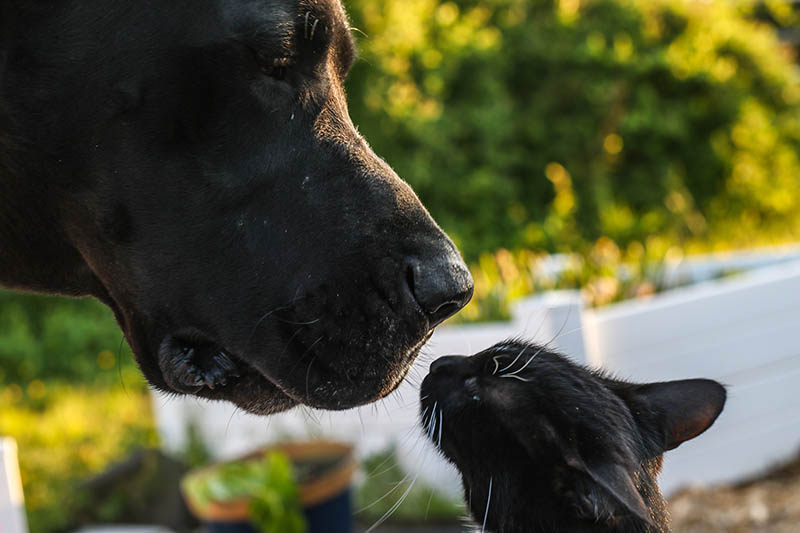
Widely recognized as one of the largest dogs, the St. Bernard is a loyal, affectionate, and tolerant giant. Despite its imposing size and mighty muscles, it has a sweet temper and creates a strong bond with its family. Does that mean it likes to be around cats, then? The answer is yes, but only if they were raised together with proper socialization.
Saints are not particularly welcoming to strangers, especially felines, and do occasionally show signs of aggression. That’s why supervision is so important. If you train a St. Bernard to be tolerant toward kitties, it’s very well possible to make your home a safe environment for both pets. So, how do you do that? Read on to learn more!

Gentle Giants: A Brief History of St. Bernard Dogs
Where did these big, mighty dogs come from? The roots of the St. Bernard giants go back to the 11th century. In 1050, a monk named Bernard (yes, hence the name), built a refuge in the Alps to shelter pilgrims crossing the border between Switzerland and Italy (Rome). And around 1660,1 the hospice started to adopt and train St. Bernard dogs.
They were bred to serve as search-and-rescue dogs for the folks trying to go through the Great St. Bernard Pass. It was incredibly dangerous, but these dogs were exceptionally good at finding and saving travelers from snow and avalanches. Yes, St. Bernards have been around for ages and are still ready and willing to help fellow humans.

So, Can They Be Friends With Felines?
With puppy training and early socialization, yes, it is possible. And for a beast as big as the St. Bernard, it is mandatory. Otherwise, it will terrify the cats in the house and the neighborhood, jump on people, scare the kids, and show aggression. To make the dog tolerate the presence of a feline, you’ll need to socialize it from the very first weeks of the dog’s life.
St. Bernards are eager to please. Once you create a trusting relationship, the dog will be quick to follow commands. So, if you tell it to sit or stay while it’s busy “eyeballing” a feline, the beast will comply. More importantly, if the two animals grow together, they won’t see each other as enemies. That’s all there is to it: raise them together and be there to provide supervision.
What About Fellow Dogs and Children?
St. Bernard is generally tolerant toward other dogs, but it’s not the most open-hearted breed. Thus, if you’re planning on introducing an adult St. Bernard to another dog, you’ll have to be there every step of the way. This is especially true for interactions in public. In contrast, a St. Bernard that was raised with a fellow pup will most likely be great friends with that other dog.
And what about little kids? We have good news: St. Bernard dogs are very patient with kiddos, almost like nannies. However, you should NEVER let your children play with this dog without supervision. Once the kids grow and learn how to interact with dogs, they’ll be able to create a strong bond with this pet.

Introducing St. Bernards to Cats: A Detailed Guide
But what if you’re adopting an adult St. Bernard? How do you introduce it to a cat? Well, the first thing you should do is create a “safe haven” for the kitty. It has to be a room with a door and ceiling that only the cat can access. As for the rest of the house, the more shelves, stairs, and other elevated spots it has, the better. Also, the two pets need to be separated for at least 4–7 days.
They’ll still be able to hear and smell each other, of course. Next, make sure there’s never any competition for food. Go ahead and put their bowls on the opposite sides of a wall/door. At first, the cat might be a bit hesitant, but with time, it will come around. Alright, now you can let the pets meet on “neutral grounds”.
Here’s how you should proceed at these meetings:
Are St. Bernard Dogs Quick to Adapt?
They’re not the most curious or energetic dogs, but St. Bernards take very little time to get accustomed to new environments. And they really love to spend time with their favorite people. It can be walking, playing various games, or pulling carts. Now, St. Bernards don’t need to be mentally stimulated 24/7. However, leaving this dog alone for a long time is a very bad idea.
It’s not a clingy pet, but if it starts to feel left out, the dog might develop destructive behavior, anxiety, and aggression. In some ways, it’s a big, fluffy baby. So, treat it accordingly!

Diet, Exercises, and Grooming: Keeping a St. Healthy
St. Bernard doesn’t have to walk or run for hours to stay fit. A long, 30–45-minute walk per day or a short yet active play session (20–30 minutes) will keep this giant in shape. If you’re a big fan of camping, hiking, and running, the dog will be more than happy to join in on the fun. However, be careful not to put too much pressure on its joints.
As for the diet, feed your furry friend premium-quality, large-dog food. It can be both commercial and home-cooked, as long as the vet says it’s ok. Also, don’t forget about the dog’s age: pups need a slightly different diet compared to seniors. As a giant breed, St. Bernard is prone to obesity. So, treat it wisely and keep a close eye on the pet’s calorie consumption.
Grooming also plays an important role in this dog’s life.
Here’s what you need to do to keep it happy:
Common Medical Conditions
Here’s a quick look at the most common and dangerous health issues in St. Bernard dogs:
- Gastric Dilatation-Volvulus. Big dogs with deep chests are highly susceptible to GDV/bloat. This condition makes the stomach twist by filling it with gas. It’s a life-threatening condition that should never be taken lightly. Thankfully, it can be avoided if you feed the dog tiny portions 2–3 times a day and let it rest an hour after and before eating.
- Wobbler Syndrome. If your St. Bernard is dragging its feet, lacking coordination, and feeling weak, that might be caused by cervical spondylomyopathy (the Wobbler syndrome). This disease develops at a young age and causes neck pain. CVI can be treated with vet-approved meds and surgery. To prevent it, ditch the collar and switch to a harness.
- Joint inflammation is a common condition in St. Bernards. In most cases, it affects 10-year-old dogs. But, if you own a pup St. Bernard, have it checked/screened by a vet ASAP. This way, it will be much easier to treat it. Again, meds and supplements do work, but if the joints are in a bad condition, only surgery will be able to help.
- Is your dog keeping its eyes closed all the time? Or maybe they’re always red or full of tears? If so, these are all symptoms of entropion. It’s when the eyelid rolls inward, and the eyelashes start “poking” the dog’s eyes. This abnormality causes the pet a lot of pain, but surgeons can remove a tiny part of the eyelid to fix the problem.
- Bone Cancer. Osteosarcoma is an aggressive bone tumor that’s very hard to treat. It targets the pet’s bones and causes severe pain, limping, and inflammation. How do you diagnose it? X-rays are a go-to technique, but the doc might use a biopsy instead. The remedies include pain meds, chemotherapy, surgery, and radiation.
- When the cancer cells develop in the lymph nodes and attack various organs in the dog’s body, it’s dealing with lymphoma. If you catch this condition at an early stage, it will be much easier for the dog to fight the disease. Most likely, the vet will treat it with chemotherapy, as it’s the most effective treatment.

Conclusion
Friendly, patient, and protective, St. Bernard is a near-perfect dog for a family. Thanks to its caring nature, it’s equally kind toward all members of the “pack”, be it a human, dog, or even cat. However, the Saint is not always open or playful with strangers. If the dog lacks training, it won’t get along with a feline.
The St. Bernard has a relatively low prey drive, but it can easily chase a cat down. So, how do you make them get along? It all comes down to early socialization. And even if you introduce the dog to a cat while it’s an adult but follow the tips from our guide, you can still turn them into best buds!
Sources
Featured Image Credit: Rita_Kochmarjova, Shutterstock
Get Hepper In Your Inbox


Pet care tips from our vets and experts, straight to your inbox.
You may opt-out at any time. View our Privacy Policy for more information.

Nicole is a lover of animals of all sizes but is especially fascinated with the feline variety. She’s the proud mom of Baby, a Burmese, and works every day so he can relax in the sunshine or by the fire. She’s always had a cat in her home and has spent countless days with others, observing behaviors and softening up even the grouchiest of the lot. Nicole wants to share her kitty expertise with you so you and your cat can live happy, healthy, and care-free.
Join the conversation
Ask a question, share your story, or send private feedback.