Hepper blog

Search our database of over 9,984 posts with up-to-date information from our experts and veterinarians.

Hepper is reader-supported. When you buy via links on our site, we may earn an affiliate commission at no cost to you. Learn more.

Can Dogs Eat Pigs’ Feet? Vet-Reviewed Health Concerns

By Chris Dinesen Rogers · Reviewed & fact-checked by Dr. Karyn KanowskiVet Approved
Dr. Karyn Kanowski
Reviewed & Fact-Checked byDr. Karyn KanowskiVeterinarian
Karyn has lived in the UK for the past 10 years after moving from Queensland, Australia. In 2010, she graduated from The University of Queensland School of Veterinary Science, and also holds a Bachelor’s degree in Zoology. Karyn is passionate about using evidence, experience, and owner collaboration to provide the best solutions for pets, and believes in making reliable information about animal health accessible to all. She shares her home with 5 cats, 4 dogs, and 1 husband, and when she is not practising as a veterinary surgeon, she spends her time writing, gardening, and cleaning up pet hair!View authorThe information is current and up-to-date in accordance with the latest veterinarian research. Read about our vets
Share
Ask us a question in the comments
Can Dogs Eat Pigs’ Feet

Many people don’t like the idea of certain meats; cow cheek or tongue, sweetbread, and pig trotters may not be as appealing as the more sanitized vision of a steak packaged in cellophane.

Pig feet appear in many cuisines as a cheap protein source. They also add body and thickness to broths, stews, and other preparations. Pig feet are safe for your dog to eat, but are not the healthiest part of the animal for your dog to eat. Let’s delve into their nutritional value to see if it’s a worthy addition to your pet’s diet.

Nutritional Value of Pigs’ Feet

Generally, the more an animal uses a specific part of its body, the more muscle and less fat it accumulates. However, active structures like feet need readily available energy. These factors can affect the nutritional value of various cuts. A 100-gram serving contains 236 calories, zero carbohydrates, 21.8 grams of protein, and 15.9 grams of fat.

This represents a good source of protein, but with a fat content on the higher side of ideal. Additionally, they contain no calcium or fiber, with only some essential vitamins.
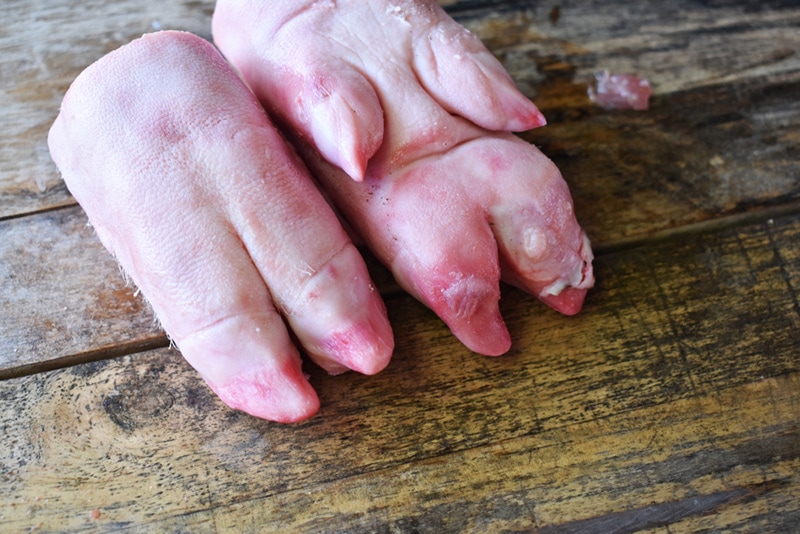
Fresh pork feet
Image Credit: moolek skee, Shutterstock

The Appeal of Pigs’ Feet

It’s easy to understand the allure of using pigs’ feet as a treat for dogs. Because it’s not a desirable cut for humans, it is more affordable. While they may be tasty, they also offer other benefits from a chef’s perspective. The gelatin in the feet adds body to broths and stocks. That can improve the mouthfeel and taste perception of those who consume it. However, there are other things to consider.

A Novel(ish) Protein

Chicken, beef, and turkey tend to top the list of popular protein sources for commercial dog foods, meaning that, if you are looking for a novel protein to offer your dog as part of an allergy workup, pork is often a good option. When trying to work out which (if any) protein ingredient a dog may be reacting to, whether that be a skin or gastrointestinal reaction, your vet will often recommend an elimination diet trial. This involves feeding your dog a food that contains a single protein source that they have not previously eaten.

Pork can be a good option; although it is sometimes used as an ingredient in commercial foods, usually as pork fat, it is not as ubiquitous as chicken and beef. That’s why many contain exotic meats, like venison and lamb, however, pork may still be an option.

Preparation Method

Preparation is another consideration when dealing with foods like pigs’ feet. You’ll see it cooked in several ways for human consumption, which could be detrimental to your pet. It can act as a flavor source and thickening agent in stews. You may also find it prepared with longer cooking techniques, such as slow cooking and braising, which usually involve problematic ingredients, like onions and garlic, and high levels of salt. This becomes an even higher level if the recipe calls for pickled pigs’ feet.

How To Prepare Pig Feet For Your Dog

You can purchase smoked pig feet from pet supply stores, or they can be fed raw, BUT, as pork can carry a number of harmful pathogens, such as Trichonella, you should freeze the feet for a period of 3 weeks before thawing them in the fridge for your dog.
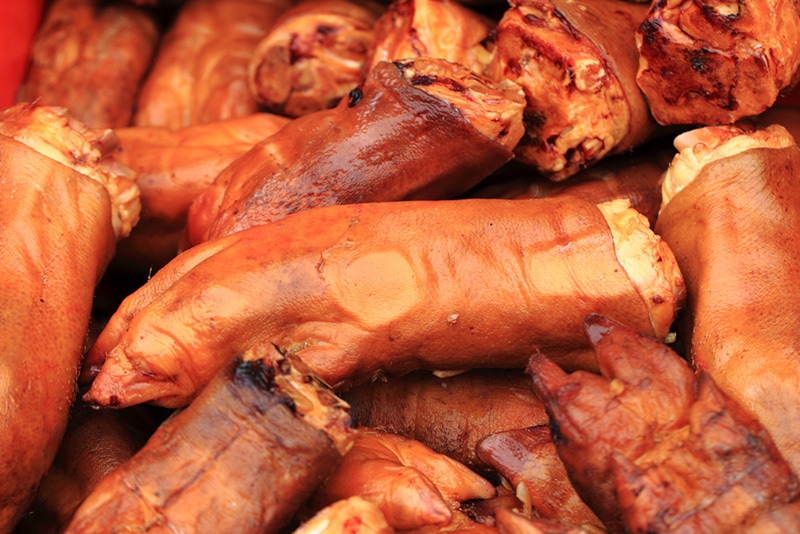
smoked pig leg feet
Image Credit: Jirik V, Shutterstock

Final Thoughts

Pig feet can be a safe addition to your dog’s diet. However, it is something that should only be offered as an occasional treat to larger dogs. The only real nutritional benefits they provide are in the form of dietary protein. They are relatively high in fat, so should not be given more often than once a month, but they can be an enjoyable way for your dog to clean their own teeth and gums!

See Also:

Sources

Get Hepper In Your Inbox

Pet care tips from our vets and experts, straight to your inbox.

List

Select all that apply.

You may opt-out at any time. View our Privacy Policy for more information.

Chris Dinesen Rogers
Authored by

Chris Dinesen Rogers

Join the conversation

Ask a question, share your story, or send private feedback.

Rate this post
Required to post. Only our editors see your rating.
Who should see this?

A human reviews every comment before it appears. Your email is never published.

Picked to go with this article

Can Dogs Eat Chicken Feet? Vet-Approved Nutrition Facts

Can Dogs Eat Chicken Feet? Vet-Approved Nutrition Facts

Chicken feet may not be the first thing that pops into your mind when looking for a dog treat, but they are worth considering. Not only can your dog eat chicke…

Hanh Duong
By Hanh Duong ·
Why Is There No Pork Dog Food? Vet-Approved Explanation

Why Is There No Pork Dog Food? Vet-Approved Explanation

Pork is a staple here in the United States. People love to barbeque, and pork is usually on the menu, especially during holidays like Memorial Day, Labor Day,…

Rachel Giordano
By Rachel Giordano ·
Are Pig and Cow Ears Good for Dogs? Vet-Reviewed Safety Guide

Are Pig and Cow Ears Good for Dogs? Vet-Reviewed Safety Guide

Pet care is changing. People are becoming more aware of how things affect their pets’ health, allowing them to make informed choices and seek advice from their…

Dean Eby
By Dean Eby ·
Can Dogs Eat Cow Tongues? Vet-Reviewed Health Concerns

Can Dogs Eat Cow Tongues? Vet-Reviewed Health Concerns

As dog owners, it’s up to us to decide what is on our dog’s daily menu. This includes their high-quality dog food, treats, and other additions we throw in. Wit…

Melissa Gunter
By Melissa Gunter ·

Keep reading

More stories you might like

Can Dogs Eat Tripe? Vet Reviewed Facts and FAQ

Tripe is the stomach of grazing animals (aka ruminants), including cows, bison, and sheep, and it's relatively popular among humans in some cultures. You might…

Gregory Iacono
By Gregory Iacono ·
Can Dogs Eat Tripe? Vet Reviewed Facts and FAQ

Can Dogs Eat Pork Bones & Ribs? Vet Reviewed Facts & Safety Guide

Dogs love chewing on bones (and anything else they can get their teeth on!), but while certain bones are safe for them to chew, others are not. So, you may not…

Misty Layne
By Misty Layne ·
Can Dogs Eat Pork Bones & Ribs? Vet Reviewed Facts & Safety Guide

Can Dogs Eat Lamb? Vet-Verified Nutritional Information

Our canine friends and fur babies are descendants of wild dogs and wolves, and as such, a carnivore’s diet is still very much hard wired into their DNA. Theref…

Rachael Gerkensmeyer
By Rachael Gerkensmeyer ·
Can Dogs Eat Lamb? Vet-Verified Nutritional Information

Can Dogs Eat Cow Hooves? Vet Reviewed Facts & FAQ

Cow hooves are a polarizing treat among dog owners, though if dogs had their say, they’d likely have one every day. Technically speaking, dogs can’t EAT cow ho…

Chantelle Fowler
By Chantelle Fowler ·
Can Dogs Eat Cow Hooves? Vet Reviewed Facts & FAQ

Can Dogs Eat Horse Hooves? Vet Reviewed Health Concerns

Horse hooves, or more aptly their trimmings, make a coveted treat for some dogs, but their safety sparks some debate. So, which is it? Should you worry that yo…

Cassidy Sutton
By Cassidy Sutton ·
Can Dogs Eat Horse Hooves? Vet Reviewed Health Concerns

Can Dogs Eat Raw Meat? Vet Reviewed Risks & Benefits

There is no doubt that dogs love their meat, and many owners wonder if it is safe to offer their pup a raw diet. Feeding your pup raw meat can be a controversi…

Nicole Cosgrove
By Nicole Cosgrove ·
Can Dogs Eat Raw Meat? Vet Reviewed Risks & Benefits

Can Dogs Eat Pork Rinds? Vet-Reviewed Health Facts & FAQ

It’s always tempting to give our canine companions some of our own food, especially when they bring out the puppy dog’s eyes. But not every food we eat is safe…

Misty Layne
By Misty Layne ·
Can Dogs Eat Pork Rinds? Vet-Reviewed Health Facts & FAQ

Can Dogs Eat Goat Meat? Vet Reviewed Health Concerns & FAQ

Before we get into this post, let’s get one thing straight: dogs can eat goat meat! Goat meat is a healthy and nutritious source of protein, vitamins, and mine…

Cheryl Regan
By Cheryl Regan ·
Can Dogs Eat Goat Meat? Vet Reviewed Health Concerns & FAQ