Hepper is reader-supported. When you buy via links on our site, we may earn an affiliate commission at no cost to you. Learn more.
Can Dogs with Pancreatitis Eat Tuna? Is it Safe? (Vet Answer)

In this article
As any owner of a dog with pancreatitis knows, diet plays an important part in the treatment of this disease. Since it’s advisable to feed a dog with pancreatitis a low-fat diet, and because many of us have cans of tuna in our pantry, it makes sense to wonder if this food fits the bill.1 Is it safe to feed tuna to a dog with pancreatitis?
The answer is not simple. There are certain types of tuna that you should avoid feeding your dog altogether, especially if it has pancreatitis. On the other hand, other types of tuna are safe to feed your dog when it has pancreatitis, but only in small quantities. Feeding a dog with pancreatitis tuna canned in spring water will likely be fine as an occasional treat. Let’s explore the issue in more depth.

What Is Pancreatitis?
To understand what food can be safely fed to a dog with pancreatitis, it’s important to first understand the disease.
Pancreatitis is inflammation of the pancreas. The pancreas is an organ located in the abdominal cavity, near the stomach and the first part of the small intestine. The pancreas has two main roles. The first is the production of insulin, a hormone that is crucial for blood sugar regulation. The second is the production of digestive enzymes, which help break down starches, fats, and proteins.
Normally, these enzymes are produced in an inactive state and are only activated once they pass into the small intestine via the pancreatic duct, where they help with the digestion of food.
Pancreatitis occurs when the digestive enzymes are activated too early while they’re still inside the pancreas. The pancreas becomes inflamed as the enzymes start to auto-digest the pancreas itself.
Pancreatitis can be acute and occur suddenly, or it can be a chronic, ongoing condition.

What Causes Pancreatitis?
The underlying cause of pancreatitis is often unclear. There are, however, a number of factors that have been implicated in its development in dogs.
These include:
The Role of Diet in the Treatment of Pancreatitis
Along with intravenous fluids, pain control, and anti-nausea medication, diet forms a crucial part of the management of pancreatitis.
Dogs with pancreatitis should be fed a highly digestible, low-fat diet. This is because dietary fat is a potent stimulus for the release of digestive enzymes by the pancreas, which may worsen pancreatic inflammation.
Dogs that have recovered from an acute bout of pancreatitis may eventually be transitioned back to their normal diet, while dogs with recurrent episodes of acute pancreatitis or those with chronic disease, may need to be fed a low-fat diet on an ongoing basis.
Is it Safe for Dogs with Pancreatitis to Eat Tuna?
Tuna is considered to be low-fat, with a 4-ounce serving of tuna containing just 3.37 grams of fat, making it safe for dogs with pancreatitis to eat occasionally in small amounts. Be sure to choose the variety that’s canned in spring water instead of oil or brine. Tuna canned in oil should be avoided due to its higher fat content, while tuna canned in brine is not a good choice for dogs due to its high salt content, regardless of if they have pancreatitis or not.
Canned tuna flavored with additives, such as garlic and chili, should also be avoided, as they can cause digestive upsets for your dog.
Why Should Dogs Not Consume Large Amounts of Tuna?
Tuna should not be consumed in large quantities, irrespective of whether a dog has pancreatitis or not, due to the relatively high mercury content of this fish. Although mercury poisoning is uncommon in dogs, consuming tuna regularly or in large amounts may put a dog at risk of developing mercury toxicity.
Mercury poisoning can cause a dog to develop kidney damage, tremors, diarrhea, and blindness.
While mercury naturally occurs in the environment, human industrial activities have increased mercury concentrations in the atmosphere to dangerous levels. Once mercury is in the atmosphere, it eventually makes its way into the ocean, where it accumulates in the tissues of the fish and other creatures that live there. Tuna feed on smaller fish already contaminated with mercury. Therefore, as tuna have a long life span and are high up on the food chain, they can accumulate large amounts of mercury in their tissues over time.
Different species of tuna have different mercury levels. In general, the larger species such as bluefin, yellowfin, and bigeye tuna have the highest mercury concentrations, while the smaller species such as skipjack have lower mercury concentrations. To illustrate, bigeye tuna has been found to contain 4 times more mercury than skipjack.
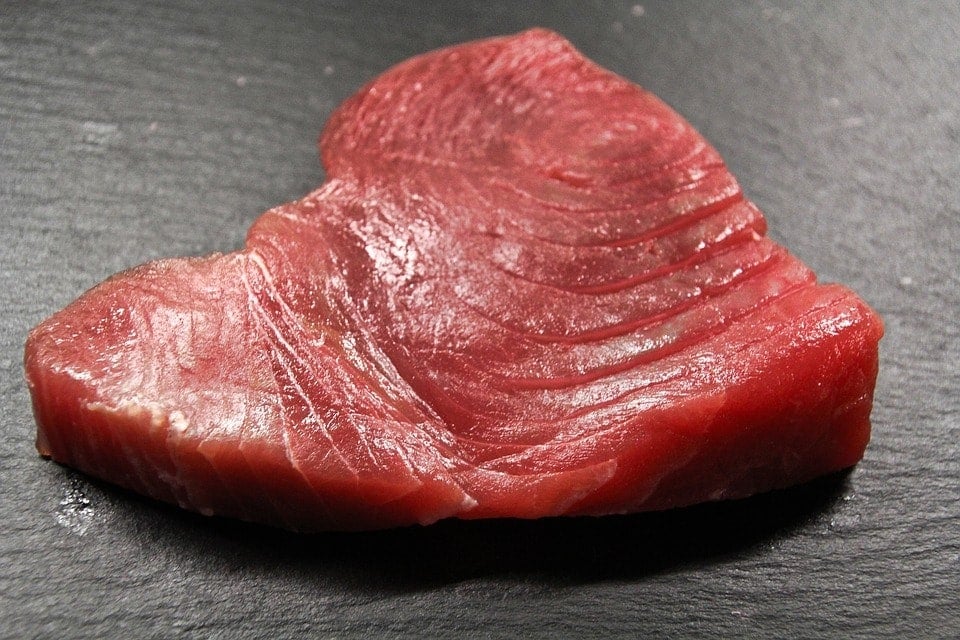
The larger species of tuna are generally served fresh as sushi or as steak, while the smaller varieties are canned—making canned tuna a generally safer choice for dogs than the fresh variety.
The Bottom Line
It’s safe for dogs with pancreatitis to eat tuna, canned in spring water, in small amounts as an occasional treat. However, tuna should not be fed regularly, or in large amounts, to any dog regardless of whether it has pancreatitis or not, due to its high mercury content.
Featured Image By: ReinhardThrainer, Pixabay
Get Hepper In Your Inbox


Pet care tips from our vets and experts, straight to your inbox.
You may opt-out at any time. View our Privacy Policy for more information.
Lindsay is a veterinarian who lives in the beautiful city of Cape Town, South Africa with her husband and their rescue cat and dog, Harrison and Blizzard. Lindsay obtained her bachelor's degree in veterinary science from the University of Pretoria and currently works in small animal practice. When she’s not at work, you can find her out in nature, hiking with Blizzard, or following some kind of creative pursuit, such as writing, playing the piano or sewing.
Lindsay is a veterinarian living in Cape Town, South Africa with her husband and their rescue animals, Harrison and Blizzard. You can find her hiking with Blizzard, enjoying time in nature, or writing when she’s not working.
Education
Lindsay graduated from the University of Pretoria, receiving her bachelor's degree in veterinary science.
Experience
Lindsay currently works in small animal practice.
Join the conversation
Ask a question, share your story, or send private feedback.