Hepper is reader-supported. When you buy via links on our site, we may earn an affiliate commission at no cost to you. Learn more.
How Do Vets Get Rid Of Fleas On Cats? Our Vets Answers

In this article
There’s no use denying it – when we share our lives with pets, we also risk offering up our homes to all sorts of tiny squatters in the form of fleas, worms, and other parasites. As the weather gets warmer, fleas are gathering an army ready to make our lives a misery throughout the summer months.
So, how do you keep your furry friend inside but ditch the hitchhikers? Here are some tips to help you get rid of fleas on cats straight from a vet!

How Can I Get Rid of Fleas on My Cat at Home?
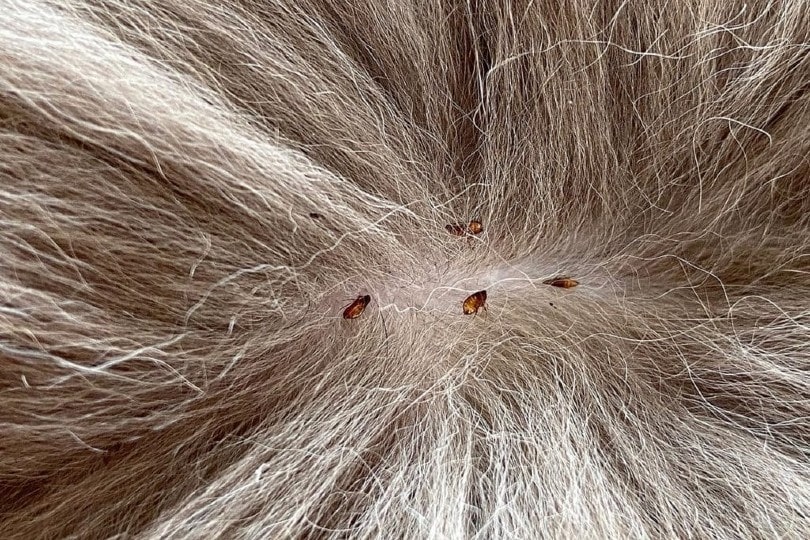
Although combing through a cat’s fur is one good way of checking for fleas, and flea dirt, it is not recommended to catch and squash individual fleas. The flea body is already quite a flat shape so they resist this, and if you do succeed any body fluids released from them may contain infectious diseases. Some of these diseases are zoonotic, meaning they can affect people. One example is cat scratch fever, which is a bacteria carried by fleas that get into the wound and causes infection.
Other non-medical methods of flea control are also generally inefficient — fleas are not easy to drown or scald, as the speed, distance, and direction they can jump away from danger is akin to a complete disappearing act. No doubt about it, an effective anti-flea medication is required.

So, What’s the Best Medication to Kill Fleas?
There is a bewildering array of preparations designed to kill any adult fleas present on your cat. Many are easily applied, “spot-on” preparations, that your cat should not object to. There is also an effective flea collar, but tablets may be a more appealing alternative if your cat is sensitive to topical treatments. Fortunately, a spray that some cats might find too noisy, is rarely required.
It is however of the utmost importance that you talk through the various options with your vet, to find the one that is best suited to your individual cat and your household. Additionally, some of the most effective treatments do require a prescription from your vet. Finally, and most importantly, your vet will steer you away from any unsuitable treatments. For example, those developed specifically for dogs can cause severe toxic effects and even death, in cats.
Treating a Cat for Fleas? Help Is at Hand
Don’t forget, that a vet or a nurse can also be available to administer the chosen treatment, should you prefer. As flea treatment must be applied regularly, it is a good idea to consider this at least once or twice, to pick up any tips and tricks that will make the task easier in the future, should your cat be of a more suspicious nature!
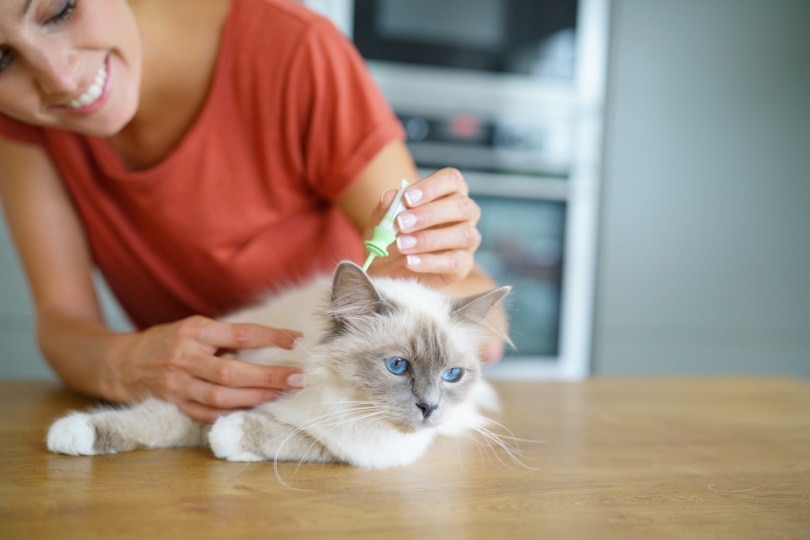
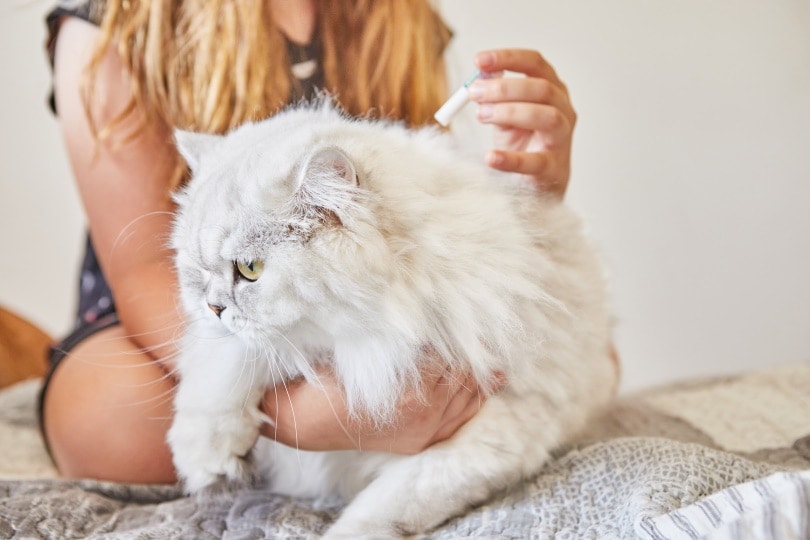
Most cats accept spot-on treatments well, although it can help to have an assistant holding your cat still. Alternatively, you could distract them with a food treat, while you part the fur of the neck and apply the fluid. If you’re giving tablets, a treat offered immediately afterward may be appreciated as a reward and it will help to wash the tablet down.
Most treatments given directly to your cat kill adult fleas rapidly, often within 24 hours. The spot-ons spread in the oils of the coat so they target fleas anywhere on the body. They are not absorbed into your cat’s bloodstream. Some products work on direct contact with the flea. Others require the flea to bite your cat one more time before they take effect, as is the case with tablet treatments. Many of the medications cause flea death through an effect on the nervous system. There is no need to worry though – licensed medications are all perfectly safe for your cat.
The Truth About Fleas
All done? Not yet! Understanding the depth of a flea problem requires some appreciation of their lifestyle. What you see is only a fraction of what you get!
Fleas lay eggs that hatch into larvae, which develop in stages into adult fleas. Every flea you see could lay 2,000 eggs, each too small to be seen with the naked eye. Eggs drop into the environment, inside and out, and when the time and conditions are right, hatching begins. Flea eggs respond to heat and humidity. The larvae that hatch out soon mature and spin a cocoon, where they bide their time in the “pupa” stage.
Adult fleas only emerge from the cocoon when they feel vibrations in their environment caused by a passing animal (or person!). When the fleas detect an unsuspecting host nearby, up they hop, and start feeding, preparing to continue the cycle of life by laying the next generation of eggs, in their hundreds.
Cat baskets and other favorite sleeping places will be hotbeds of flea eggs and pupae. Cats with access to the outdoors will often operate a “timeshare” agreement for popular resting spots, meaning that even if you have treated your own cat for fleas, to keep properly on top of the problem, you'll have to address a continual influx of the parasites left behind by other felines in the neighborhood.

Win the War Against Fleas
So now it is clear; to control or prevent a flea infestation, you want to stop those eggs from hatching! Break the lifecycle and prevent adult fleas from developing. There are several measures you can take, and they work best in combination.
- Vacuum cleaning. This physically removes eggs and cocoons from the home. Pay particular attention to any thoroughfares that cats use, carpets, and soft furnishings. Dispose of the vacuum cleaner bag straight away
- Wash your cat’s bedding. Don’t forget to wash everything your cat sleeps on. If, like most cats, your cat prefers your resting spots to her own, don’t forget to include duvet covers, sofa throws, and cushion covers. If the fabric can handle it, you should use a 60-degree cycle, as flea eggs can survive temperatures lower than this.
- Treatment to prevent eggs and immature fleas from developing into adults. This is something else that your vet can advise on. These come in various forms, including sprays for the house, or it may be one ingredient of the treatment used on your cat, covering two arms of therapy in one go. All these treatments are much more effective if the groundwork of vacuuming and laundry has been completed first
Conclusion
If you’re wondering how to get rid of fleas on cats, you are now fully equipped to win the battle! There are lots of treatment options to discuss with your vet and you can be sure to find something to suit any feline. Living pest-free, you will have a contented cat and a happy household.
See Also:
Featured Image Credit: anastasya perfenyuk, Shutterstock
Get Hepper In Your Inbox


Pet care tips from our vets and experts, straight to your inbox.
You may opt-out at any time. View our Privacy Policy for more information.
Joanna is an experienced vet working in the UK. She has written about pets and pet health for many websites, blogs, and pet magazines and loves to help owners understand their pets through her writing.
Joanna is an experienced vet working in the UK who has always loved both writing and science. So, after following her passion for science and graduating as a veterinarian, she was able to begin writing and join her two passions together.
She has written about pets and pet health for many websites, blogs, and pet magazines. She loves to help owners understand their pets better through her writing, and loves to teach and educate her clients. She owns her own freelance company to help even more clients than just the one standing in front of her in a consultation room.
Education
In 2016, Joanna graduated from the University of Nottingham, with a degree in Veterinary Science (BVMedSci) and a degree in Veterinary Medicine and Surgery (BVM BVS).
Experience
Joanna practiced as a clinical vet from 2016 - 2019 and left full-time practice after that to work as a locum/relief vet in the Channel Islands, alongside her freelance writing work.
Join the conversation
Ask a question, share your story, or send private feedback.