Hepper is reader-supported. When you buy via links on our site, we may earn an affiliate commission at no cost to you. Learn more.
How Smart Are Cats? Our Vet Explains

In this article
Depending whom you ask, you may get answers at either end of the spectrum. Some people would say that cats aren’t smart because you can’t always teach them to do tricks, walk to heel or play fetch like a dog. Others would argue that cats are incredibly smart, for exactly the same reasons.
Cats are known to be independent, needy, playful, serene, cuddly, feisty, and many more contradicting qualities, and there are plenty of people who would attest to feeling judged by a cat at one time or another!
Their demonstrated problem solving abilities, social structure, and talent for manipulation leave no doubt that cats are intelligent, but how do we measure that intelligence?
Keep reading to learn just how intelligent felines can be.

Do Cats Have Memories Like Humans?
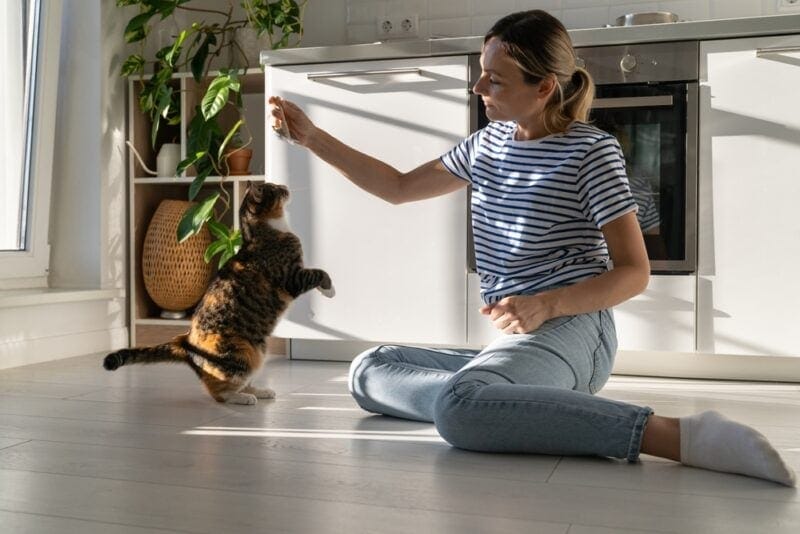
You may have noticed your cat learning different behaviors through practice, such as learning how to open a door, how to manipulate you to get treats, and many other examples. They have the ability to remember certain actions, the results of those actions, and whether or not they like what response they get.
This type of memory is known as classical conditioning; the type of learning that happens without conscious effort.
- Action → positive reaction → action repeated and reinforced
- Action → negative reaction → action avoided in future
This type of learning is not necessarily an indication of high intelligence, but is a basic survival technique. Where the intelligence of cats becomes more apparent is when they start to use classical conditioning on us, their humans.

Have You Ever Heard the Term “Cat Paralysis”?
One thing that most cat owners want most from their pet is to have them curl up on their lap, all snuggly and warm, but as soon as you move, the cat jumps off, disappears, and ignores you for the rest of the day. So we learn to sit as still as we can, for as long as we can, not moving a muscle for fear of losing the purring comfort of our cat; hence, cat paralysis.
The question is, are we teaching the cat, or are they training us?
There are many anecdotes about the ways in which people report to have been “trained” to do their cat’s bidding, like the cat that would paw at the bell on his collar until his owners let him out, or the couple that learned that their cat wouldn’t scratch the sofa if she was fed before the dog.
In each case, the actions are mutually beneficial, so it is impossible to ascertain which party is the trainer, and which is the trained.
Signs of a Smart Cat
You might estimate your cat’s intelligence through different behaviors, like doing tricks or responding to their name. They might demonstrate recognition of trusted friends vs. new or suspicious individuals by the way they interact with them, or show situational reactions to things, like avoiding the pet carrier at home, but wanting to get back into it when they are at the vet. They know that the carrier at home takes them somewhere they don’t want to be, but that same carrier will also return them home, showing that their aversion isn’t to the carrier itself, but to what it represents in different locations.
Cats are also known to demonstrate emotional intelligence, seeming to know just when their people need a reassuring headbutt or purring weight on their chest. Even the most standoffish of felines will often adjust their behavior when confronted by a human in distress, providing comfort, even affection, to an upset owner.
The Curious Case of Oscar the Cat
In 2007, the New England Journal of Medicine published an article about a rather extraordinary cat named Oscar, one of several feline residents at a nursing and rehabilitation centre. Over a period of years, he earned a reputation for his accuracy in predicting death.
He would wander the wards by day, and, when the time seemed to feel right, would curl up on the end of a patient’s bed. Invariably, that patient would die within the next few hours. Oscar accurately predicted the deaths of 50 patients over 4 years.
Some may argue coincidence, or perhaps self-fulfilling prophecy, but Oscar’s story certainly suggests that there is more to feline intelligence than simply training us to bring them dinner.
“Dogs have owners. Cats have staff.” - Margaret Benson, author of The Soul of a Cat
One might suggest that the difference in the way in which dogs and cats interact with their humans is based on the loyalty and dedication demonstrated by canines, but we could equally surmise that cats have simply realized that they are able to obtain the benefits of food, protection, shelter, and companionship, without all the tricks and training that dogs go through in order to obtain those same perks.

In Conclusion
There is more than enough evidence to show that cats are highly intelligent creatures. What is more difficult, is knowing whether that intelligence is based purely on survival instincts, or demonstrative of their understanding of how the world works, and how to manipulate it.
It seems prudent to assume the latter, rather than underestimate our feline friends. After all, if cats were to evolve opposable thumbs, we might soon find ourselves replaced as Earth’s dominant species!
Featured Image Credit: Ground Picture, Shutterstock
Get Hepper In Your Inbox


Pet care tips from our vets and experts, straight to your inbox.
You may opt-out at any time. View our Privacy Policy for more information.
Karyn has lived in the UK for the past 10 years after moving from Queensland, Australia. In 2010, she graduated from The University of Queensland School of Veterinary Science, and also holds a Bachelor’s degree in Zoology. Karyn is passionate about using evidence, experience, and owner collaboration to provide the best solutions for pets, and believes in making reliable information about animal health accessible to all. She shares her home with 5 cats, 4 dogs, and 1 husband, and when she is not practising as a veterinary surgeon, she spends her time writing, gardening, and cleaning up pet hair!
Karyn comes from Queensland, Australia, but has lived in the UK for the past 10 years. She is passionate about using evidence, experience, and owner collaboration to provide the best solutions for pets, and believes in making reliable information about animal health accessible to all.
She shares her home with 5 cats, 4 dogs and 1 husband, and when she is not practising as a veterinary surgeon, she spends her time writing, gardening, and cleaning up pet hair!
Education
In 2010, Karyn graduated from The University of Queensland School of Veterinary Science and also holds a Bachelor’s degree in Zoology.
Experience
Dr. Kanowski has worked in small animal practice, both in Australia and the UK, and she will be very happy if she never has to see another post-Brexit Animal Export Certificate again! Karyn has special interests in acupuncture and canine behavior and loves challenging surgical cases.
Join the conversation
Ask a question, share your story, or send private feedback.