Hepper is reader-supported. When you buy via links on our site, we may earn an affiliate commission at no cost to you. Learn more.
How to Stop a Dog From Barking at Noises: 5 Vet-Approved Tips



Expecting a dog to not bark goes against their nature. Barking is a way for them to communicate. Although, some dogs bark at every little noise. It is annoying for the owner, but a dog’s excessive barking can also upset your neighbors or cause problems with your landlord.
Barking, among other things, is a way for your dog to communicate. Dogs have distinctive barks, and most times, we can identify them. A dog may have a particular bark for greeting people and another bark for alerting us to strange animals or things. But do we really know “why” they are barking? You may think they bark just to be heard, but that isn’t necessarily the case.
If you need help with training your dog, we suggest speaking with a vet online.

Why Do Dogs Bark?
There are various reasons why your dog might be barking:

The 5 Tips to Stop a Dog From Barking at Noises
1. Take a Trip to the Vet
In some cases, sensitivity to sound can be caused by other conditions, like separation anxiety. Your best bet is to talk to your vet. You may be able to address the noise anxiety with a behaviorist or professional trainer. In some instances, if the condition is severe, the dog may require anti-anxiety medication along with training.

2. Identify Upsetting Sounds
First, identify the noises that your dog reacts to most often. The easiest way to stop your dog from barking at unfamiliar noises is to narrow it down to which noises in particular may be causing your dog’s anxiety.
A dog’s specific noise anxiety can escalate to the point of barking at every little noise. They may start by reacting to fireworks and, over time, start to react to everyday noises that other dogs ignore.
3. Desensitization or Changing the Volume
Is your dog barking every time he hears the opening of the mailbox or the neighbor opening the door of his car? If this is the case, you will need to use positive desensitization.
If you are friendly with the neighbor, ask them to text you when leaving the house. You can then sit with the dog and as the neighbor is opening doors and making noise, start feeding the dog treats and softly talk to the dog. Continue to give him treats until the noise stops. If the dog starts to bark, stop giving him treats.
Repetition is key to getting the dog to understand. You may want to ask the neighbor to engage, allowing the dog to get to know them. The dog will eventually associate the neighbor’s noise making with something positive, getting treats.
If your canine is reacting to regular household noises, you can desensitize your dog by controlling the volume of the offensive noise. Adjust the volume of the radio or TV to a low level while giving him treats. The dog will associate the noise with something positive, allowing you to increase the volume over time.

4. Increase Activity
Boredom and excess energy can lead to anxious barking. You decrease a dog’s pent-up energy by simply taking him for a walk or playing a game of fetch. If you and your canine are stuck indoors, play a game of hide-and-seek or give him a treat puzzle to release some energy.
5. Use of Commands
A command can be a sound, sign, or gesture. Dogs respond well to them.
Patience and consistency are the keys. Do not give a command and walk away. When giving the dog a command, you must calmly continue to give the command until the behavior stops.
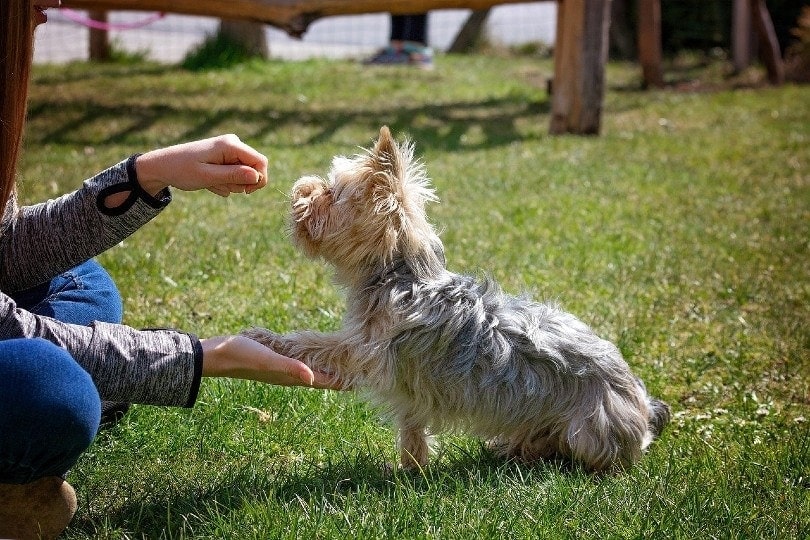
Teaching your dog to bark on command works in the opposite direction. When you tell your dog to “speak” and he responds, give him a treat. Once he learns to speak on command, you can teach “Quiet” by giving him a treat when they stop barking. As the dog learns what you want from him, you will no longer need the treats.
Here Are Some Things Not to Do

In Conclusion
You will need to be patient and consistent. Teaching your pet “appropriate” barking may not be easy but with time and the proper techniques, you and your little buddy can conquer this challenge together.
Sources
Featured Image Credit: cynoclub, Shutterstock
Get Hepper In Your Inbox


Pet care tips from our vets and experts, straight to your inbox.
You may opt-out at any time. View our Privacy Policy for more information.
Nicole is a lover of animals of all sizes but is especially fascinated with the feline variety. She’s the proud mom of Baby, a Burmese, and works every day so he can relax in the sunshine or by the fire. She’s always had a cat in her home and has spent countless days with others, observing behaviors and softening up even the grouchiest of the lot. Nicole wants to share her kitty expertise with you so you and your cat can live happy, healthy, and care-free.
Join the conversation
Ask a question, share your story, or send private feedback.