Hepper is reader-supported. When you buy via links on our site, we may earn an affiliate commission at no cost to you. Learn more.
How To Train a Labradoodle: 15 Vet Reviewed Tips



If you own one, you know that Labradoodles are friendly, affectionate, and intelligent dogs, thanks to the genes passed down to them from their Labrador Retriever and Poodle parents. However, even the cutest, sweetest Labradoodle can be a handful and become problematic if they aren’t trained and socialized well. Like all dogs, the first few weeks and months of a Labradoodle’s life are a critical time for training that will impact their entire life and your life together.
If you’ve recently adopted one of these delightful designer dogs, knowing how to train a Labradoodle correctly is critical. To help you get started on the right foot, below are 15 expert tips from professional dog trainers. Read on to ensure your lovable Labradoodle puppy grows into a well-behaved, trustworthy adult dog.

The 15 Tips to Train a Labradoodle
1. Prepare Your Home Before Your Labradoodle Puppy Arrives
Training any puppy takes time, dedication, and persistence, and that includes training a Labradoodle. However, before any of these things can happen, you need to have everything to train your puppy correctly, like a leash, a collar, and treats. Your home must also be prepared, including your yard, if you have one. Below is a list of things you’ll need to buy or do to prepare for training your Labradoodle.
- A properly-sized dog crate with bedding
- A leash and collar
- Training treats
- Puppy pee pads
- Puppy toys
- A foldable, movable outdoor enclosure
- Dog bowls for water and food
- Enzymatic cleaner for accidents
- A yard that’s closed off to the street

2. Start Training Your Labradoodle Immediately
Many new Labradoodle owners make the mistake of giving their new puppy a few days to “settle in” to their new home before training them. Professional dog trainers say that is a bad choice and that you should start obedience training immediately, including the day your new Labradoodle pup arrives home.
The reasoning is simple; your new pup will know what to expect and will be less confused if you set boundaries right away. Letting them get away with whatever behavior they want, even for a day or two, only makes the training more difficult.
3. Labradoodles Respond better to Positive Reinforcement
When training, experts recommend using positive reinforcement rather than negative.
They argue that positive reinforcement, although it might take longer and demand a little more work, ultimately ensures the bond between you and your Labradoodle is based on respect and love rather than fear of punishment. Not only that, but your Labradoodle will come to see training as a good thing rather than something unpleasant or painful.
If you need help with training your dog, we suggest speaking with a vet online.
4. Experts Recommend Crate Training your Labradoodle
You might think of a dog crate as a tool to punish a dog for being “bad” or to keep them from destroying your home when you’re out and about. If done correctly, however, your Labradoodle will come to see their crate as a place of safety and peace. Once they do, your Labradoodle will gladly seek out their crate during nap time or when they want to escape a stressful situation.
One caveat is to purchase a crate that’s just the right size for your puppy. If it’s too large, your Labradoodle might go potty inside its crate, which is something you definitely don’t want.
5. Follow this Simple Crate Time Rule
According to the Humane Society, puppies younger than 6 months of age shouldn't be left in a crate for more than 3 or 4 hours1. They have small developing bodies and can't control their bladders or bowels for that long. A similar rule should apply to an adult dog if they are still not housebroken. This means that even at night, you must take your puppy out every 3 to 4 hours for a potty break.
Locking them in their crate for extended periods would thus be cruel and could cause health problems for your pup.

6. Socialization Is Critical for Your Labradoodle
Thanks to their bloodlines, Labradoodles are one of the most social designer dogs you’ll likely meet. However, your Labradoodle still needs plenty of opportunities for socialization with other dogs, people, and pets to grow into a mature and well-behaved adult.
Proper socialization can help reduce any aggressive tendencies your puppy might have. It also helps them grow accustomed to loud noises and other sights and sounds that could be provocative or frightening. Trainers suggest bringing your Labradoodle puppy to a dog park. However, it is important to wait until they've had their initial vaccinations and have been treated for tick prevention. It is hard to control that all dogs brought into a park are healthy. You can start to socialize your puppy with dogs that you have more information about, but you should still wait until they've had their second round of vaccines.
7. Socialization Can (and Should) Be Planned While Considering the Risks and Vaccinations
The first 16 weeks of your puppy’s life are crucial. Knowing the risks and vaccination schedules is essential to ensure that you can let your puppy develop their social skills without putting them at risk of developing deadly diseases.
Puppies are born in a litter and socialize with their mother and siblings until someone takes them home. One of the most deadly pathogens that puppies are susceptible to is parvovirus, which is highly contagious and even deadly. A puppy requires three shots to be considered vaccinated against parvovirus, as well as canine distemper virus. Normally, your puppy must have received their first round of the DAPP vaccine before you pick them up. This is a combination vaccine that protects puppies against four different viruses: distemper, adenovirus, parainfluenza, and parvovirus.
The change that a puppy experiences when brought to a new family, away from their siblings, can cause significant stress, and it is best to control your puppy's environment during this critical time. Give them time to adapt and socialize with their immediate family. Once your puppy gets their second shot at about weeks 12–14, you can start socializing them with known healthy dogs. Avoid bringing your puppy to a park where you cannot control what kinds of dogs visit until they have received their third shot, at about 16–18 weeks. Always make sure to consult your veterinarian for detailed information regarding your puppy's complete vaccination schedule.
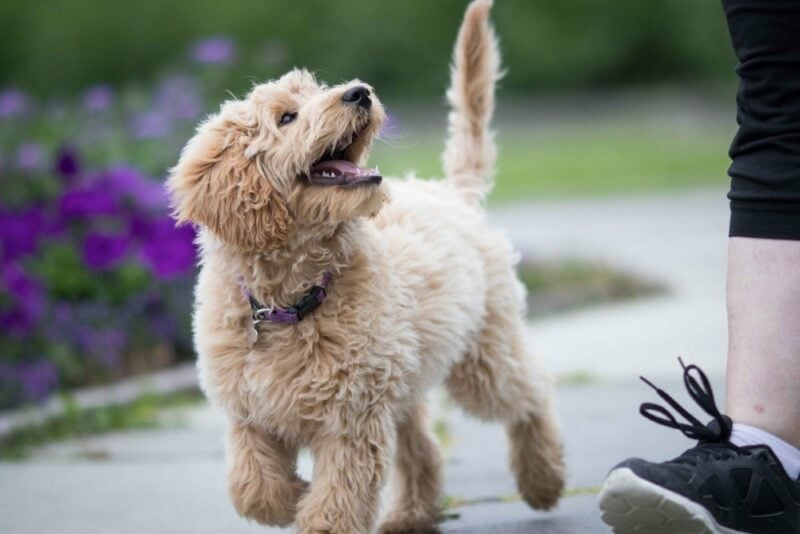
8. Make a Schedule and Stick to It During Training
Setting a schedule and falling into a routine will help your Labradoodle immensely, as they will know what to expect and when. Feeding time, potty time, and training sessions should occur at the same time. The more they become routine and happen simultaneously every day, the better for your pup and the better results your training will produce.
9. During Training, Be Calm and Assertive with your Labradoodle
Labradoodles have an interesting tendency to mimic the behavior of their owners. If, for example, you’re excited about something, they will act that way, also. That’s why trainers recommend staying calm and being assertive (not aggressive) when training your Labradoodle. Your pup will pick up on your serious attitude and bounce that back, making your training sessions more productive.

10. Make Sure You Have Time for Training
If you try to force training here and there with no schedule and routine, your results will be fair at best. Trainers recommend that before adopting a Labradoodle, you closely examine your lifestyle to ensure that a puppy, and the hours of attention they demand, fits into it. If not, for whatever reason, adopting a Labradoodle might not be a good choice.
11. Use Tiny Treats When Training Your Labradoodle
This expert tip concerns the treats you use when training your Labradoodle; they should be very small. The reason is that training treats aren’t meant to provide nutrition as much as positive reinforcement. Giving your puppy large training treats could have adverse effects, like filling your pup’s belly. A full puppy will have less interest in treats and less interest in learning a new trick or command. To prevent that and possible obesity issues, training treats should be kept very small.
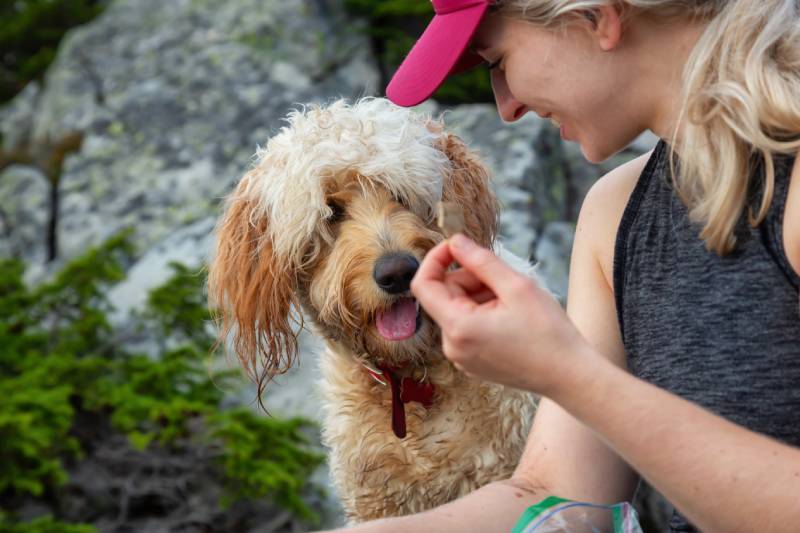
12. Enforce Every Command You Give Your Labradoodle
Labradoodles are clever dogs and will learn from everything you train them (and some things you don’t). If, for example, you give your Labradoodle a command but don’t enforce it, your puppy will learn that the particular command is optional and not meant to be followed. If you do the same thing over and over, your Labradoodle won’t learn the command but will learn that they can ignore it. In short, after every command, be sure to enforce what you’ve just said. To achieve this, find your Labradoodle's motivations, and use only positive reinforcement methods.
13. Never Use Your Labradoodle’s Name in a Negative Way
Labradoodles, like all dogs, will start responding to their name after a few days. That’s critical, of course, to properly train your Labradoodle puppy. However, when training, you should never use your pup’s name when punishing or warning them. For example, if your Labradoodle’s name is Buster, saying “Bad Buster” or “Don’t do that, Buster!” can lead to a negative connection. You want your Labradoodle to respond with happiness and joy when they hear their name, not fear or anxiety.

14. Praise Your Labradoodle Immediately
One mistake many new Labradoodle owners make is to refrain from praising or scolding their puppy immediately after they do something good or bad. A dog, even an intelligent Labradoodle, doesn’t hold onto thoughts like a human does. In mere moments after they do something good or bad, your puppy will forget about it and move on to the next shiny object, so to speak.
That’s why you must praise them immediately after your Labradoodle learns a trick. By doing so, you ensure they know what they’re being praised for, and the lesson becomes better ingrained.
15. Use a Specific Sound for “No!”
Use the same word for “no” when training. It can be any word you like, but it should be bold, sharp, and guttural so your Labradoodle immediately knows they need to stop what they’re doing. Words like “Uh,” “Ack,” and “Hup” will work well.

Final Thoughts
Training a Labradoodle, for the most part, is easier than many other breeds since Labradoodles are intelligent and eager to learn. Still, the proper training techniques are necessary if you want to be successful and end up with a well-mannered dog that listens intently to your comments.
To that end, the 15 expert Labradoodle training tips we’ve shared today should be beneficial. When you train them adequately, your lively and lovable Labradoodle will become your best buddy and an all-around good dog!
Sources
Featured Image Credit: Joca de Jong, Shutterstock
Get Hepper In Your Inbox


Pet care tips from our vets and experts, straight to your inbox.
You may opt-out at any time. View our Privacy Policy for more information.
Greg Iacono is a self-taught writer and former chiropractor who, ironically, retired early due to back problems. He spends his time writing scintillating content on a wide variety of subjects. Greg is also an accomplished video script writer known for his ability to take a complex subject and make it accessible for the layperson.
Join the conversation
Ask a question, share your story, or send private feedback.