Hepper is reader-supported. When you buy via links on our site, we may earn an affiliate commission at no cost to you. Learn more.
Positive Reinforcement vs. Correction Dog Training Methods: Key Differences



In this article
Whether you're a current dog owner or about to become one, you're likely pondering the optimal training approach for your furry companion. Should you lean toward the encouraging path of positive reinforcement, or should you pick a more assertive method, like correction-based training? Perhaps a blend of both methods, known as balance training, could be the answer.
You can keep reading for details about both training methods to make an informed decision!
If you need help with training your dog, we suggest speaking to an online vet for tips and tricks.

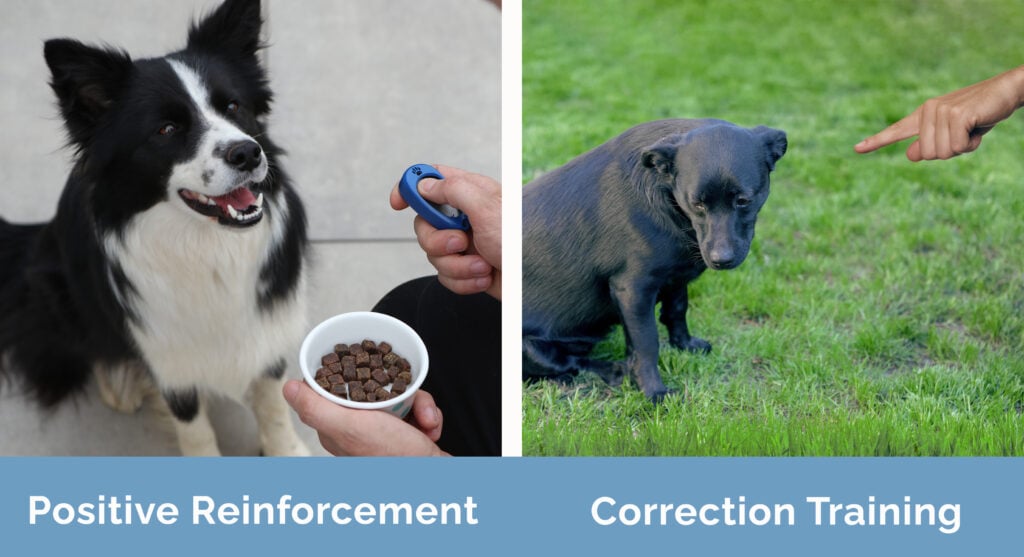
Visual Difference
At a Glance
Overview of the Positive Reinforcement Training Method
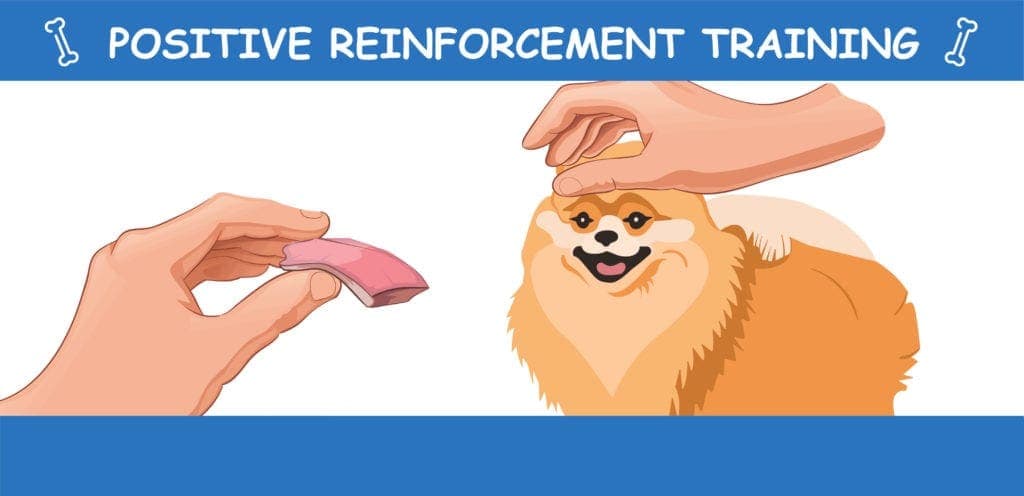
The term “positive reinforcement” can be confusing. In this case, the word “positive” does not mean “good,” but rather “added.” You add something (like a treat) immediately after a desired behavior (like sitting down on command), thus reinforcing that behavior.
For example, petting your dog's head for doing a paw shake is positive reinforcement because you add something (positive) to encourage (reinforce) the behavior. Many studies have shown that positive reinforcement training alters dog behavior more effectively than aversive training.
What Are the Four Quadrants of Operant Conditioning?
Positive reinforcement is one of the four quadrants of operant conditioning, which also includes negative reinforcement and positive and negative punishment. While positive reinforcement means adding something immediately after a desirable behavior occurs, negative reinforcement means removing something immediately after the behavior occurs.
An example of negative reinforcement is using a choke collar; the tension is released when the dog stops pulling on it. Thus, the desired behavior (stop pulling on the leash) removes an undesirable consequence (the tension of the collar on the dog's neck). Holding your dog's mouth closed to stop them from barking is a positive punishment, as it is an action to discourage unwanted behavior.
Lastly, negative punishment consists of refusing or withdrawing a reward, so the behavior decreases. For example, taking the ball away from your dog for barking is a negative punishment because you removed a stimulus intending to decrease unwanted behavior.
What’s important to remember is that "negative" does not necessarily mean "bad," just as "positive" does not necessarily mean “good.” For instance, positive punishment, like a swat on the rump to stop your dog from barking, is not a training method recommended by the American Veterinary Society of Animal Behavior (AVSAB), nor is negative reinforcement.
Pros
- Creates lasting behavior changes
- Builds trusting relationships with owners
- Reduces fear and aggression risks
- Fosters a positive learning environment
- Protects the behavioral health of dogs
Cons
- Requires patience and consistency
- Can generate different responses from individual dogs
Overview of the Correction-Based Training Method
Correction-based training is also known as aversive training. It usually includes positive punishment and negative reinforcement. This approach involves applying some form of discomfort or punishment when your dog behaves undesirably. This might include leash corrections, electric collars, or even shouting and physical reprimands.
Historically, correction-based training was more popular, largely due to traditional (and incorrect) ideas about dominance and hierarchy in dog-human relationships. However, modern science has revealed the potential downsides of this method. While it might yield immediate results, it can also have unintended consequences.
For instance, if you scold your dog for barking excessively, they might stop barking, but they could also become anxious, fearful, or even aggressive. They associate the unwanted behavior with discomfort or pain rather than understanding what they should do instead.
There's also a risk of the dog becoming conditioned to the corrections, requiring increasing levels of discomfort to produce the desired response. This can result in a cycle of escalating aversive methods that can harm the dog's well-being and your relationship with them.

Other Types of Training
What Does Science Say About Aversive Training?
A 2020 study examined numerous dogs sourced from schools that either employed aversive techniques like shock collars and leash corrections or exclusively embraced positive reinforcement, relying on treats for desired behavior. The dogs from the positive reinforcement schools consistently outperformed their counterparts in tasks presented by researchers.
Conversely, the dogs subjected to aversive training exhibited significantly heightened stress, evident through behaviors like licking, yawning, pacing, and whining and elevated cortisol levels. In a year-long investigation at the University of Pennsylvania, researchers surveyed dog owners who employed confrontational or aversive methods to address aggression in their pets.
The findings indicated that the animals would likely persist in aggressive behavior unless the training approaches were adjusted. Interestingly, the study also highlighted that employing non-aversive or neutral techniques, such as increased exercise or rewards, yielded minimal aggressive responses.
Furthermore, leaders in the pet health and behavior industry, such as the AVSAB, advocate for adopting the least-invasive and minimally aversive training methods. The organization released a position statement that states that "reward-based training methods have proven more effective than aversive methods," referencing numerous survey studies demonstrating enhanced obedience in dogs trained through reward-based approaches.

What About Balanced Training?
Balanced training relies on a mix of positive reinforcement and correction-based training. Therefore, this approach includes all four quadrants of operant conditioning. For example, a dog owner might use treats to reward their pet for sitting (positive reinforcement), and they also use a choke collar to teach their pup to walk on a leash (positive punishment).
At first glance, balanced training may seem like an ideal all-encompassing approach. However, as PetMD points out, no research supports the theory that dogs learn best when trained with a combination of methods, including aversive training. Overall, it’s better to stick to positive reinforcement, which has already proven its worth.
Pros
- May be effective in the short term
Cons
- Can increase the dog’s fear, anxiety, and or aggressivity
- Leads to dogs becoming fearful, avoidant, and aggressive
- Needs to be carried out by an experienced dog owner
- May never fix bad behavior
- Can create strong negative associations in the dog’s brain
Final Thoughts
Choosing the right training method for your dog is a decision that can impact their well-being and the quality of your relationship. There are many reasons to use humane methods rather than aversive ones. Positive reinforcement training is generally considered more effective, humane, and ethical because it builds trust and promotes a healthier bond between dogs and their owners.
Correction-based methods can lead to anxiety, fear, and other behavioral issues. Such approaches may yield quick results but risk eroding trust and even inciting aggression. If you need help training your furry friend, seek out a local dog trainer through the Association of Professional Dog Trainers or a veterinary behaviorist through the American College of Veterinary Behaviorists (ACVB).
Also, ask your veterinarian for advice if you have any concerns regarding the well-being of your beloved pup.
Happy positive dog training!
See Also:
Sources
Featured Image Credit: (L) ANN PATCHANAN, Shutterstock | (R) Jaromir Chalabala, Shutterstock
Get Hepper In Your Inbox


Pet care tips from our vets and experts, straight to your inbox.
You may opt-out at any time. View our Privacy Policy for more information.
Genevieve, a biologist and science writer, who harbors a profound affection for capuchin monkeys, pumas, and kangaroos. This passion has led her to travel extensively, volunteering and working at wildlife rehabilitation centers in Bolivia, Guatemala, Canada, and Australia. Now residing in Argentina as a Canadian expat, Genevieve enjoys the view of horses and cows greeting her from the vast plains outside her home office window. She proudly cares for three rescued dogs—Lemmy, Nala, and Pochi—and a playful kitten named Furiosa. Sharing her extensive knowledge and love for animals brings her immense joy and fulfillment.
Join the conversation
Ask a question, share your story, or send private feedback.