Hepper is reader-supported. When you buy via links on our site, we may earn an affiliate commission at no cost to you. Learn more.
How To Train A Weimaraner: 13 Expert Tips

Weimaraners are canines with an excess. They have an excess of intelligence and an excess of energy! Let’s not overlook their beauty, they’ve got more than enough of that too.
Weimaraner experts and devotees will tell you that the key to keeping your Weim happy is exercise and training (and love, of course). Neglecting these two aspects of their upkeep will result in an emotionally unstable and miserable moggie. When Weims are unhappy they're liable to let you know in a destructive manner. The furniture and house fittings may bear the brunt of their excess, as will your clothes, shoes, and self.
They are naturally territorial and if this is not managed through training, they may get aggressive. It is through no fault of their own but is simply what happens when dogs aren’t provided with clear boundaries by their humans.
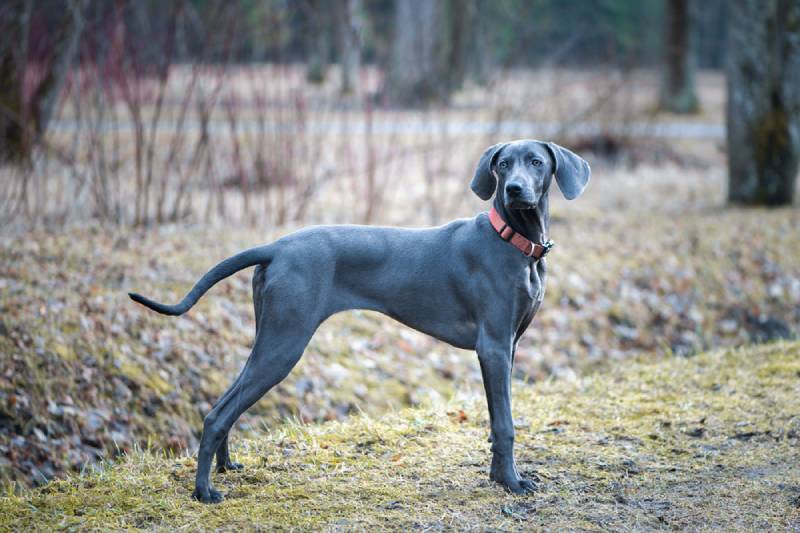
As hunting dogs, their prey drive is highly developed, and training and discipline are essential to ensure that it does not run riot. We have compiled this list of 13 expert Weimaraner training tips to help keep your silver ghost under control.

The 13 Tips on How to Train a Weimaraner
1. The Three C’s
There’s no hard and fast definition for “The Three C’s” of dog training. Wherever you research you’ll find excellent and reputable trainers using different definitions or acronyms. No one is more right than anyone else. However, we like these:
We’ve put these three C’s at the top of our list of training tips because they should be applied in all other training activities. From the moment your new Weim comes into your life, no matter its age or level of training, you will employ these ideals in your interactions with it.
Be consistent with regular training sessions, the quality of training sessions, the techniques you use (unless they become ineffective) and your attitude. Be clear when giving a verbal command or when communicating with your Weim in other ways, such as your body language and tone. Use cues to prepare for a command or reinforce a behavioral response. Cues can be the tone of your voice or your body language. They immediately signal to your Weim that it is on the right track or that it has strayed from it.
2. Early Socialization
Socializing your Weim pup from as close to three weeks old 1 as possible is vital for setting it up to be comfortable in all environments in the future. It is also a solid foundation on which to base all subsequent training. Socializing means gently and lovingly exposing them to as many different people, environments, and other animals as they, and their mum, can tolerate. Remember to reward positive engagement and acceptable responses. Do not force them into a situation in which they appear anxious or afraid.
Because of their highly developed prey drive, it is particularly important to socialize them with different species. If you have any hope of your Weim sharing its space with other pet cats or birds this is essential. It’s still not a guarantee that they will get on with these animals but it’s a good place to start.
A well-socialized Weim is a relaxed and happy Weim.

3. Puppy Training
This goes hand in hand with socializing your Weim pup from an early age. Puppy training can start from eight weeks 2 of age and should be appropriately structured. Remember the three C’s! Initial structured training sessions should be very short, usually just a few minutes, but repeated fairly often.
The majority of your Weim pup’s training will happen through the course of normal daily life. It will be focused mainly on housebreaking and teaching your pup to respect you. He needs to fit in with your life, not the other way around. If respect is not taught at this age, it will be increasingly difficult to garner as time passes.
At around three to four months old your Weim will be ready for more demanding obedience training, which it will relish. Fully mature Weimaraners enjoy high-level obedience and agility training, so the sky's the limit when it comes to deciding how far you want to go.
If you need help with training your dog, we suggest speaking with a vet online.
4. Positive Reinforcement
Weims respond well to positive reinforcement, rather than negative reinforcement. They don’t react well to being shouted at, scolded or punished, probably due to their high intelligence.
Praise them verbally and physically and reward them with treats to demonstrate your pleasure and to acknowledge appropriate behavior. Some Weims may not like to be patted on the head so rather give them a chest or chin scratch.
5. Teach Basic Voice Commands Early On
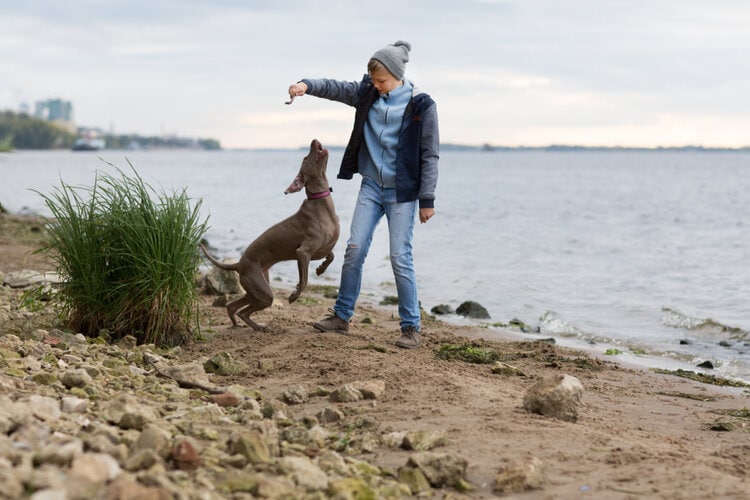
Several basic commands should be taught as soon as possible. These will form the backbone of discipline and respect from which much of your Weim’s subsequent training will stem. If your Weim responds obediently to these commands from an early age it also gives you a modicum of control over their boundless energy and intelligence in most situations.
The basic commands that you should include in your arsenal right now are:
6. Don’t Neglect Your Weimaraner’s Exercise Requirements
This is an important one. Weimaraners were originally bred to be big game hunting dogs. They are exceptional athletes with outstanding stamina. They have to receive rather rigorous exercise to direct all their energy constructively. A gentle walk around the block once in a while is not going to cut it.
If this component of their care regime is neglected then training sessions will most likely be compromised. A Weim with pent-up energy will struggle to focus. The sudden attention directed at them by their beloved human will elicit an excited response that will result in them literally bouncing off the walls.
If you know your Weim needs to let off some steam, then let them have a gallop or play before trying to focus on some training.

7. Use Training Aids if Necessary
Training aids such as leads or long lines may be useful in restraining a boisterous Weim in the early days of their training. Their heightened prey drive means that they are constantly scanning the area for things to chase down.
If they are not at that stage of their training where they will obey your voice commands, then a physical training restraint might just save the neighbor’s cat.
8. Preparation
Weimaraners are smart hounds. If you aren’t adequately prepared for your training session they may take advantage of you. At the very least it may mean that a behavior, good or bad, is not correctly reinforced or corrected and this could mean a setback in their training. It’s more difficult to undo bad habits than form new ones without any preconceptions.
Have a plan of action that includes what tasks you will work on and their duration, as well as your expectation of the different ways in which your Weim may respond. Being prepared in this way will help you to respond calmly and proactively.
Know how you will respond in any given scenario and stick to it. Decide how and when you will reward and be consistent.

9. Play Mentally Stimulating Games
This ties into your Weim’s aforementioned superior intelligence. In much the same way that they need to receive physical exercise to keep their excessive energy at bay, they need to have their busy brains exercised too.
If you don’t find ways to keep their boredom under control, then they will. And you can rest assured that their ways will not align with yours! Recall our previous mention of destructive tendencies.
Weims enjoy normal play sessions like other dogs where they get to engage with their human/s one on one for a while. But you can also include other more mentally stimulating games like getting them to search for their food or treats. Puzzle feeders are great fun for this purpose. Or you can hide treats inside a cardboard box and see how they figure out access. You can let your imagination run wild with games like this and others.
10. The Pros and Cons of Routine
A certain amount of routine is great for creating a stable environment in which your Weim can relax. Knowing how and when certain activities, like feed time or training sessions, happen helps alleviate anxiety associated with the unknown. However, too much routine or a complete lack of deviation from routine can be harmful.
If your Weim becomes completely reliant on and expectant of routine then their “wheels could fall off” if an activity doesn’t happen when it normally does. For example, if you are late from work, decide to go out for the day, or you have to miss a training session.
Changing routines a bit can prepare your moggie for those occasions. The idea is that a certain sense of independence and an inherent trust in the way things happen is fostered. For example, you could delay feed time by half an hour, or tell your Weim to stay in one room of the house while you go to another for a few minutes. Reward calm responses of trust and ignore noisy protests. They will eventually get the idea.
11. Frequent, Shorter Training Sessions
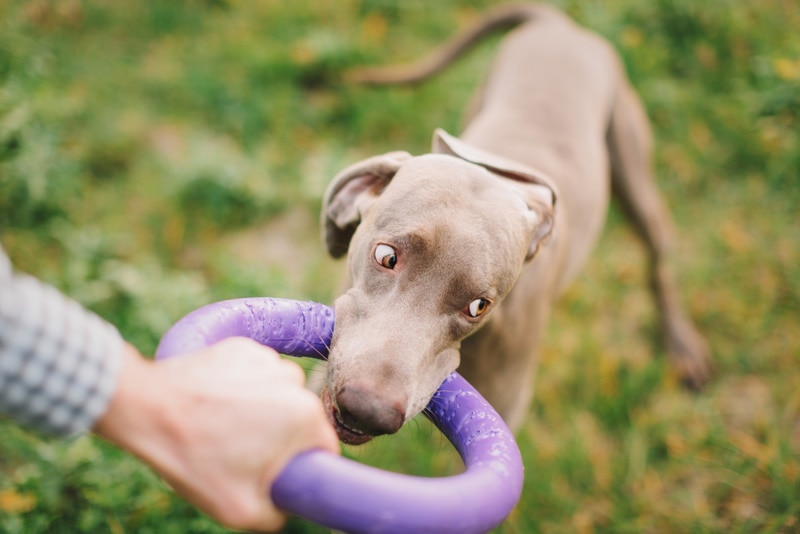
As a rule of thumb, short and frequent training sessions are more beneficial to Weims. Aim for around five-minute sessions, three to four times a day. These can even be conducted opportunistically during the day when a gap presents itself.
Of course, all Weims are different and you may find that yours can, and wants to, focus for longer sessions. But shorter sessions are a good starting point, particularly if your Weim is still young.
12. Teach Your Weimaraner to Respect You
Dogs are hierarchical and only feel relaxed and comfortable when they have a clear sense of where they fit into the hierarchy. Remember that you are the “pack leader” in your home and it’s important that your Weim understands that. The onus rests on you to communicate this clearly to your Weim.
He/she should not be allowed to disrespect you by disobeying commands, destroying your property, barking at visitors you have admitted to the house, running away from you, stealing food, and so on.
All of these behaviors, and any others that are indicative of disrespect, need to be addressed immediately. It’s never a good idea to let your Weim get away with it even once. Be careful about thinking of certain behaviors as cute. Pretty soon things will be out of control and you will have a challenge on your hands trying to remedy the vice.
13. Have Fun!
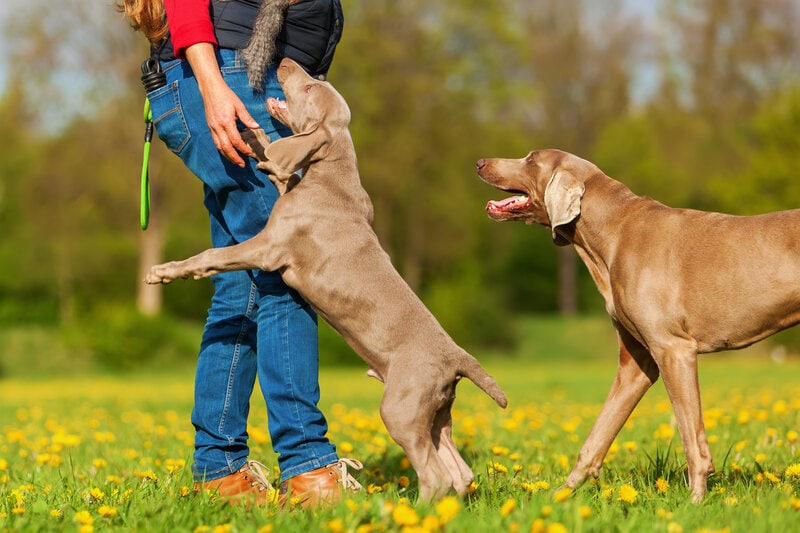
Working with your silver ghost should be a joyful experience. If you’re in a bad mood that you don’t think you’ll be able to surmount, then defer a training session. The same may be true of your Weim, although as its leader you should be able to divert that canine grumpiness into obedience. Weims are naturally eager to please, so this shouldn’t be too difficult.
The most important thing when training your Weim is to always have fun. We don’t mean roll-on-the-floor-laughing fun (although, this may happen!), but rather wholesome, structured enjoyment. Approach each session with a positive attitude and this will be inevitable.
Conclusion
Training is not an option in a Weimaraner’s care regime, it is a necessity. Consistent and committed training should be included if you want the Weim in your life to be calm, anxiety-free, and happy. It needs to be confident of its position in the household hierarchy which has you as the “pack” leader. As well as training, never neglect your Weim’s exercise needs. These impressive canines are athletes and will explode dramatically if they don’t get their fix.
We hope that our list of training tips has given you some ideas to fine-tune your Weim’s training regime. Or, if you are new to Weim ownership hopefully you are set on the right track to a rewarding and fulfilling life adventure with your silver ghost.
Related Reads:
Featured Image Credit: BIGANDT.COM, Shutterstock
Get Hepper In Your Inbox


Pet care tips from our vets and experts, straight to your inbox.
You may opt-out at any time. View our Privacy Policy for more information.

Eleanor is a high school Math and Science teacher and freelance writer. She lives in the lush KwaZulu Natal Midlands of South Africa with her six-year-old son, horse, cat and three chickens. As an animal devotee, science graduate and life-long learner, she is overjoyed to be able to turn her passions into helpful articles for pet parents. Eleanor and her son love to explore their beautiful country in their spare time. Road-tripping to interesting camping destinations is a favorite pastime. They particularly enjoy relaxing near the ocean, in the mountains or surrounded by African wildlife.
Eleanor is a high school Math and Science teacher and freelance writer. She lives in the lush KwaZulu Natal Midlands of South Africa with her six-year-old son, horse, cat and three chickens. As an all-time animal devotee, science graduate and life-long learner, she is overjoyed to be able to turn her passions into informative and helpful articles. Eleanor and her son love to explore their beautiful country in their spare time. Road-tripping to interesting camping destinations is a favorite pastime. They particularly enjoy relaxing near the ocean, in the mountains or surrounded by African wildlife.
Join the conversation
Ask a question, share your story, or send private feedback.