Hepper is reader-supported. When you buy via links on our site, we may earn an affiliate commission at no cost to you. Learn more.
Are Turtles Smart? 4 Interesting Displays of Intelligence (Vet Answer)

In this article
Have you ever found yourself wondering how smart turtles really are? The most important thing to remember when analyzing the intelligence of turtles is that the things we measure our intelligence by won't necessarily be relevant in the world of a turtle. Turtles have a finely tuned set of skills that enable them to survive and thrive in their world, but it is a tricky business defining exactly how clever they are.
Turtles are wild animals; therefore they need to have strong survival instincts. They have survived and evolved over many millions of years. As part of their natural life cycle, they are required to be able to navigate over very long distances. Some may argue that what they can achieve may be driven by instincts rather than intelligence. They are, however, capable of learning new skills and they are able to remember certain facts. They also demonstrate problem-solving abilities.
They are certainly not top of the pile in the animal IQ rankings, but they finish higher than you would expect. This article will discuss in depth the intelligence level of these fascinating creatures.

Turtle Behavior
To assess whether they are intelligent or not, it is important to understand a little about the natural behavior and habits of turtle species. Different species of turtles are required to do different things depending on what is happening in their immediate environment.
Hawksbill turtles live in tropical and subtropical waters of the oceans. They spend a lot of their time near coral reefs and nest in rocky areas. They have a narrow head and a jaw shaped like a beak to enable them to retrieve food from crevices in the reef.
Flatback turtles have a flattened or domed shell and dwell in shallow, soft-bottomed tropical waters. Olive Ridley turtles have multiple habitats and geographical localities depending on what stage they are at in their life cycle.
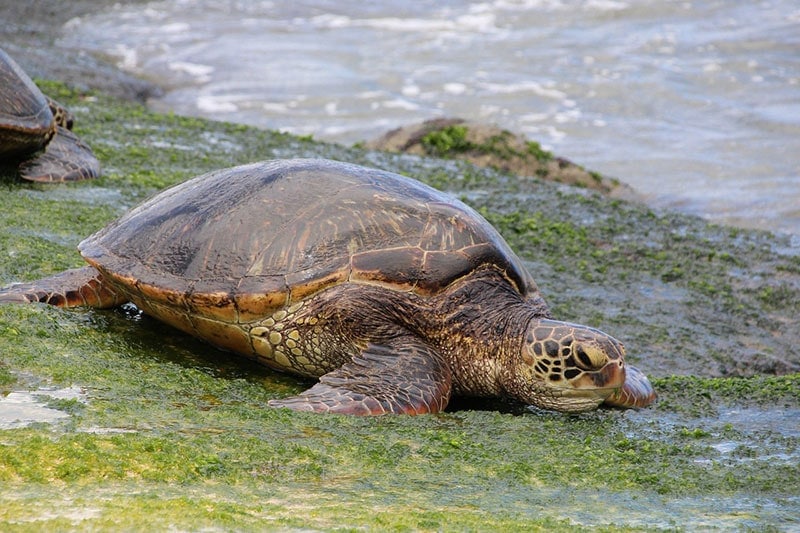
Green sea turtles dwell in tropical and subtropical waters. As with other sea turtles, they need to migrate over long distances from the beaches they hatch on, traveling to feeding grounds. Leatherback turtles are the largest of the sea turtle species and also one of the most migratory.
As you can see, turtles all have slightly different requirements from their environment. They all tend to follow similar patterns in that they need to travel far to access suitable feeding grounds. This means they do have to be intelligent to navigate their way around.
The Turtle Brain
Turtles are reptiles, so they do not have the same brain structure as humans or other mammals. Reptile brains are usually smaller than mammal brains and less complicated. There are some subtle but significant differences in the makeup of reptile and mammalian brains. For example, the neocortex of mammal brains has six inlayers while reptile brains have only three.1
Turtle brains have smaller cerebral hemispheres compared to mammals. These are the areas of the brain that control higher-level functions such as pattern recognition and reasoning. Despite the fact they are smaller, they still have evolved and adapted over millions of years to suit the needs of the turtle.
Some recent research demonstrated that turtles that exist today have a much better sense of smell, hearing, and sight compared to turtles that existed millions of years ago. This shows how well turtles have evolved to adapt to their environment over time.2

The 4 Ways Turtles Display Intelligence
It is difficult to measure or assess intelligence in turtles in the way that we do in humans. We do know that turtles can display remarkable cognitive skills, though. Let's discuss them.
Turtles have an amazing ability to navigate across huge areas of ocean. What is even more fascinating is that baby turtles, that have never set foot (or flipper) in the sea before, seem to know exactly where to go as soon as they are born. They appear to be able to follow complicated migratory paths that take them across oceans and back. Turtles can find their way to specific feeding grounds, then mating grounds, and on to nesting areas. They have enough brain power to navigate through open seas with no obvious landmarks.
It is believed that they are driven by the Earth's magnetic field and celestial bodies. Scientists have suggested that turtles are able to sense the Earth's electromagnetic forces which means they can map their surroundings in a virtual sense without having to first process the information with their eyes.
They also have a keen sense of smell which allows them to locate specific beaches to lay their eggs on.
2. Memory and Learning
Turtles are capable of recognizing individual humans they become familiar with and interact with them on a daily basis. Turtles are capable of learning simple tasks such as tracking a specific route to their food source or responding to a name. This demonstrates a good memory and strong pattern recognition and association skills.
3. Problem-Solving
Turtles are faced with many different challenges in their wild habitats. They can find food for themselves, and they need to keep out of the way of predators and find a suitable place to mate and nest.
They do all of these things by using problem-solving skills to navigate their way through situations. For example, they will know to retract their head and flippers if a predator approaches that they know they cannot outrun or fight. Turtles have also been known to demonstrate the use of tools, for example using rocks to break open shellfish.
Some turtles have a gene that is thought to have been passed down from dinosaurs which allows them to view their surroundings in a larger red spectrum than humans or other mammals would. This enables turtles to differentiate between potential obstacles under water from food which makes them better equipped to manage.
4. Sensory Perception
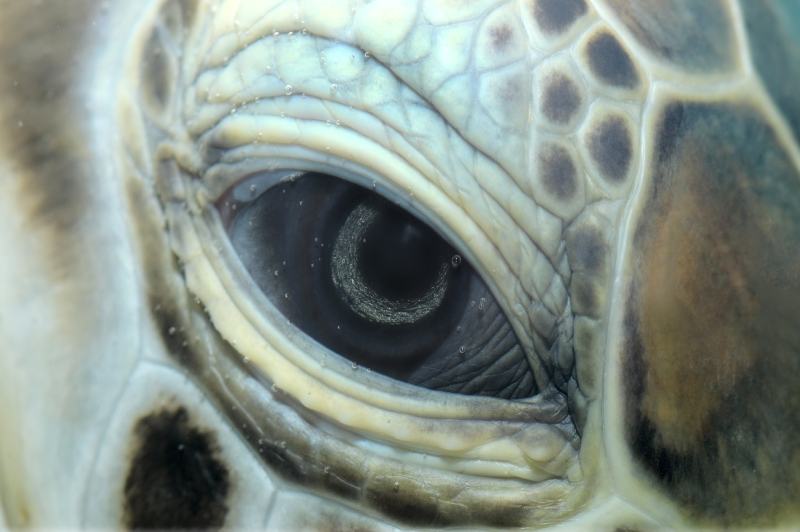
Turtles have a very keen sense of smell and good eyesight. They use this to their advantage to navigate around their environment, steer clear of predators, and find food. They can detect changes in the water pressure around them which allows them to hide from predators and move away from boats in open waters.
Conclusion
Compared to humans, turtles may not demonstrate the same skills to be classed as intelligent, but this does depend on how intelligence is defined, and they do display sophisticated cognitive functions that enable them to survive in different environments. They act on instincts, sensory perception, and learned behavior which allows them to thrive.
Turtles have unique cognitive strengths that have been finely tuned over millions of years of evolution. If this makes them clever enough to survive as a species, that's pretty impressive.
Sources
Featured Image Credit: Debra Anderson, Shutterstock
Get Hepper In Your Inbox


Pet care tips from our vets and experts, straight to your inbox.
You may opt-out at any time. View our Privacy Policy for more information.
Dr. Emma is an experienced vet who is always happy to share her knowledge and expertise with our readers. Her passion is surgery but she will happily talk about anything animal related. Dr. Chandley graduated from The Royal Vet College and since then she has worked in general practice in the UK. She has completed a postgraduate certificate in Small Animal Surgery and has also gained Advanced Practitioner status in the same discipline. She enjoys developing her skills in clinical pathology, animal behavior and nutrition as well.
Emma is an experienced veterinarian who is always happy to share her knowledge and expertise with our readers. She is passionate about surgery but will happily talk about anything animal related.
Experience
Since graduating, Dr. Emma has worked in general practice in the UK. She has completed a postgraduate certificate in Small Animal Surgery and has also gained Advanced Practitioner status in the same discipline. She also has expert knowledge in small animal medicine with a special interest in Endocrinology, although surgery is her passion. She enjoys developing her skills in clinical pathology, animal behavior, and nutrition as well.
Education
Emma received her degree from the Royal Vet College, University of London. She obtained her postgraduate certificate from the British Small Animal Veterinary Association and Nottingham Trent University.
She was granted Advanced Practitioner status by The Royal College of Veterinary Surgeons.
Join the conversation
Ask a question, share your story, or send private feedback.