Hepper is reader-supported. When you buy via links on our site, we may earn an affiliate commission at no cost to you. Learn more.
How to Use a Dog Whistle: 7 Effective Steps
In this article
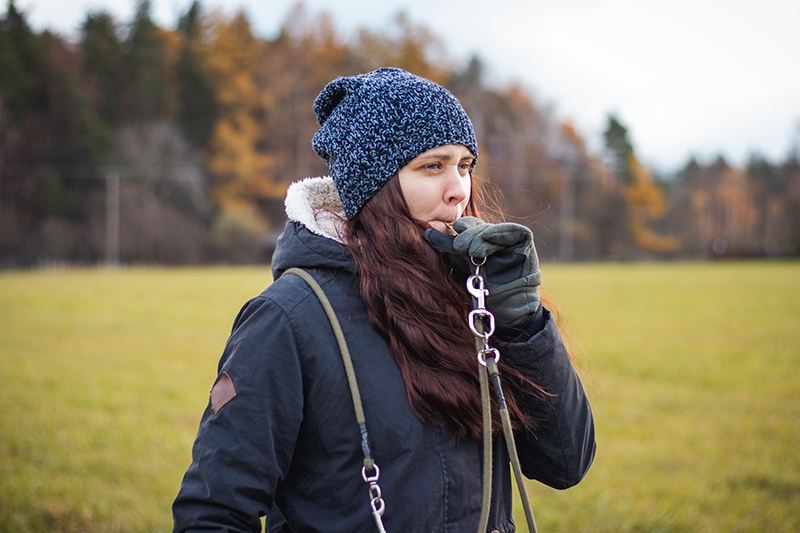
If you want to command your dog quietly and effectively, there are few options as reliable as the good old-fashioned dog whistle.
It makes it easy for you to stay in contact with your dog, and unlike your voice, it won’t get drowned out in all the other noise pollution that you’re liable to encounter while outdoors.
However, using one isn’t as simple as just taking it outside and blowing on it — you need to know what you’re doing first. In the guide below, we’ll show you how to use one of these devices to ensure that your dog responds to you every single time.

First, Understand the Different Kinds of Whistles
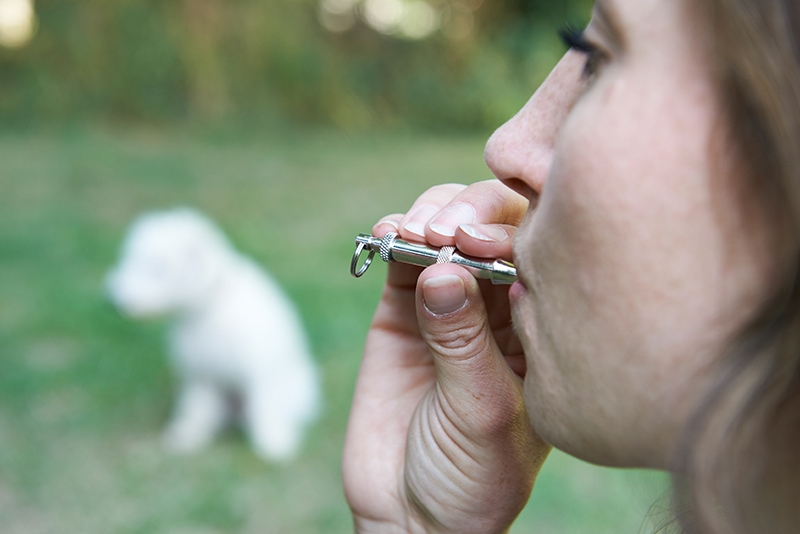
There are three general kinds of dog whistle: silent, those with or without a pea, and dual-tone.
Silent whistles (also called “ultrasonic”) operate at a pitch that’s too high for humans to hear. Your dog can definitely detect it, though, and using one of these allows you to call your pup without annoying other people in the area.
Some whistles have a little ball called a “pea” inside them; this ball rattles around when you blow on it, allowing you to create different sounds. These are good if you want to assign different commands to different frequencies.
If you live in a cold climate, the pea might freeze, rendering it useless. As a result, they make pea-less whistles, which are exactly what they sound like. While these are more reliable in inclement weather, they can’t make as many sound variations as their counterparts.
Finally, we have dual-tone whistles. They have two distinct tones (and often two different areas for you to blow on). You can test to see which one your dog is more likely to respond to, or you can assign a different command to each tone.
Advantages of Using a Whistle
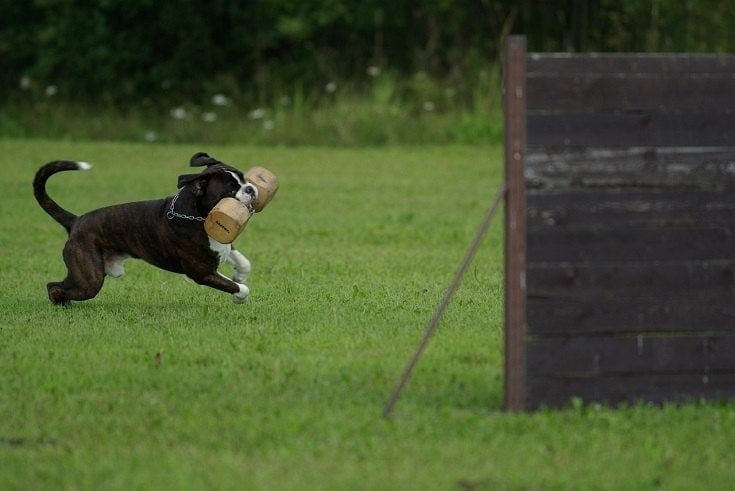
One of the biggest advantages of using a whistle is that it extends the range at which you can communicate with your dog. Your voice will carry only so far, even when shouting; a whistle, on the other hand, can be heard from a long way away. This is why many hunters prefer to use them.
Whistles aren’t usually drowned out by ambient noise either. Your voice can get swallowed up by the wind or the murmur of a large crowd; a whistle will pierce through these noises without any trouble.
Also, you can sabotage your training efforts with your tone of voice. It’s best to be as consistent as possible while training, but if you allow emotion to creep into your voice, it can confuse your pup. A whistle, on the other hand, will sound exactly the same every time.
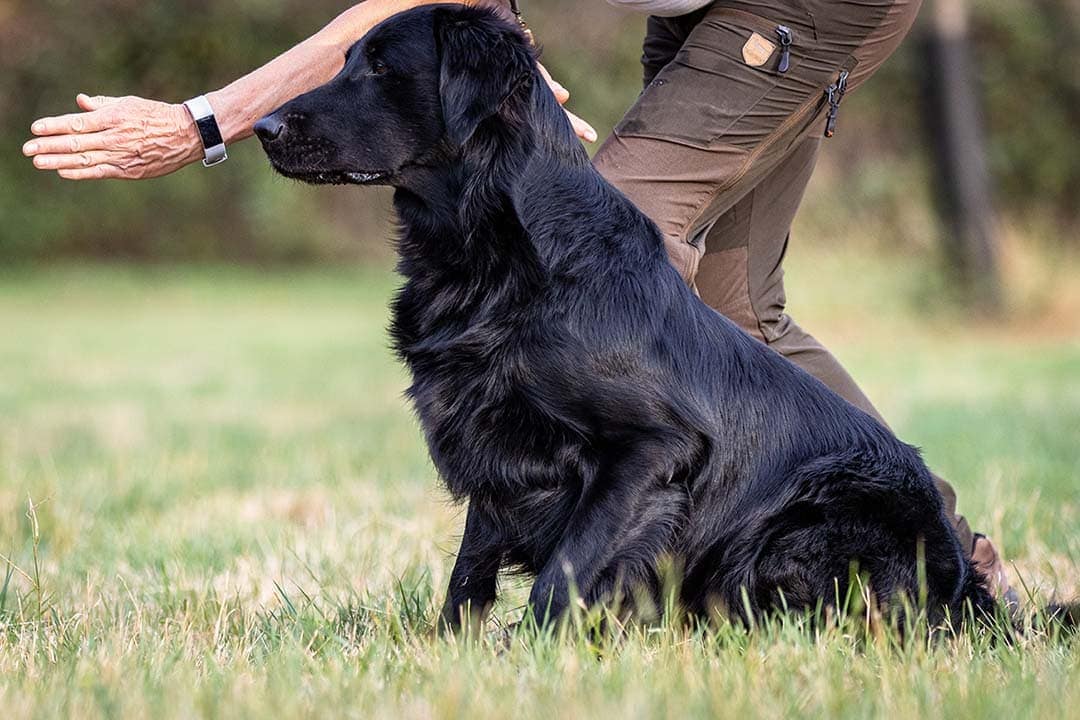
Whistles make unusual sounds as well, and that alerts dogs to the fact that you’re communicating with them. You may say words like “sit” and “stay” multiple times in regular conversation, so your dog will ignore those commands unless they know you’re talking to them. When you use a whistle, though, they’ll know for sure you want their attention.
Finally, unlike clickers and similar training aids, whistles keep your hands free. You can then use your hands to give signs or dole out treats promptly, without having to shuffle items around. Also, a whistle will save your voice.
If you need help with training your dog, we suggest speaking with a vet online.

How to Use a Dog Whistle
1. First, Find Your Dog Whistle Frequency
When whistle training a dog, the first thing you want to do is pick a dog whistle frequency. Dogs don’t all respond to the same frequency in the same way. That means you’ll need to experiment until you find one that your dog can hear clearly.
You can do this by blowing on it until you see your dog respond in some way. Some owners like to test whistles — especially silent ones — on sleeping dogs; if it wakes them up, there’s a good chance that they’ll respond to it when they’re not sleeping.
Once you know your dog can hear the whistle, you’ll need to practice with it to be sure you can make the desired noises every time, as each command will have a different noise associated with it. Once you can do that, you’re ready to start the actual training process.
2. The Easiest Way to Do It
By far, the easiest way to teach your dog to respond to a whistle is to incorporate it into your established training regimen.
For example, if your dog responds to a verbal command, issue the command and then blow the whistle a certain way. Reward your dog for responding and then carry on with the training.
Eventually, the dog will associate the whistle blast with the command, and the whistle will be all you need.
If your dog doesn’t respond to verbal commands reliably or you haven’t started training them at all, you’ll have to put in a little more work.
3. Only Use the Whistle for Positive Things
If you whistle for your dog to come to you just so you can punish them for chewing on your shoes, your pup will quickly learn to head the other way when they hear the noise.
As a result, you should teach your dog that good things are waiting for them when they hear the whistle. If they come when you blow for them, reward them lavishly for it with treats or praise.
Never, ever punish your dog for responding to the whistle, or they’ll soon stop.
4. Start Small and Set Your Dog Up for Success
Don’t make this process more difficult than it has to be — for you or your dog.
If you start by blowing the whistle at a busy dog park, your pooch will be unlikely to respond in a manner that you find satisfactory (and you may end up calling a dozen other dogs to you instead).
So, start slowly, and make it as easy as possible for your dog to succeed.
We suggest starting in your home with incredibly simple tests. Is the dog at the other end of the hall? Blow the whistle and reward them for coming to you. It’s that simple.
5. Next, Start Working Outside — But Still Make Things Easy
Once they’re responding reliably inside the house, you can take the training outdoors.
Don’t ratchet up the degree of difficulty too much, though. Stay around your house, and limit training to times when there aren’t many distractions.
A good way to start is to take your dog into the backyard and let them sniff around a little bit. Once their attention is off you, blow the whistle and reward them for responding.
If you feed your dog outside, calling them with the whistle is a good idea, as it further reinforces the idea that good things are waiting for them when they hear that sound.
What you should not do, however, is blow it when your dog is unlikely to respond or is already running away from you. If they’re losing their minds barking at a squirrel, wait for them to finish before you call them.
6. Move to Public Areas
When your dog starts reliably coming to you in the yard, you can try working with them in public spaces. Again, though, set them up to succeed.
That means limiting distractions as much as possible. Don’t do it in an area with a large number of people or other dogs around, and make sure your pup will be safe, so stay away from busy streets.
Start by staying close to your dog — 10 yards or so away is plenty. As your dog proves themselves capable of responding, you can increase the distance or the number of distractions but don’t increase both at once.
You may want to keep your dog on a long training lead until you’re fully confident that they’ll return to you every time. It’s a good way to keep them safe while also giving them the freedom to choose whether to respond.
7. Once You’re Confident, Move On to Other Commands
Once you’ve taught them recall, you can move on to other commands. Remember that every command needs a distinct whistle blast, or else, you’ll confuse your dog and the training will be ruined.
For non-recall commands, your best bet is to use verbal instruction and pair that with a distinct whistle blast before slowly phasing the verbal part out.
The good news is that once you get your dog used to responding to the whistle, teaching them subsequent commands becomes much easier.


In Conclusion
Now you know how to use a dog whistle. Once you start teaching your dog to respond to a whistle, you’ll wonder why you ever bothered with a clicker or verbal commands. While the initial learning curve may be steeper with a whistle, once your dog is proficient with it, you’ll find that it makes giving them commands easier than ever.
The fact that it’s easy isn’t the real appeal to using a whistle, of course. The real appeal comes when you can use the whistle in public to show everyone else how much better trained your dog is than theirs.
See Also: Dog Training Quotes
Featured Image Credit: SpeedKingz, Shutterstock
Get Hepper In Your Inbox


Pet care tips from our vets and experts, straight to your inbox.
You may opt-out at any time. View our Privacy Policy for more information.

Nicole is a lover of animals of all sizes but is especially fascinated with the feline variety. She’s the proud mom of Baby, a Burmese, and works every day so he can relax in the sunshine or by the fire. She’s always had a cat in her home and has spent countless days with others, observing behaviors and softening up even the grouchiest of the lot. Nicole wants to share her kitty expertise with you so you and your cat can live happy, healthy, and care-free.
Join the conversation
Ask a question, share your story, or send private feedback.