Hepper is reader-supported. When you buy via links on our site, we may earn an affiliate commission at no cost to you. Learn more.
Are Dog Whistles Cruel or Harmful? Vet Reviewed Facts & FAQ



In this article
Dog whistles are popular among dog owners and trainers because they tend to work so well when issuing commands. They are not harmful to dog ears and don't irritate human ears either. However, if used incorrectly, they can irritate and even hurt your dog.
It's important to remember that a dog's ears are more sensitive than ours, so sounds that may not bother you may cause discomfort in your dog. There are also several noises in our surroundings that can make dogs irritated.
In this article, we'll dive into the effects of dog whistles and how to use one correctly.

Are Dog Whistles Harmful?
Dog whistles are not exactly harmful to your animal's ears. This is because dogs can hear a certain frequency of sound that humans can't, and dog whistles create this frequency
While humans can only hear a frequency of up to 23 kHz, dogs can hear up to 65 kHz. Extremely high frequencies will hurt your dog's ears and make them uncomfortable.
When abused, these whistles can be painful to dogs. Abuse ranges from whistling too loudly in confined spaces, whistling too close to your dog's ears, and whistling after your dog has shown signs of irritation. Blowing the whistle too close to your dog could hurt him and cause damage to the eardrum. It can cause pain and even temporary deafness. This is why it's recommended that you consult a professional trainer to advise you on responsible use.
Different Kinds of Dog Whistles
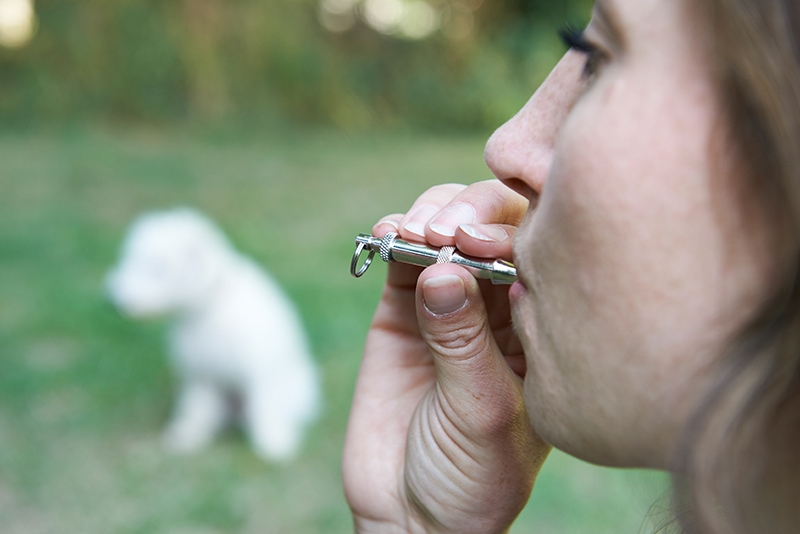
The first thing to understand is that there are three different types of dog whistles:
Silent Whistles
These whistles operate on a pitch that's too high for humans to hear. Only your dog and some other animals can detect it. It is efficient since it calls your dog to you without annoying other people in the vicinity.
Dual-tone Whistles
These types of whistles have two distinct tones and places you can blow on.
Pea Whistles
Some whistles have a small wooden ball inside them called a pea that rattles when you blow on it. The sound produced will depend on how much the pea rattles. It's the perfect whistle if you want to assign different frequencies to certain commands.

The 5 Steps to Use a Dog Whistle Correctly
A dog whistle is essentially an extension of your voice, so it does not make sense to use one indoors. It comes in handy outdoors when hunting, herding, or hiking, when your voice can get carried away by the wind. Before using a dog whistle, you need to ensure your dog has mastered voice commands. Some other tips you should consider when using a dog whistle include:
1. Finding the ideal frequency for your dog
When training your dog using a dog whistle, you first need to find the right frequency. Dogs don't respond to all frequencies the same way—some love a low frequency while others love a higher one. You need to experiment with your dog until you find the right one.
However, if your dog starts barking in response to the frequency, you should stop using it and find a more suitable one.
2. Only use it for positive behavior
You should never use a dog whistle to punish bad behavior as they will learn to run the other way when they hear it. Instead, teach your dog that good things are coming when they hear it. You can use dog treats or praise as a reward.
3. Start small
When using a dog whistle for the first time, starting small is advisable. Start at a lower frequency and work your way up until your dog reacts correctly. You should also start with simple tests in a quiet and familiar area.

4. Use other verbal commands with the dog whistle
Once you've taught your dog to obey the dog whistle, you can teach them which frequency goes with which command. You can do this by using verbal instruction with each whistle blast and then phasing out the verbal commands until your dog reacts to the different whistle commands.
5. Take your dog to the vet
Before training your dog, take it to the vet for a checkup to ensure the ears are fully functional. Also, if your dog stops responding to commands, it could be a result of partial deafness—this happens with senior dogs especially.


Conclusion
Dog whistles have been used to train dogs and teach them commands for years. They mimic human whistling, also used as a recall command for dogs. You can use a dog whistle to teach your dog commands or establish a routine.
Dogs react to silent whistles more since they can hear a higher frequency range than humans. The right whistle or frequency will depend on the breed of the dog and its age.
Featured Image Credit: Vaclav Sonnek, Shutterstock
Get Hepper In Your Inbox


Pet care tips from our vets and experts, straight to your inbox.
You may opt-out at any time. View our Privacy Policy for more information.
Nicole is a lover of animals of all sizes but is especially fascinated with the feline variety. She’s the proud mom of Baby, a Burmese, and works every day so he can relax in the sunshine or by the fire. She’s always had a cat in her home and has spent countless days with others, observing behaviors and softening up even the grouchiest of the lot. Nicole wants to share her kitty expertise with you so you and your cat can live happy, healthy, and care-free.
Join the conversation
Ask a question, share your story, or send private feedback.