Hepper is reader-supported. When you buy via links on our site, we may earn an affiliate commission at no cost to you. Learn more.
How Do Cats Greet Each Other? Feline Communication Explained

In this article
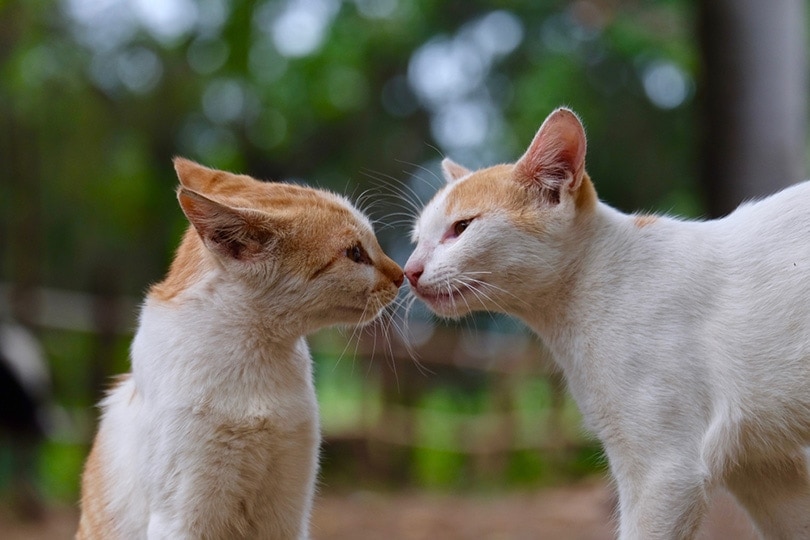
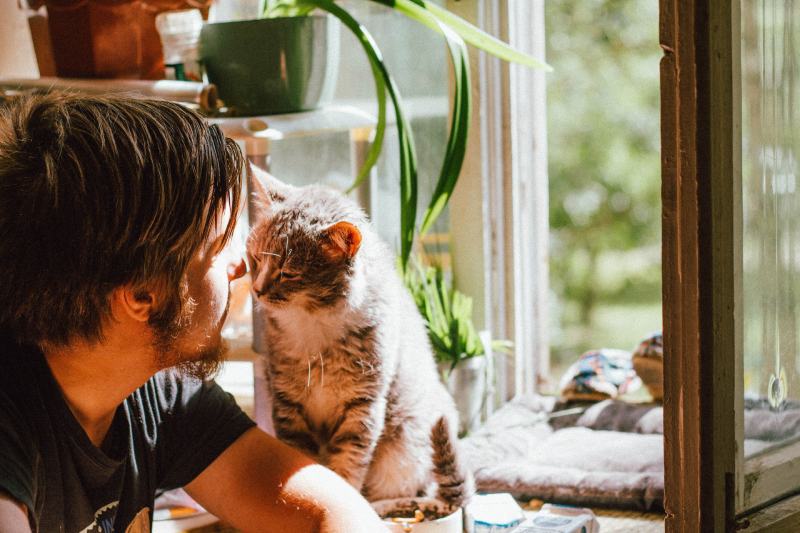
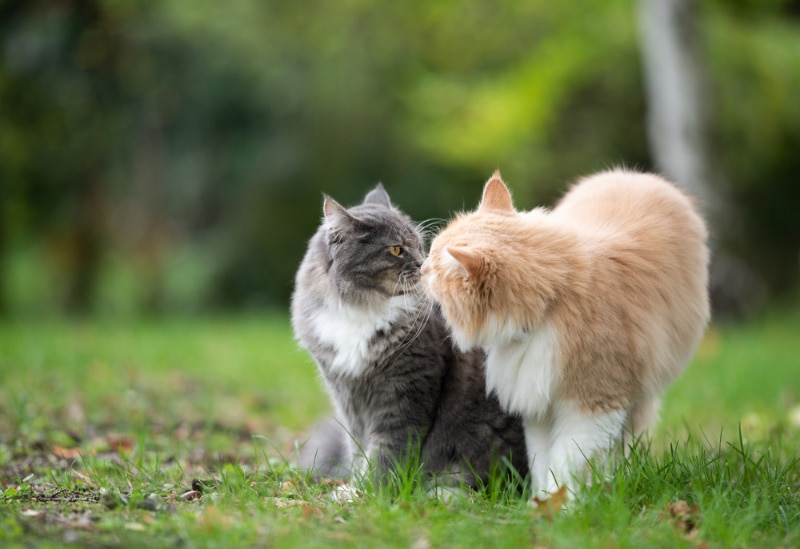
Cats often greet one another when bonded or in the same family group. Cats are social despite being typically solitary by nature, using a combination of body language, facial expressions, and vocalizations to greet each other. The most common greeting cat owners will notice between their cats is a friendly nose-touch, with the cats approaching one another and "cat-kissing" by briefly bumping noses.
A cheek rub and a trill often follow this. The greeting a cat will give or receive depends on their relationship with the other, such as a mother and kitten or a rival cat coming into an owned territory.

How Do Cats Use Their Bodies to Greet Each Other?
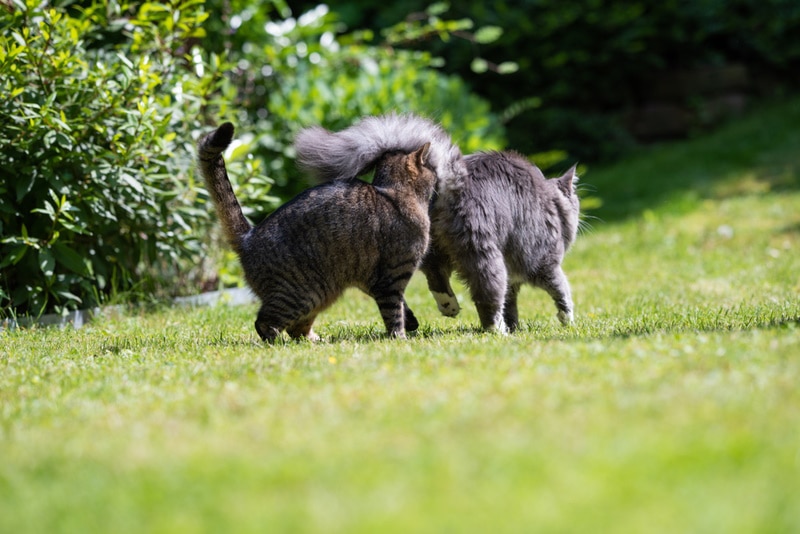
Cats will precede any physical greetings with body language. This allows the cats to communicate across distances and alert each other to their friendliness. If the cats are friendly with one another, they will approach confidently with their bodies relaxed and standing tall to be visible, often with their tails held high. They might also have their tail tips flicked forward eagerly in anticipation of the greeting!
If the cats are bonded, they might lick the tops of each other's heads when passing and touch noses as a gesture of affection. Trills or chirrups often accompany physical greetings to draw attention. Cats will often stop to rub along one another's bodies when greeting to exchange scents.
One sweet interaction cats can perform when greeting is hooking the tips of their tails (where the image of a pair of cat's tails making a heart shape comes from), extending the greeting, and making a picture of friendship.

Do Cats Meow When Greeting Each Other?
Despite some misconceptions, cats usually only meow at people in greeting rather than at each other. Meowing is a learned behavior that cats specifically developed to elicit affection from humans; kittens produce a sound very similar to meows when they're born (known as a "mew"), which alerts the mother cat to any of their needs. Kittens typically grow out of this at around 3 to 4 months old, but cats can learn to meow in a specific way to "coerce" people to give them food or care.
Cats more often trill or chirrup to greet one another or give a long and happy purr. Both trilling and purring are sounds mother cats use to communicate with their kittens; a mom cat uses trilling to get her kittens to follow her, and both mom and babies use purring to help stimulate milk production and denote comfort and pleasure.

How Else Do Cats Communicate With Each Other?
Cats are great communicators, but most communication is done in very subtle ways. Cats have four main communication methods, and different types will be used more or less depending on whether the cat is a pet, semi-feral, or feral. Cats communicate via body language, facial expressions, pheromones, vocalizations, touch, and gestures.
1. Body language
Feline body language is a broad communication category comprising postures (body positions), facial expressions, including ear and eye positions, and gestures or movements. Some of these messages are so subtle that they can be hard for humans to notice (such as minute changes in ear positioning). Others are clear even to us, such as the arched back and fluffed-up tail of an aggressive stance.
Facial expressions are versatile and most useful to humans trying to decipher their cat's mood or intentions. However, pheromones and positions might be more beneficial for inter-cat communication.
2. Postures
Postures are body positions that give off clear intentions and signals to other cats from further away than facial expressions can. They are helpful in communication between cats and between cats and humans and are most often used in highly emotional situations. Some common postures used in cat greetings include:

3. Facial Expressions
Facial expressions convey lots of information quickly at a close range. Cats use their eyes and ears in most facial expressions, which are most noticeable to humans. Eye positioning and pupil dilation are often utilized in inter-cat communication in subtle and direct ways.
Cats that stare directly at one another offer a challenge of dominance or aggression. Direct staring is often used during territorial disputes. These stares can be seen during greetings if one cat is the more dominant in a pair or group. On the opposite end of the scale, soft looks and lowered eyes convey submission and an unthreatening position.
The slow blink is the most well-known cat facial expression humans can use to "talk" to their cats! It is a special expression used amongst cats and cats and humans to show that the cat or person on the receiving end of the blink is loved and trusted. If a cat slowly blinks at another cat during the greeting, they are showing complete trust and affection. It's not known exactly why cats slowly blink at people and other animals they love, but it's thought to be linked to lower levels of stress hormones and relaxation.
4. Tails
Tails are the last component of cat body language communication and are a good indicator of a cat's general mood. For example, cats greeting one another often have their tails held high if they're friendly, and if a cat greets their owner, the tail might even shiver happily.
5. Pheromones and Vocalizing
Pheromones are essential in cat communication but are only used in a small part of a greeting. Pheromones are used more as a long-distance communication and message-relaying method, such as a tomcat spraying on a tree in their territory. Urine marking and scent marking left by the scratching and rubbing of glands on different parts of a cat's territory are all pheromonal communication.
Cats will also vocalize to communicate, mostly trilling or chirruping, as explained earlier in the article. However, cats can also growl, hiss, and scream to express fear, aggression, or pain.

How Do Cats Say Hello?
Cats often say hello to humans or other friendly cats by meowing or chirruping in greeting and acknowledgment. These little chirrups are also seen when cats pass each other in the home, keeping them connected. In addition, cats will say hello to one another by touching noses and "bunting" each other and might even do the same to you if you offer them your nose. However, as cats often lick each other's foreheads or stop for a quick grooming session, be prepared to get a rough tongue licking the end of your nose!
Conclusion
Cats greet one another in a few ways, but the most common greeting is a nose touch and a chirruping trill. Cat communication is fascinating and has many elements, some of which owners can use to let their cats know how much they mean to them. For example, if you similarly greet your cat, using a soft voice and a slow blink, you might get a friendly nose touch and even a quick groom from your cat in return!
Sources
https://www.aspca.org/pet-care/cat-care/common-cat-behavior-issues/meowing-and-yowling.
https://www.cuteness.com/13715548/do-cats-recognize-other-cats
https://www.petmd.com/news/view/cat-language-101-how-do-cats-talk-each-other-37620
https://blogs.scientificamerican.com/news-blog/the-manipulative-meow-cats-learn-to-2009-07-13/
https://en.wikipedia.org/wiki/Cat_communication#Olfactory_communication
https://animalworksvets.com/tips-on-how-to-speak-your-cats-language/
Featured Image Credit: Nils Jacobi, Shutterstock
Get Hepper In Your Inbox


Pet care tips from our vets and experts, straight to your inbox.
You may opt-out at any time. View our Privacy Policy for more information.
Beth is a mom to two babies: one with four legs, and one with two. Beth has years of practical experience as a veterinary care assistant, working in both the operating room and in consult, expanding her knowledge to gain certification in her favorite subject: feline behavior and well-being! When she's not writing about her favorite topics (cats, dogs, and creature comforts), she's looking after her two-year-old daughter and her energetic eight-year-old Nebelung, Kiba. When she gets a moment's respite, Beth loves to read fiction books. Horror is her number one genre, with fantasy and rich history being her second option.
Join the conversation
Ask a question, share your story, or send private feedback.