Hepper blog

Search our database of over 9,984 posts with up-to-date information from our experts and veterinarians.

Hepper is reader-supported. When you buy via links on our site, we may earn an affiliate commission at no cost to you. Learn more.

How Long Can Fish Live In a Bag? Vet-Approved Facts & Care Tips

By Lindsey Stanton · Reviewed & fact-checked by Dr. Luqman JavedVet Approved
Dr. Luqman Javed
Reviewed & Fact-Checked byDr. Luqman JavedDVM (Veterinarian)
Dr. Luqman grew up with an extreme fondness for animals and turned a childhood dream into reality by becoming a veterinarian. His goals are now focused on helping pet owners understand their pets better in order to ensure the best quality of life for all pets globally. He is passionate about wildlife, exotic pets, pet owner education, and animal welfare. Luqman has 3 years of professional experience working with a variety of animal species. He has skills in demonstrating proper animal husbandry and training some exotic species, such as parrots. Additionally, he has decades of personal experience with keeping many exotic pets: freshwater fish, parrots, songbirds, chickens, ducks, turtles, and hamsters.View authorThe information is current and up-to-date in accordance with the latest veterinarian research. Read about our vets
Share
Ask us a question in the comments
fish in bag

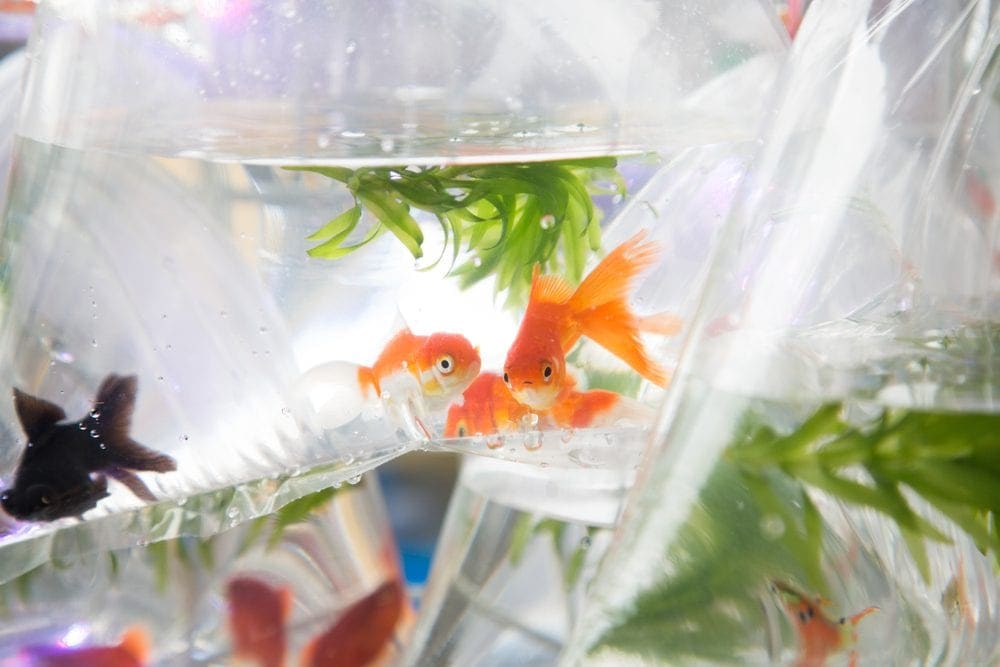
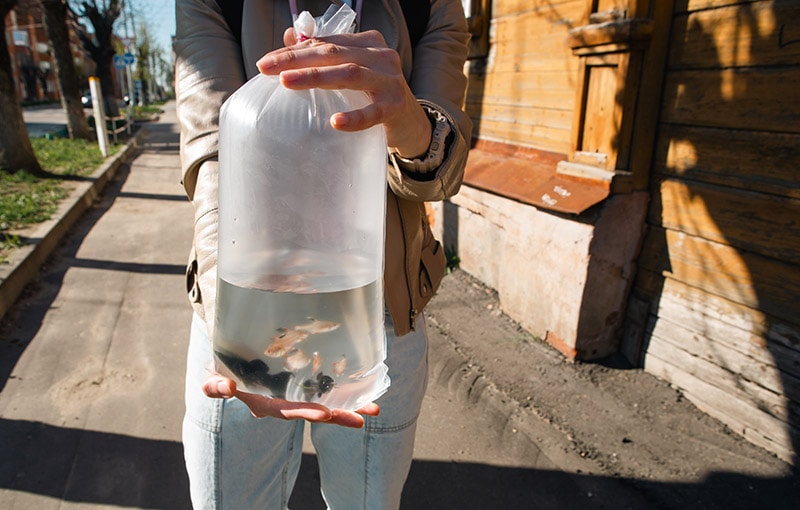
When you buy a new fish from the pet store, it likely comes home with you in a bag. You know you have to give the fish time to acclimate to the new tank environment. However, you might not know how long the fish can safely be kept in the bag.

The short answer is a fish can live in a bag for between 7 and 9 hours. Fish may last longer in bags that contain additional chemicals for absorbing fish waste and ammonia. However, there are many factors that influence the amount of time fish will be safe and comfortable in a plastic bag. Read on to learn more.

Factors That Impact How Long Fish Can Live In a Bag

While fish can generally be safely kept in a plastic bag for 7 to 9 hours, this amount of time is not always healthy. It’s also possible a fish can survive in a bag for longer than 9 hours if certain conditions exist.

  • Oxygen - Fish need oxygen to breathe. In a tank, the filtration system helps move the water around. Fish absorb the oxygen from the water as it moves over their gills. When you keep a fish in a bag for too long, the oxygen levels will deplete and the fish will suffocate.
  • Air vs. pure oxygen - If the bag is filled with pure oxygen instead of air, the fish can survive longer. Most pet stores used oxygen to fill fish bags instead of air. Using pure oxygen will make it possible for your fish to breathe more easily in the bag.
  • Number of fish in the bag - If you’re bringing home multiple fish at the same time, you’ll want to either ask the pet store to put them in separate bags or remove them from their bags sooner. The more fish you have in a bag, the more quickly the oxygen will be depleted.
  • Size of the bag - The bigger the bag, the more oxygen you can put in it. Only about one-third of the bag should be filled with water. The rest should be filled with oxygen.
  • Type of bag - Ziplock bags don’t make good choices for fish transport. They can break too easily. Hard plastic containers are also not ideal. They don’t allow for enough oxygen nor can you use them to acclimate your fish to the new tank like you can a plastic bag. This is why polybags are typically used for fish transport. They are thicker than Ziplock bags, so there’s a lower risk of ripping. They can also be topped with plenty of pure oxygen to keep your fish safe.
  • Transportation conditions - Factors such as temperature can impact the rate at which the oxygen is used up by your fish. If it is too hot or cold, the fish can become agitated or excited. This will cause them to use the oxygen more quickly than if they were calm and comfortable. A small cooler is a good way to transport fish home. If you place the bags in the cooler, the temperature won’t fluctuate and the bags won’t bounce around.
  • Additives - The water in some bags is supplemented with chemicals or additives that help absorb fish waste (such as ammonia) to make the water safe for the fish for as long as possible.
  • Last meal of the fish - If the fish wasn’t fed for a day or two before being placed in their bag, they will produce less waste. Therefore, they may last longer in the bag.
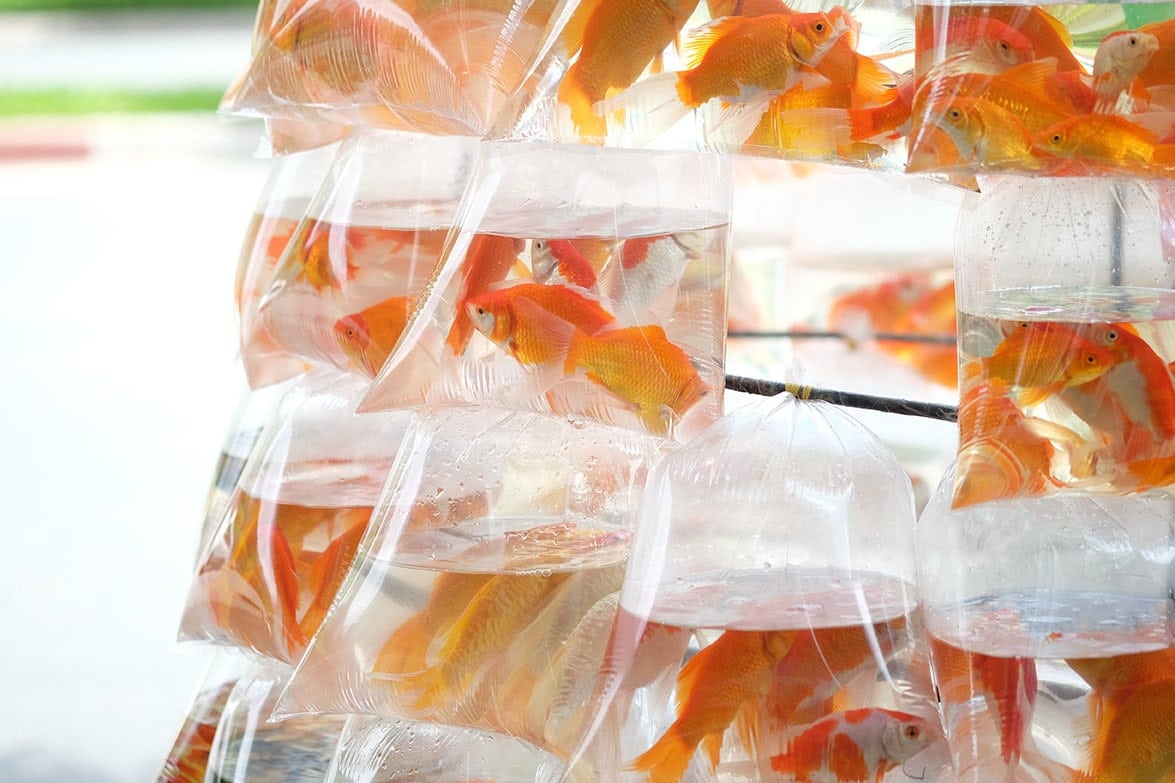
goldfish in plastic bag
Image Credit: TRAN THI HAI YEN, Shutterstock

Acclimating New Fish to Your Tank

Another thing you need to consider when bringing a new fish home is how long they need to acclimate to your tank. You need to let the bag float in the tank for 15 to 20 minutes so the fish can acclimate to the temperature.

You also need to allow your fish to adapt to the pH levels in the new tank. This is done by adding a little of the tank water to the bag with the fish in it. You should do this several times over an hour or two. Please note that if you already have fish in the tank at home, you should place your new fish in a quarantine tank instead of your existing one.

Once the fish has had a chance to acclimate, you’ll want to add them to the tank using a net. Don’t add the bag water to the tank. It can contain bacteria and diseases that might harm your other fish.

You’ll need to add these steps into your calculation of how long your new fish will be in a bag.

Conclusion

While some fish can live for up to 48 hours in a bag, if the oxygen levels are high enough, most cannot survive for more than 7 to 9 hours. You’ll need to be mindful of this when you bring new fish home. Accounting for how long it will take to acclimate them and the levels of oxygen in the bag is essential for a healthy introduction for your fish.

Related Reads:


Featured Image Credit: kao, Shutterstock

Get Hepper In Your Inbox

Pet care tips from our vets and experts, straight to your inbox.

List

Select all that apply.

You may opt-out at any time. View our Privacy Policy for more information.

Lindsey Stanton
Authored by

Lindsey Stanton

Join the conversation

Ask a question, share your story, or send private feedback.
Rate this post
Required to post. Only our editors see your rating.
Who should see this?

A human reviews every comment before it appears. Your email is never published.

Picked to go with this article

How Long to Let Fish Acclimate to a New Tank: Our Vet Explains

How Long to Let Fish Acclimate to a New Tank: Our Vet Explains

Bringing home a new fish can be extremely exciting, whether it’s your first fish in a new tank or a new addition to an existing tank. It can also be a difficul…

Dr. Luqman Javed
By Dr. Luqman Javed ·
How to Safely Transport Fish for Short & Long Distances (Vet Answer)

How to Safely Transport Fish for Short & Long Distances (Vet Answer)

The prospect of transporting fish could be more pleasant. Unlike most other pets, fish must be transported in water, which brings many complications. Nonethele…

Dr. Luqman Javed
By Dr. Luqman Javed ·
How Long Can a Fish Live Out of Water? Vet-Approved Facts & Info!

How Long Can a Fish Live Out of Water? Vet-Approved Facts & Info!

The average human can hold their breath underwater for about 2 minutes. The record after breathing a lungful of pure oxygen first is 24 minutes and 3 seconds.…

Lindsey Stanton
By Lindsey Stanton ·
How To Transfer Betta Fish Into a Tank: Our Vet Answers

How To Transfer Betta Fish Into a Tank: Our Vet Answers

Adopting a new pet fish is an exciting prospect for most aquaculture enthusiasts. With a wide array of fin types, colors, and sizes, picking a betta to bring h…

Dr. Luqman Javed
By Dr. Luqman Javed ·

Keep reading

More stories you might like

Why Your Fish is Gasping for Air? 7 Reasons & What to Do

A fish that constantly gasps for air at the surface is never a good sign. Although fish like the Siamese fighting fish will gulp in the air occasionally as in…

Lindsey Stanton
By Lindsey Stanton ·
Why Your Fish is Gasping for Air? 7 Reasons & What to Do

How to Calm Down Stressed Fish: 9 Helpful Tips & FAQs

Having stressed-out fish is not good because fish are fairly fragile and sensitive. Eventually, the stress could even lead to the death of your fish. Unfortuna…

Lindsey Stanton
By Lindsey Stanton ·
How to Calm Down Stressed Fish: 9 Helpful Tips & FAQs

What Happens When You Overfeed a Fish? 8 Vet-Approved Issues

Many people, especially beginners, think that they can just keep feeding fish until the cows come home. Can you overfeed fish? Yes, while your fish do need an…

Lindsey Stanton
By Lindsey Stanton ·
What Happens When You Overfeed a Fish? 8 Vet-Approved Issues

How to Give a Fish CPR: Our Vet Explains (With Pictures)

It is every owner’s worst nightmare to find one of their fish out of water. Knowing what to do (and what not to do!) in this situation is very important. Cardi…

Dr. Emma Chandley
By Dr. Emma Chandley ·
How to Give a Fish CPR: Our Vet Explains (With Pictures)

How to Tell When a Fish Is Hungry: 5 Vet-Verified Behaviors to Look For

There is no doubt that fish love their food, and many fish keepers will agree that feeding time is the highlight of their fish’s day. Fish rely on food as thei…

Sarah Psaradelis
By Sarah Psaradelis ·
How to Tell When a Fish Is Hungry: 5 Vet-Verified Behaviors to Look For

Why You Should Never Buy a One-Gallon Fish Tank: Our Vet Explains

We're all familiar with the picture of a fishbowl and a single fish inside. This image has been so normalized that most people are unaware that keeping fish in…

Dr. Paola Cuevas
By Dr. Paola Cuevas ·
Why You Should Never Buy a One-Gallon Fish Tank: Our Vet Explains

Why Does My Fish Tank Smell? 7 Common Reasons Explained

Having an aquarium or fish tank is a very popular hobby in the United States, with nearly 15 million households having at least one. Amazingly, in 2020, the aq…

Gregory Iacono
By Gregory Iacono ·
Why Does My Fish Tank Smell? 7 Common Reasons Explained

How Many Fish Can Be In A 5-Gallon Tank? Facts & FAQs

This is honestly a very subjective question, one that is harder to answer than simply providing you with a concrete number. Strictly speaking, the amount of fi…

Lindsey Stanton
By Lindsey Stanton ·
How Many Fish Can Be In A 5-Gallon Tank? Facts & FAQs