





Siamese cats are considered gorgeous and unique felines. These beautiful cats often have a slim body, blue eyes, and pointed dark coloration along the tail, face, and paws. This coloration is formally called “points” since the rest of the cat’s body is primarily lighter in color, typically cream to fawn.
Even though all Siamese cats have points, they come in different colors. Interestingly, there are only four colorations accepted by all traditional breed standards from the main cat associations, but up to 29 colors have been accepted by different organizations around the globe.
Read on to learn about 29 Siamese colors and how Siamese cats’ colors change throughout their lifetimes.

29 Siamese Cat Colors
Now, let’s dive into 29 possible cat colors. We will first look at the four most accepted colors. From there, we will look at each classic point and their tabby, tortie, and/or tortie tabby variety.
1. Seal Point

When most people think of Siamese cats, the Seal Point Siamese is often what they imagine. Seal Points have almost black points, but the points are more of a dark brown color. In comparison to other Siamese cats, the Seal Point has the darkest body tone overall, although body shade can vary with age and temperature due to temperature-sensitive pigment expression.
2. Chocolate Point

Chocolate Points are notably lighter-bodied than Seal Points. The primary body color of Chocolate Points is ivory white to warm cream. As its name suggests, the points on the Chocolate Point are often a lighter, warm brown (milk chocolate) color. Because of the contrast between the lighter body and darker points, these points stand out dramatically.
3. Blue Point

Blue Point Siamese cats are appropriately named because most of their body is white with a bluish tint. As the cat ages, most Blue Points become gradually darker due to increased pigment deposition influenced by temperature-sensitive enzyme activity. The points are often deep blue or slate-colored. The coloration of the Blue Point is much cooler looking than many of the other Siamese cats.
4. Lilac Point

Lilac Points, sometimes called Frost Points, have a glacial white body with light gray points that have a subtle pinkish hue. Of all Siamese coat colors, the Lilac Point has the lightest body. Even as the Lilac Point ages, the white coat remains relatively light compared to other color points, although some gradual darkening can still occur.
5. Tabby AKA Lynx Point

It’s debated whether Tabby Points should be considered Siamese cats because they had to have been bred with another breed at some point or another, although many modern breed registries recognize these cats as Siamese variants (often called Lynx Points) due to the presence of the tabby (agouti) gene. It’s believed that Tabby Point Siamese cats were created in Scotland around the 1940s. You may also hear Tabby Points called “Lynx Points.”
Tabby Points stand out from the classic points because they have the traditional tabby “M” marking across their forehead. If their points are too dark, the “M” may not show clearly. There is a Tabby Point version for all classic points.
6. Seal Lynx Point

The Seal Tabby Point has the classic Seal Point Siamese coloration with the distinctive “M” marking on the forehead. Since Seal Point Siamese cats have such dark point colors, the Tabby Point may be difficult to see.
7. Chocolate Lynx Point

The Chocolate Tabby Point has chocolate color points with an “M” marking. Once again, the “M” may not be visible through the Chocolate Point coloration.
8. Blue Lynx Point

Blue Tabby Points are a bit easier to spot than Seal and Chocolate Tabbies. Often, you will be able to see the “M” marking on the forehead.
9. Lilac Lynx Point

It’s almost guaranteed that you will be able to identify a Lilac Tabby Point. Because Lilac Points are so light, the “M” marking is always recognizable.
10. Tortie Point

Tortie Points are easily the most stunning coloration of a Siamese cat, but they are not always accepted as an official coat color by all cat registries. Tortie Points stand out because their points are made up of a tortoiseshell pattern.
Much like Tabby Points, Tortie Points came about by mixing Siamese cats with a different breed that has a tortoiseshell coat. All Tortie Points have traditional Siamese color points, but some are also mixed with Tabby Points.
11. Seal Tortie Point

Seal Tortie Points have Seal coloration with patches of red or cream tortoiseshell patterning on the points. Because of the tortoiseshell patterning, the points may appear darker and more mottled than those of a traditional Seal Point.
12. Chocolate Tortie Point
Chocolate Tortie Points have chocolate coloration with patches of red or cream tortoiseshell patterning on the points. The tortoiseshell patterning can give the points a mottled appearance compared to a traditional Chocolate Point.
13. Blue Tortie Point

Blue Tortie Points have soft blue-gray points with cream tortoiseshell patches scattered throughout the coloration. This combination creates a uniquely blended and variegated appearance that differs from the more uniform color of a traditional Blue Point.
14. Lilac Tortie Point

Lilac Tortie Points have pale lilac coloration with cream tortoiseshell patches on the points. Their light color scheme often gives the tortoiseshell patterning a soft, delicate appearance compared to darker Tortie Points.
15. Red Point or Flame Point

The Red Point, also called the Flame Point or Orange Point, is a Siamese color variation with warm reddish-orange or apricot-colored points and bright blue eyes. Many Red Points also have faint tabby striping on the face, legs, and tail because the red color gene naturally allows tabby markings to remain visible. This color was developed by crossing Siamese cats with red tabbies or tortoiseshell cats.
16. Red Lynx Point

Because the red gene tends to display striping, many flame points have visible tabby patterns on their points.
17. Cinnamon Point

Cinnamon Points look very similar to Chocolate Points, but they are slightly lighter in the point areas. Their points have a warm cinnamon-brown color, and the faces aren’t overly shaded. The rest of the coat is light, and their nose and paw pads are often pinkish-brown or pink.
18. Cinnamon Lynx Point

You can find Cinnamon Lynx Point cats with cinnamon-colored tabby (“lynx”) point markings, including the characteristic tabby “M” on the forehead.
19. Cinnamon Tortie Point

Imagine a classic Siamese, but instead of deep seal-brown points, the face mask, ears, legs, and tail are colored in warm cinnamon shades with soft splashes of orange-red, as though they were lightly dusted with cinnamon.
20. Cinnamon Tortie Lynx Point
Like several other Siamese point varieties, Cinnamon Points can also occur in a Tortie Lynx Point pattern, combining cinnamon-colored tabby markings with tortoiseshell patches on the points.
21. Cream Point

Cream Points are recognized by some cat registries but not all. The color was developed through breeding programs involving Red Point Siamese and other breeds carrying the dilute gene, including Abyssinians and Domestic Shorthairs. The result is a Siamese cat with pale cream-colored points. There is very little contrast between the cream-colored points and the pale coat.
22. Cream Lynx Point

Cream Lynx Points have pale cream-colored tabby markings on the face, ears, legs, and tail. Like other lynx point cats, they display the characteristic tabby “M” on the forehead and subtle striping on the points, creating a soft, elegant contrast with the pale body.
23. Apricot Point
Apricot isn’t an officially recognized coat color in most cat registries. Instead, some breeders use the name to describe cream-colored cats or points with a warm, peachy tint. Genetically, these cats are usually cream, which is the dilute form of red. In some breeding programs that recognize caramel, “apricot” may be used to describe a cream coat or points thought to be modified by the proposed caramel gene. However, because the genetics of caramel haven’t been conclusively established, most registries continue to recognize these cats as Cream Points rather than Apricot Points.
24. Apricot Tabby Point
Nearly all Apricot Points are Tabby Points. You can often see tabby stripes extend down the cat’s body, much further than other Siamese tabbies.
25. Fawn Point

A Fawn Point is among the rarest recognized Siamese and Colorpoint coat colors. Its points are a soft, warm beige that stands out subtly against a creamy white body, giving the cat a refined and delicate appearance.
26. Fawn Lynx Point
A fawn lynx point is an exceptionally rare color pattern that combines fawn coloration, the colorpoint pattern, and tabby (lynx) striping and M marking.
27. Fawn Tortie Point
At this point, you probably understand what it means when you see Tortie Point at the end of a color!
28. Fawn Tortie Tabby Point
Fawn Tortie Tabby Points have both the “M” and tortoiseshell points.
29. Foreign White
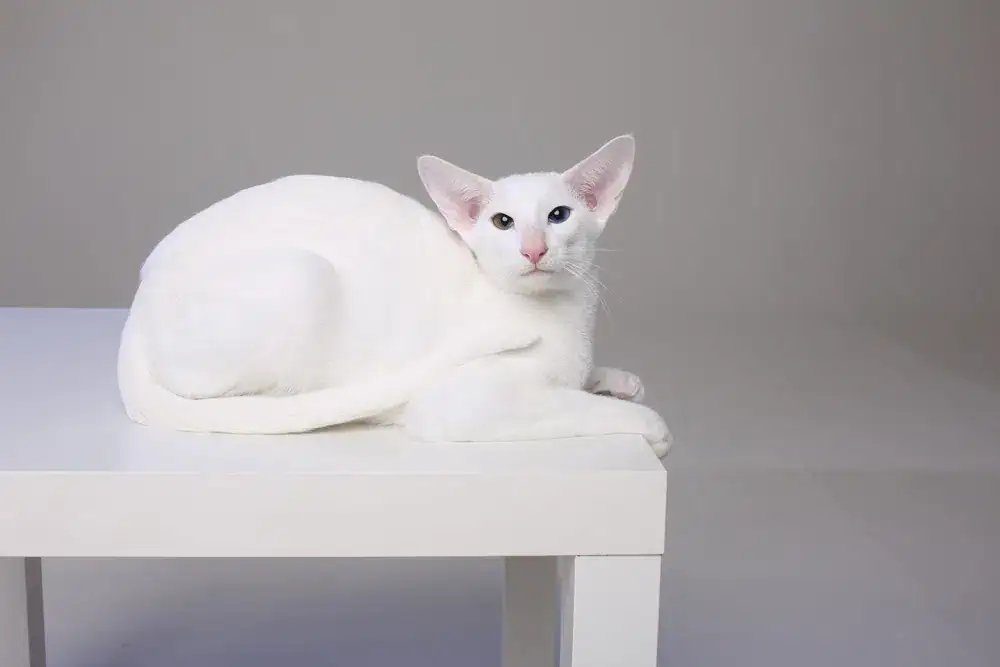
The last color is Foreign White. Often, the Foreign White is accepted as a completely different breed of cat, but they are often called “White Siamese” cats, which is why we put it on this list. This cat was created by crossing a Siamese with a white British Shorthair.
About Siamese Cat Colors
Let’s talk about what to expect if you are looking for a Siamese cat with an accepted color. As we mentioned above, many Siamese cat color and pattern combinations are recognized by at least one major cat registry, but not all organizations agree as to which colors and patterns should be accepted.
No matter what cat organization you look at, Seal Point, Chocolate, Blue, and Lilac are accepted. Similarly, Cinnamon, Cream, Fawn, Red, Tabby, and Tortie are accepted at some organizations, but not all, while others, like Apricot, are seen as variations in hue rather than true, unique colors.
Siamese cats can be separated into three general color patterns, including the classic points, tabby, and tortie. Tabbies and torties are not accepted at all organizations, especially if they are mixed with the classic points. Many of these colors and patterns were originally introduced through carefully planned breeding programs involving other breeds before becoming established in Siamese and related Colorpoint lines.
Even though tabbies and torties aren’t always considered accepted colors for Siamese cats, they make gorgeous coats nonetheless.

Siamese Cat Color Changes
Siamese cat coats can be confusing. In addition to having many possible color points, the Siamese coat color changes as the cat ages.
There are generally four stages of development for the Siamese color point development.
- Siamese cats are born white and have little to no visible points at birth.
- Points begin to develop in the cooler regions of the cat’s body first. The cooler regions include the cat’s extremities. You will first see points appear at the tip of the cat’s nose, ears, tail, and paws.
- Those points will extend more towards the cat’s torso, causing the points to extend over the cat’s face, most of the tail, and most of the legs.
- Finally, the cat’s torso coat will darken with age. This last step will be more prominent in certain coat colors than others.
Final Thoughts
If you want to get a Siamese cat, know that there are a lot of point colors to choose from. IIf you want a traditional Siamese cat, we recommend a Seal, Chocolate, Blue, or Lilac Point, but you can go with any of the other above-mentioned coats for a gorgeous Siamese cat that truly stands out.
- See also: Colorpoint Shorthair Cat
Featured Image Credit: STARSsoft, Shutterstock
 29 Siamese Cat Colors