Hepper is reader-supported. When you buy via links on our site, we may earn an affiliate commission at no cost to you. Learn more.
St. Bernard Australian Shepherd Mix: Pictures, Care, Temperament & Traits

In this article
Hybrid dogs may be all the rage these days, but some breed mixes are more common than others. The St. Bernard and Australian Shepherd mix may be unfamiliar to many of our readers because there aren’t that many of them out there. However, they make excellent pets for the right family. Keep reading to find out more about this unusual mixed-breed dog.
Breed Overview
Height:
Weight:
Lifespan:
Colors:
Suitable for:
Temperament:
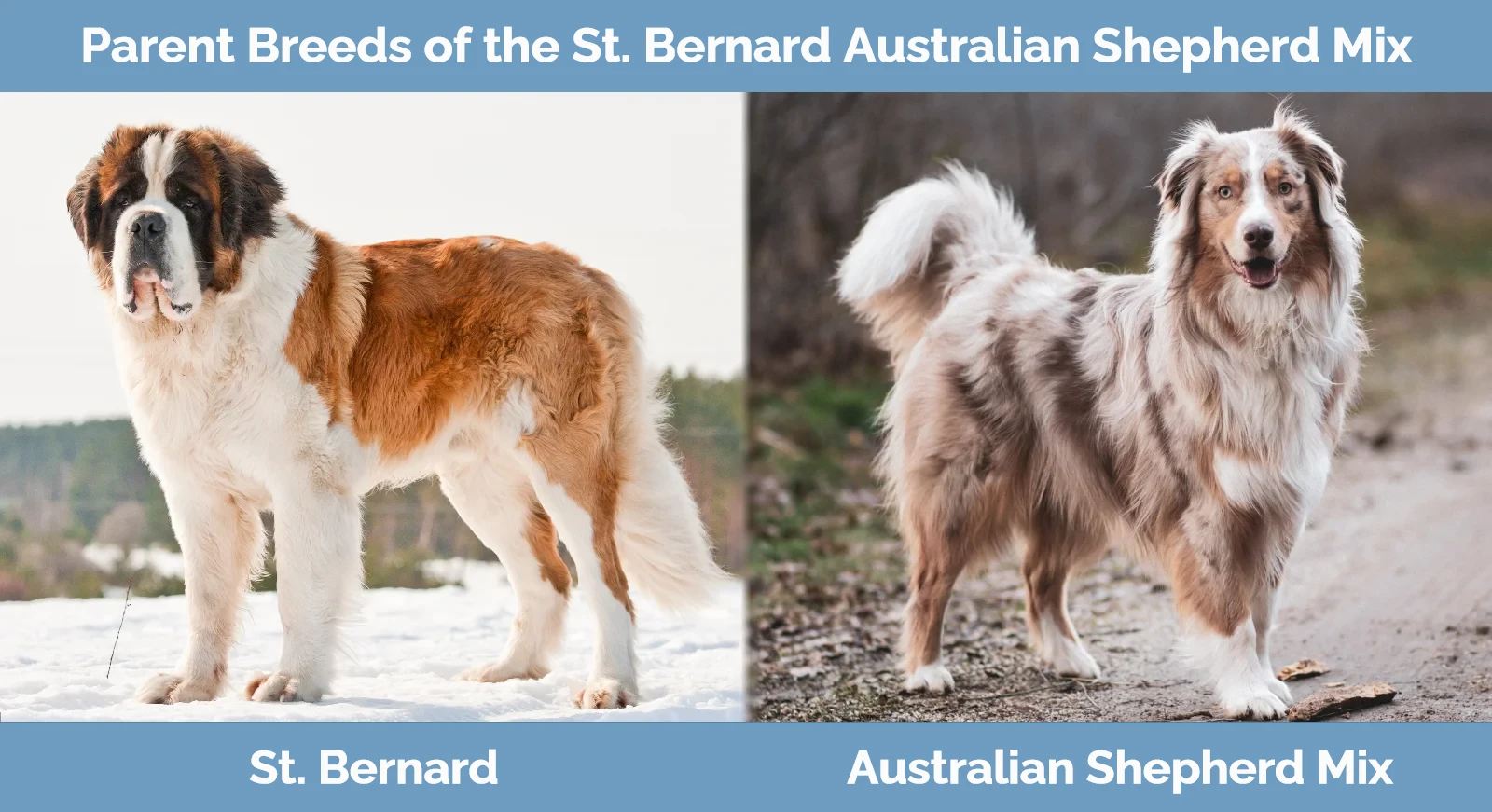
The St. Bernard-Australian Shepherd mix is a combination of two breeds that are very different from each other in personality and physical appearance. The St. Bernard, the famous search-and-rescue dog of the Alps, is a gentle giant not known for being especially energetic. On the other hand, Australian Shepherds are among the most energetic and driven working breeds you’ll find.
A full-grown St. Bernard can also easily be triple the size of an adult Aussie. Combining any two breeds will always result in a dog that may take after one parent more than the other, but in this case, the differences are more drastic than some. In this article, we’ll look more closely at the St. Bernard-Australian Shepherd mix, including what you can expect if you live with this breed.

St. Bernard Australian Shepherd Mix Breed Characteristics
St. Bernard Australian Shepherd Mix Breed Puppies
St. Bernard-Australian Shepherd mix puppies will most likely be difficult to find. With so few of these mixes available, you’re unlikely to find a St. Bernard-Aussie for adoption. You’ll likely need to search for a breeder and be prepared to travel to pick up your new pet. The rarity of this mix also means you can expect to pay more for a puppy than a more common hybrid breed, like a Labradoodle.
How the St. Bernard-Australian Shepherd behaves as a puppy depends on which parent they take. Australian Shepherd puppies are typically more energetic than St. Bernards, and it is tough to predict the energy level of the mix. The puppy’s size could also vary quite a bit.
Giant breeds like St. Bernards grow more slowly, so your St. Bernard-Australian Shepherd mix may also display slower growth. No matter which parent this mix takes after, early socialization and training are essential. Chances are the adult dog will be big and strong, so they must learn how to behave before they potentially outweigh you!

Temperament & Intelligence of the St. Bernard Australian Shepherd Mix 🧠
Are These Dogs Good for Families? 👪
While it may be hard to predict many things about a St. Bernard-Australian Shepherd mix, this is one place where both parent breeds have something in common. St. Bernards and Australian Shepherds are typically excellent family dogs, so a mix of the two should also be a wonderful companion for families.
St. Bernards are nicknamed “nanny dogs” because of their gentleness and watchfulness with kids. Australian Shepherds bond closely with their families, and their playfulness and energy make them a good match for older, active kids.
Because the St. Bernard-Australian Shepherd mix is usually a large, active dog, they must be closely supervised around small children who could easily be knocked over. This dog may also inherit the herding instincts of their Australian Shepherd parent, leading them to chase and nip unruly children as they would cattle. Training and supervision are essential.
Something else to remember is that this dog generally won’t do well if left alone frequently. Both parents thrive in the company of their humans and may develop behavior problems or separation anxiety without enough attention.
Does This Breed Get Along With Other Pets?
The St. Bernard-Australian Shepherd mix can get along with other pets, but it is essential to socialize them early. Their size could pose a danger to smaller pets, especially without proper training. They may also try to herd or chase cats or other small “prey” animals.
Small exotic pets should be kept away from dogs they may view as predators. Predator stress can cause health issues for these pocket pets.

Things to Know When Owning a St. Bernard Australian Shepherd Mix:
Food & Diet Requirements 
Depending on their size, a St. Bernard-Australian Shepherd puppy will probably need to eat a large-breed puppy diet. These diets help control the growth rate of these large dogs to ensure they don’t develop too quickly. Talk to your vet to determine when to switch to an adult diet.
Healthy St. Bernard-Australian Shepherds should be able to eat any quality, nutritionally balanced dog food. Feeding dry food is the most cost-effective option because the big dogs will probably eat a lot! Your vet can help you calculate how many calories your dog needs to eat daily.
Avoid feeding a homemade diet unless it’s properly formulated with the help of your vet or a veterinary nutritionist. A St. Bernard-Australian Shepherd needs the right vitamins, minerals, and other nutrients to stay healthy. Homemade diets may not be properly balanced without professional help.
Exercise 🐕
Your St. Bernard-Australian Shepherd’s exercise requirements will vary based on which parent breed’s genetics are more heavily featured. Australian Shepherds are tireless and may need as much as 2 hours or more of vigorous exercise daily. St. Bernards have more moderate exercise needs and less energy overall.
Because of their size and energy level, the St. Bernard Aussie does best in a house with a yard. You can expect to spend time every day exercising your dog, but whether that means a long run or a walk around the neighborhood will vary.
Training 🎾
Australian Shepherds are one of the most intelligent breeds and are generally eager to learn. They’re so driven that they need a job to keep them busy, or you may find yourself dealing with frustrating behavior issues. St. Bernards are generally willing to learn but have a stubborn streak and aren’t necessarily as motivated as the Aussie.
While there will be some variation, you can expect a St. Bernard-Australian Shepherd mix to be fairly easy to train, possibly with a stubborn streak. As mentioned in a previous section, getting an early start on training and socialization is key. Concentrate on using positive, reward-based training methods for the best results.
Grooming ✂️
Australian Shepherds and St. Bernards have thick, double coats. No matter which parent breed the mix takes after, you can expect a dog that sheds frequently, even heavily, at some times of the year. Daily brushing will likely be needed.
Keep your dog’s nails trimmed short, clean their ears as needed, and brush their teeth regularly. Get your dog used to grooming routines when they’re young and small to make it easier to continue once their grown.
Health and Conditions ❤️
The St. Bernard-Australian Shepherd mix may suffer from inherited diseases common to the parent breeds. The best way to get a healthy puppy is to only buy from a breeder who screens the parents for genetic health conditions before breeding. Unfortunately, this could be tougher for those looking for this particular mixed breed because there are fewer breeders overall.

Male vs Female
Like most breeds, male St. Bernard-Australian Shepherd mixes are typically larger than females. Unneutered males may be more energetic and aggressive than females as well. Unspayed females will generally go into heat twice a year.
During the heat cycle, females can be moody and should be kept separate from unneutered males to prevent accidental breeding. Talk to your veterinarian about the best time to get your dog spayed or neutered.
3 Little-Known Facts About the St Bernard Australian Shepherd Mix
1. They Can Have Intense Personalities
Australian Shepherds are not known to be easy-going dogs. Bred to work, they constantly search for a task to keep them busy. Combined with their high intelligence, it is not always the easiest breed to live with. Adding the mellow St. Bernard genetics could mean a St. Bernard-Australian Shepherd is less intense. But there’s no guarantee, so be prepared if your dog inherits the work drive of the Australian Shepherd.
2. They Might Drool a Lot
St. Bernards constantly drool. A St. Bernard-Australian Shepherd mix may also inherit this charming tendency. Be prepared for regular face wiping and floor mopping, just in case!
3. They Need a Job
The St. Bernard and the Australian Shepherd are working breeds. Even if the St. Bernard-Australian Shepherd mix isn’t quite as driven as a purebred Aussie, they’re still likely to be happier if they have something to do. Whether pulling the kids in a wagon or learning advanced obedience, this mixed breed likes to stay busy and spend time with their family.
Final Thoughts
Although no mixed breed is exactly the same, the St. Bernard-Australian Shepherd mix is generally an excellent choice for families with kids. However, the dogs can grow to well over 100 pounds, so ensure you’re prepared for the financial responsibility of such a large pet. Although you may not have many breeders to choose from, do your best to research those available before you purchase a puppy. Medical costs are also higher for large breeds, and you want the healthiest dog possible.
Related Reads:
Sources
Featured Image Credit: Left - Aneta Jungerova, Shutterstock | Right - RebeccasPictures, Pixabay
Get Hepper In Your Inbox


Pet care tips from our vets and experts, straight to your inbox.
You may opt-out at any time. View our Privacy Policy for more information.

A lifelong lover of all creatures great and small, Elizabeth got her first cat at 5 years old and at 14, she started working for her local veterinarian. After spending more than 20 years working as a veterinary nurse, Elizabeth decided to step away to become a stay-at-home parent to her daughter. Now, she is excited to share her knowledge with our pet parents. Elizabeth lives in Iowa with her family, including her two fur kids, Linnard, a husky mix and Algernon, the worldʻs most patient cat. When not writing, she enjoys reading, watching soccer, and spending time outdoors with her family.
Join the conversation
Ask a question, share your story, or send private feedback.