Hepper blog

Search our database of over 9,984 posts with up-to-date information from our experts and veterinarians.

Hepper is reader-supported. When you buy via links on our site, we may earn an affiliate commission at no cost to you. Learn more.

Can Dogs Eat Gooseberries? Vet Reviewed Health Concerns

By Grant Piper · Reviewed & fact-checked by Dr. Paola CuevasVet Approved
Dr. Paola Cuevas
Reviewed & Fact-Checked byDr. Paola CuevasMVZ (Veterinarian)
Paola Cuevas is a veterinarian and animal behaviorist, with over 18 years of experience working with a variety of species. Her passion is animal welfare and focuses on the importance of preventive medicine. Paola has skills in the fields of nutrition, microscopy, clinical pathology, diagnostic imaging, and endoscopy as well as extensive experience in animal training through positive reinforcement. As our in-house veterinarian, Paola is very happy to share her knowledge and experience with our readers and hopes to be helpful with any issue presented by your non-human family members.View authorThe information is current and up-to-date in accordance with the latest veterinarian research. Read about our vets
Share
Hepper_Can Dogs Eat_Gooseberries

Gooseberries are not very common, so many people don’t know much about them. If you live in an area with gooseberries, you may wonder if you can let your guard down for your dog. Is it safe for your furry friends to nibble on the occasional gooseberry?

Looking online, there appears to be some confusion about gooseberries being toxic. While gooseberries can cause diarrhea in dogs, the most common varieties are not toxic. Still, dogs should be kept away from gooseberries, and if they ingest gooseberries, they will need monitoring, and potentially even a trip to the veterinarian.

Here is everything you need to know about gooseberries and your dogs.

What Are Gooseberries?

Most commonly, “gooseberries” refer to the fruit of a variety of plants of the genus Ribes including Ribes grossularia var. Uva-crispa and Ribes hirtellum. These berries can be found on shrubs that grow in northern latitudes or specific types of vines. Ribes also include fruits like currants. The leaves and stems of this fruit’s plant do contain toxic hydrogen cyanide, but this is not present in the mature fruit.

However, there are about 40 species of plant that are commonly known as “gooseberries”, and some of them are toxic.
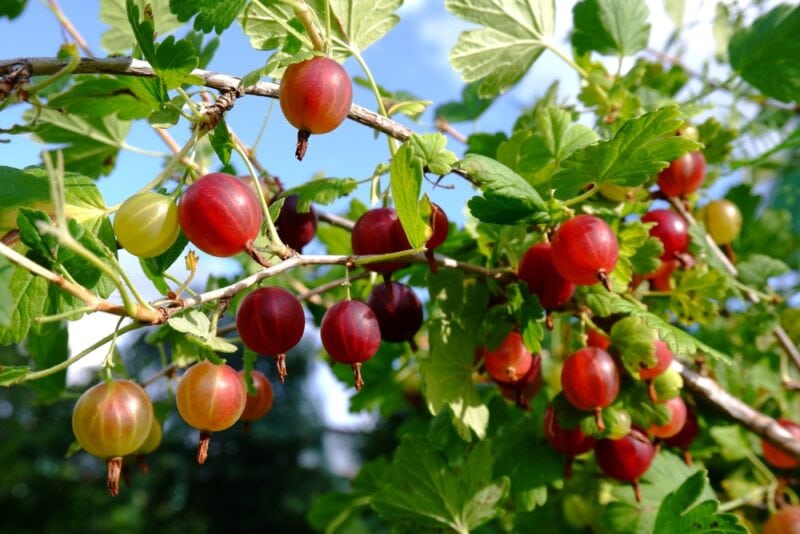
Fresh gooseberries on a branch in the garden
Image Credit: Mila_22 79, Shutterstock

Do Dogs Like Gooseberries?

Luckily, many dogs do not enjoy eating gooseberries. Gooseberries are tart and can have a strong, acidic taste. This puts off many dogs, which causes them to avoid the berries. But some dogs are not picky eaters and will gladly vacuum up gooseberries no matter how bitter they are.

What Happens If Your Dog Eats a Gooseberry?

Keep an eye out for stomach problems, discomfort, lethargy, or diarrhea. Gooseberries do not typically need a visit to the veterinarian unless your dog becomes unwell.

Conclusion

Gooseberries are not toxic to dogs but can possibly cause some gastrointestinal discomfort and should be avoided. Thankfully, dogs do not typically like to eat gooseberries because of the bitter taste, but that won’t dissuade all dogs from trying to take a bite. You should monitor your dog if they eat gooseberries at any point. A trip to the veterinarian might be required for treatment if your dog shows any signs of illness after ingesting gooseberries.

See Also: 

Sources

Featured Image Credit: P A, Shutterstock

Get Hepper In Your Inbox

Pet care tips from our vets and experts, straight to your inbox.

List

Select all that apply.

You may opt-out at any time. View our Privacy Policy for more information.

Grant Piper
Authored by

Grant Piper

Join the conversation

Ask a question, share your story, or send private feedback.

Rate this post
Required to post. Only our editors see your rating.
Who should see this?

A human reviews every comment before it appears. Your email is never published.

Picked to go with this article

Can Dogs Eat Berries? Vet-Reviewed Nutrition Facts & Safety Guide

Can Dogs Eat Berries? Vet-Reviewed Nutrition Facts & Safety Guide

Your furry friends are more than just pets; they are part of the family, so their nutrition and health should be a top priority. As pet parents, it is normal t…

Nicole Cosgrove
By Nicole Cosgrove ·
Can Dogs Eat Currants? Vet Reviewed Health Concerns & FAQ

Can Dogs Eat Currants? Vet Reviewed Health Concerns & FAQ

Many people know that grapes and raisins are toxic to dogs, but what about currants? That depends on what kind of currants you are talking about. Zante currant…

Nicole Cosgrove
By Nicole Cosgrove ·
Are Dogs Allergic to Grapes? Vet Approved Facts & FAQs

Are Dogs Allergic to Grapes? Vet Approved Facts & FAQs

Feeding the best food to dogs is vital for keeping them healthy and hopefully, leading to longer lifespans. It also means knowing what not to feed them. Many h…

Kathryn Copeland
By Kathryn Copeland ·
My Dog Ate Grapes or Raisins: What to Do and Prevention (Vet Answer)

My Dog Ate Grapes or Raisins: What to Do and Prevention (Vet Answer)

Grapes (and the dehydrated version, raisins) are undoubtedly delicious, hence why they make one of the most popular snacks in our day-to-day lives. Be it on th…

Dr. Joanna Woodnutt
By Dr. Joanna Woodnutt ·

Keep reading

More stories you might like

Can Dogs Eat Golden Berries? Vet Approved Health Concerns Reviewed

Golden berries—also known by various names including Cape gooseberries, husk cherries, and Peruvian groundcherries—are small, yellow-orange fruits wrapped in t…

Kit Copson
By Kit Copson ·
Can Dogs Eat Golden Berries? Vet Approved Health Concerns Reviewed

Can Dogs Eat Passion Fruit? Vet Reviewed Health & Safety Facts

If you are looking for a new treat to feed your dog, you may be considering passion fruit. You have likely heard of other pet parents using fruits or veggies a…

Jordyn Alger
By Jordyn Alger ·
Can Dogs Eat Passion Fruit? Vet Reviewed Health & Safety Facts

Can Dogs Eat Gourds? Vet Verified Facts & Safety Concerns

Dogs aren’t only man’s best friend, they’re also cherished family members. With our four-legged pals being so important to us, ensuring they are eating a compl…

Melissa Gunter
By Melissa Gunter ·
Can Dogs Eat Gourds? Vet Verified Facts & Safety Concerns

Can Dogs Eat Huckleberries? Vet Approved Facts & Safety Guide

As pet owners, we want to share everything we eat with our canine friends. However, giving your dog everything you eat is not a good idea, because some foods t…

Patricia Dickson
By Patricia Dickson ·
Can Dogs Eat Huckleberries? Vet Approved Facts & Safety Guide

13 Fruits Dogs Can Eat Safely: Vet-Approved Types (With Pictures)

Fruits make a tasty, sweet treat for us to eat, and many fruits are extremely affordable. If you live near a grocery store, they are also usually widely availa…

Brooke Billingsley
By Brooke Billingsley ·
13 Fruits Dogs Can Eat Safely: Vet-Approved Types (With Pictures)

Can Dogs Eat Acai Berries? Vet Reviewed Risks & Tips

As a pet parent, it is important to provide your fur babies with foods that give them balanced nutrition and help them lead healthy lives. There are always new…

Melissa Gunter
By Melissa Gunter ·
Can Dogs Eat Acai Berries? Vet Reviewed Risks & Tips

Can Dogs Eat Elderberries? Vet-Approved Facts & FAQ

Elderberries are a common and popular fruit that’s made into delicious jams, desserts, and syrups. They’re attractive berries, which is why your dog might want…

Gregory Iacono
By Gregory Iacono ·
Can Dogs Eat Elderberries? Vet-Approved Facts & FAQ

Can Dogs Eat Boysenberries? Vet Reviewed Facts & Health Concerns

If you have a furry companion at home, you may be curious if they can eat some of the same foods you enjoy. It is always better to be safe than sorry, especial…

Hanh Duong
By Hanh Duong ·
Can Dogs Eat Boysenberries? Vet Reviewed Facts & Health Concerns