Hepper is reader-supported. When you buy via links on our site, we may earn an affiliate commission at no cost to you. Learn more.
Were Cane Corsos Really Roman War Dogs? Origins & Facts

In this article
One look at a Cane Corso is all that’s required to convince us of its noble and worthy ancestry. Though looks can be deceiving, is that the case with this imposing breed?
As it turns out, the Cane Corso is not faking. This majestic canine possesses an impressive lineage that stretches back thousands of years. Its ancestors played a significant role in ancient combat as Roman war dogs.
Read on to discover the origins and evolution of this magnificent canine combatant.

Cane Corso Pre-Roman War Origins
The Cane Corso (plural: Cani Corsi) is a Molossoid or Molosser breed of dog with its roots in ancient Greece. References to the Molossers extend as far back as 411 B.C. The big dogs were favored by Greek livestock keepers as guardians for their animals. These imposing yet athletic dogs were nimble and strong enough to chase and fight off predators. It is widely believed that Molossers are the predecessors of the large group of Mastiffs and Mastiff-type dogs with which we are familiar today.
The exact history surrounding this interesting group of canines for this time is a bit vague. Although the most widely accepted belief is that the Molossers were more like the modern-day Mastiff, this may not have been the case. One historian suggests that they may have more closely resembled a Saluki or Greyhound. Records from the time are not able to conclusively settle this debate.

The Roman War Dog
The Romans became familiar with Molosser dogs at the time of their invasion of Greece around 200–100 B.C. They took some of these dogs back to Italy where they were interbred with native dogs of that region. This resulted in a more familiar heavy-set Mastiff-type dog not dissimilar to the contemporary Cane Corso and Neopolitan Mastiff. These two breeds are closely related descendants of Molossers.
The resultant dogs, known as Canis Pugnax, were trained by the Romans to go into battle with them. They sported collars and anklets with large spikes and treacherous curved blades. They would be sent in ahead of the cavalry to wreak havoc and weaken the enemy’s lines.
Renowned for their fearlessness and bravery, the imposing Canis Pugnax were also used as “pireferi”. They would be harnessed up with buckets of flaming hot oil with which they charged into the Roman opposition.

Collapse of the Roman Empire
With the collapse of the Roman empire around the 5th century, the Roman war dogs took on a more sedate and domestic role. Similar to their Molosser ancestors, they once again returned to the role of guardian. They were valued as farm guard dogs, livestock herd protectors, and hunting dogs.
The name, Cane Corso, seems to have first been given to the dogs around 1,100 A.D. Cane is the Italian word for dog. There are numerous interpretations for the name in its entirety, none proving to be conclusively accepted. Some breed enthusiasts believe the word Corso to be derived from the Latin word “cohors”—meaning guardian. Others say it comes from the direct translation of the Italian word Corso, meaning course, referring to its history as a hunting or running dog (on the course). Another suggested meaning is “protector of the courtyard” or estate.
As useful working dogs, they continued in this role until the advent of the World Wars. The first half of the 1900s began to see a decline in the numbers of the Cani Corsi, by then also known as the Italian Mastiff. The huge changes in farming methods as well as tough economic conditions resulted in a diminished need for the working dog in an agricultural role.

The Modern-Day Cane Corso
So minimal was the need for the Cane Corso as a working dog, that by the end of World War I, it was rare to encounter one of these dogs at all. Were it not for a group of Cane Corso devotees, the breed may well have become extinct. In the 1970s, the breed was recovered in Italy and its numbers were bolstered by concerted breeding efforts. By the 1990s, the breed had become well-known throughout Europe through exposure to dog shows.
The Cane Corso made its debut in the USA in the 1980s but was officially recognized by the AKC relatively recently, in 2010. In modern times, the Cane Corso occupies the position of a beloved pet and intimidating part-time family guard dog.
Are They Aggressive Dogs?
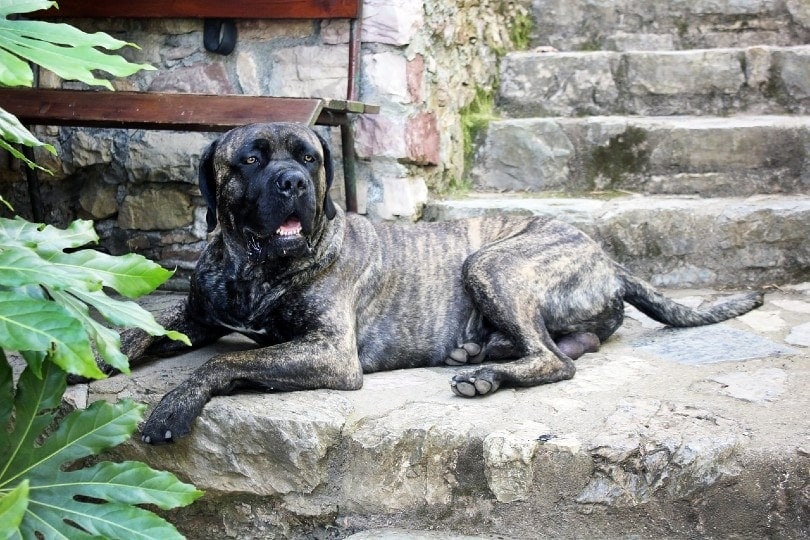
Considering their military roots, it would be natural to assume that they are no-nonsense dogs with an aggressive streak. As it turns out, this is not strictly true. Cani Corsi certainly are sought after for their protective instincts, and they can be fiercely loyal guard dogs. We can well imagine that there could be little more terrifying than being charged by 100 pounds of snarling, black muscle. But this is not all there is to them.
The truth is that with the correct socialization and training, they are generally mild and even-tempered dogs. They are known to be intelligent, affectionate, and incredibly loyal to their humans. Their unequivocal devotion can lead to a bit of unpredictability regarding their protective response. This might account for most folks choosing a sensibly more cautious approach with them.

Do They Make Good Family Pets?
Cani Corsi make wonderful family fur members in most cases. We say “most” because there are a couple of caveats.
Their assertive character, intelligence, and working dog background mean that they require stimulation. Simple obedience exercises, regular engagement, and appropriate socialization with other people and animals will usually suffice. Work with the Cani Corsi needs to be conducted with confidence and conviction. The Cane Corso would thrive with even higher-intensity and demanding work, such as agility or tracking exercises.
Neglecting these aspects of a Cane Corso’s care regime may result in erratic or inappropriate expressions of its protective instincts. This could manifest as seemingly unpredictable aggression, though will rarely be directed towards human family members. Rather, strangers perceived as a threat may become unwitting targets.
Their bold and wilful personality and size, make these devoted hounds not ideally suited to first-time dog owners. As with many gentle giants, Cani Corsi are often not aware of the impact that their size and strength can have. They are, therefore, not a great choice for homes with very small children unless there is permanent supervision. In homes with older children, they make wonderful, loving pets especially if you’re looking for a dog that will provide a protective function too.
Conclusion
From its ancient beginnings, the role of the Cane Corso in human society has certainly undergone a radical change. The once noble war dog retains its noble countenance as the guardian of our beloved families. The devotion that this imposing hound bestows upon its humans is equal to the love felt for them by their owners, as any Cane Corso fur parent will attest to.
Although they have begun to become popular only relatively recently, we feel sure that the Cane Corso will continue to ascend the popularity ranks in years to come.
Sources
Featured Image Credit: otsphoto, Shutterstock
Get Hepper In Your Inbox


Pet care tips from our vets and experts, straight to your inbox.
You may opt-out at any time. View our Privacy Policy for more information.

Eleanor is a high school Math and Science teacher and freelance writer. She lives in the lush KwaZulu Natal Midlands of South Africa with her six-year-old son, horse, cat and three chickens. As an animal devotee, science graduate and life-long learner, she is overjoyed to be able to turn her passions into helpful articles for pet parents. Eleanor and her son love to explore their beautiful country in their spare time. Road-tripping to interesting camping destinations is a favorite pastime. They particularly enjoy relaxing near the ocean, in the mountains or surrounded by African wildlife.
Eleanor is a high school Math and Science teacher and freelance writer. She lives in the lush KwaZulu Natal Midlands of South Africa with her six-year-old son, horse, cat and three chickens. As an all-time animal devotee, science graduate and life-long learner, she is overjoyed to be able to turn her passions into informative and helpful articles. Eleanor and her son love to explore their beautiful country in their spare time. Road-tripping to interesting camping destinations is a favorite pastime. They particularly enjoy relaxing near the ocean, in the mountains or surrounded by African wildlife.
Join the conversation
Ask a question, share your story, or send private feedback.