Hepper is reader-supported. When you buy via links on our site, we may earn an affiliate commission at no cost to you. Learn more.
What is Pigmentary Uveitis in Golden Retrievers? Eye Problems Explained (Vet Answer)

In this article
Pigmentary uveitis in Golden Retrievers is a more recently recognized disease that is believed to, in part, stemmed from genetic traits. The full extent of the genes involved has yet to be determined, which makes a full understanding of the condition difficult. However, good criteria exist for establishing a diagnosis, and early detection can be helpful.
Signs that your golden may be suffering from this complex, and potentially vision-stealing disease can include changes to the pigment or color of the eyes, changes to the size of the eye, changes to the shape or size of the pupil, and inflammation in tissues around the eye, amongst others.
Read on to learn more about what this disease is in golden retrievers, the causes, the signs, and how to care for your golden if they develop pigmentary uveitis.

What is Pigmentary Uveitis?
Pigmentary uveitis in goldens is a term for a disease that has only been detected in the last few decades. It was first reported in the northeastern US, but is now found worldwide, though it is most commonly reported in North America at present. Initial suspicion of a genetic component was strong, and further research seems to have withheld this proposition.
The condition itself is specific to the breed and is also called Golden Retriever Pigmentary Uveitis (GRPU), and in extreme cases, can lead to vision loss, and even require surgical intervention. In most dogs, the condition involves both eyes (i.e., it is bilateral and not unilateral). The condition stems from underlying inflammation, which seems to result in adhesion or scar formation between the iris or lens, and the inner surface of the eye.
Typically, adhesions such as these occur after trauma to the eye, but in GRPU, there appears to be no underlying cause that incites the development of the inflammation or adhesions. Secondary pigmentation occurs after these adhesions form, and as a result, cataracts and pathological increases in eye pressure can occur. Most affected dogs are middle-aged or older.
What Are the Causes of Pigmentary Uveitis?
Goldens are suspected to be affected, in part, due to a genetic mutation, though that has yet to be fully characterized. It does not appear to be linked to sex, and may skip generations, or affect one sibling but not others in the same litter. Because the genetics are not fully understood, and because it can take years for the disease to occur, it is difficult for breeders to understand how to best monitor for and remove the trait from breeding animals.
Some data suggest that cysts that develop from the iris (uveal cysts) may also be related to the future development of GRPU. However, this does not mean that all goldens with uveal cysts will develop the condition. And, it is not understood what causes uveal cysts in dogs—so while this research is ongoing, it does not help to better understand the condition of GRPU at present.
Similar diseases affect other dog breeds such as Great Danes, but are less well characterized and studied than GRPU.
Where Are the Signs of Golden Retriever Pigmentary Uveitis?
The signs of GRPU are generally fairly obvious, as most people can easily recognize changes to their dogs’ eyes. It becomes more difficult if the changes occur gradually. In instances where you have concerns that something may be abnormal with your pup and their eyes, one of the best approaches is to take regular photographs of both eyes up close, and from afar, to help monitor changes.
Signs of GRPU can include:
GRPU is a fairly complicated disease, and not one that is easy to confidently identify at home. In fact, many professionals find this a challenging disease to work with! Therefore, if you have any concerns about your dog’s eyes, always seek help from a veterinarian, who can better guide you about how to interpret what you are seeing. Generally, this will require an in-person examination of your dog; sometimes it will also require a referral to a specialist to definitively identify the condition.
How Do I Care for a Dog with Pigmentary Uveitis?
Caring for a dog with pigmentary uveitis is challenging, as no definitive treatment exists. Generally, treatment is instead aimed at controlling clinical signs, such as reducing inflammation and controlling pain, if it is present.
Inflammation is often controlled with oral medications or ophthalmic drops. Pain medication can similarly be an oral medication, or given directly to affected eyes via drops. There are pros and cons for each of these medications. If you find one form very challenging to give to your dog, ask your vet if there are any alternatives, as a replacement can often be found.
If you have a dog with pigmentary uveitis, it is extremely important to follow your veterinarian’s instructions for administering eye medications, including the number of drops to each eye, and the frequency. Skipping a set of drops can be extremely detrimental to keeping concerns under control. Top tip: if you are having to administer multiple eye drops, ensure you leave at least 5 minutes between the application of different medications, to allow each drop to work effectively!
Goldens with GRPU are generally managed at home. In instances where surgery is required, there may be short periods of hospitalization needed for monitoring their surgical recovery. As mentioned earlier, caring for your dog can also include regular photographic documentation of what is happening with their eyes. These photos can also be shared with your vet, which may lessen the frequency of visits needed for monitoring.
Dogs with GRPU can generally have normal activity levels and do not require exercise restriction, unless they are in the recovery phase from surgery, or if your vet specifically recommends restricting their activities. Dogs with GRPU also shouldn’t require special foods, as there are currently no known nutritional contributions to the condition. The condition is not known to be contagious to other dogs or cats in the house, so isolating affected dogs should not be needed.
Frequently Asked Questions (FAQs)
Is pigmentary uveitis painful?
The condition can be quite painful, generally due to the development of secondary issues, such as adhesions (scar tissue that forms between the inner and outer structures of the eye) or glaucoma (abnormally high eye pressure). If you do think your dog is in pain or uncomfortable as a result of this condition, speak with your vet about an appropriate pain management protocol to help keep them as comfortable as possible. As mentioned previously, this may include eye drops or even oral pain medications.
Is pigmentary uveitis in goldens curable?
Until the underlying causes, including the specific genetic mutations that cause the issue, can be identified, it is unlikely that prevention or cure will be possible. At present, treatment involves addressing the clinical issues, which, in extreme circumstances, may necessitate surgery to remove eyes that are no longer visual, or that have progressed beyond conventional treatment options.
Can pigmentary uveitis cause blindness?
Yes, in extreme or advanced cases, pigmentary uveitis can lead to permanent blindness. This tends to be in the advanced stages of the disease and can take long periods of time to reach that point.

Conclusion
Golden retrievers are prone to a unique disease of the eyes known as Golden Retriever Pigmentary Uveitis (GRPU for short). Though it is currently not known what specifically causes the development of GRPU, a strong suspicion that genetics play a role is a common belief. Over time, it is hoped that the condition will become better understood. At present, treatment involves addressing the clinical signs of the disease, such as pain, inflammation, and the development of increased eye pressure, if they occur. Extreme cases may require surgical intervention.
Sources
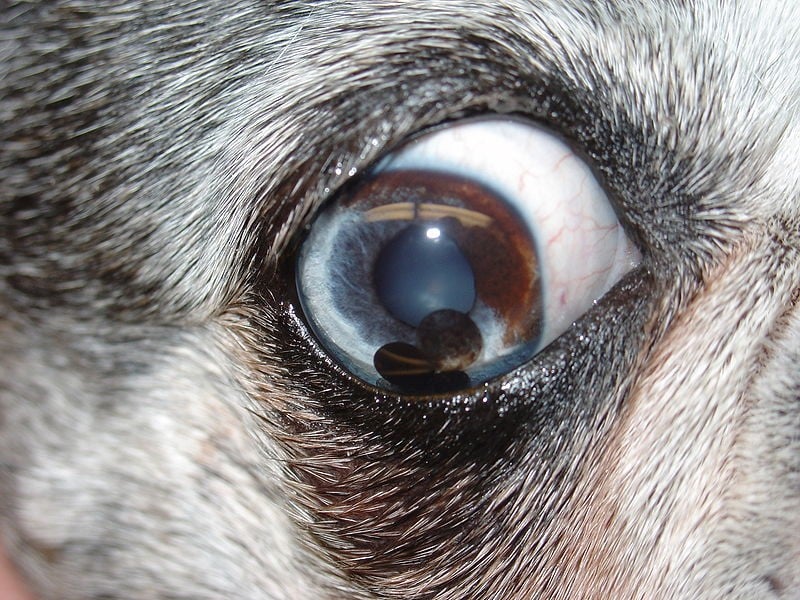
Featured Image Credit By: Iris cyst, Joel Mills, Wikimedia Commons, CC BY 3.0 Unported
Get Hepper In Your Inbox


Pet care tips from our vets and experts, straight to your inbox.
You may opt-out at any time. View our Privacy Policy for more information.
As a veterinarian, Lauren is happy to share her experience in emergency medicine and cats, with everyone. She enjoys sharing insightful, real life tips for having cats as part of your life, and what to do in critical situations with your pets.
Lauren is a vet with over a decade of experience in cats and dogs, along with infectious diseases. She loves teaching, and lectures for students, owners, and clinicians, on various topics.
Lauren received her degrees from Murdoch University, in Perth.
Join the conversation
Ask a question, share your story, or send private feedback.