Hepper is reader-supported. When you buy via links on our site, we may earn an affiliate commission at no cost to you. Learn more.
11 Shocking Australian Animal Shelter Statistics & Facts: Updated in 2026
In this article
Pet shelters provide an invaluable and important service by taking in stray, homeless, and abandoned animals. In some cases, they also help try to tackle the overpopulation problem that leads to abandonment. While they do an excellent and often thankless job, it is devastating they have to exist at all.
Australia is home to some 30 million pets. While fish are the most common, in terms of population, dogs and cats are the most widely kept. But, despite the nation’s love of pets, hundreds of thousands of stray and abandoned animals are taken in by shelters and rescues across the country, every year. With nearly 400 shelters and rescue centres across the country, it is obvious there is a huge overpopulation problem in Australia, as there is in virtually every country around the world.
It can be difficult to find reliable, up-to-date facts because there is no register of shelters and animal rescue centres, and many shelters do not publish annual records, but, below, we have gathered 11 statistics relating to pet shelters and the animals that they help.

The 11 Australia Pet Shelter Statistics
69% of Australian households have pets.
There are 6.3 million pet dogs and 5.3 million pet cats in Australia.
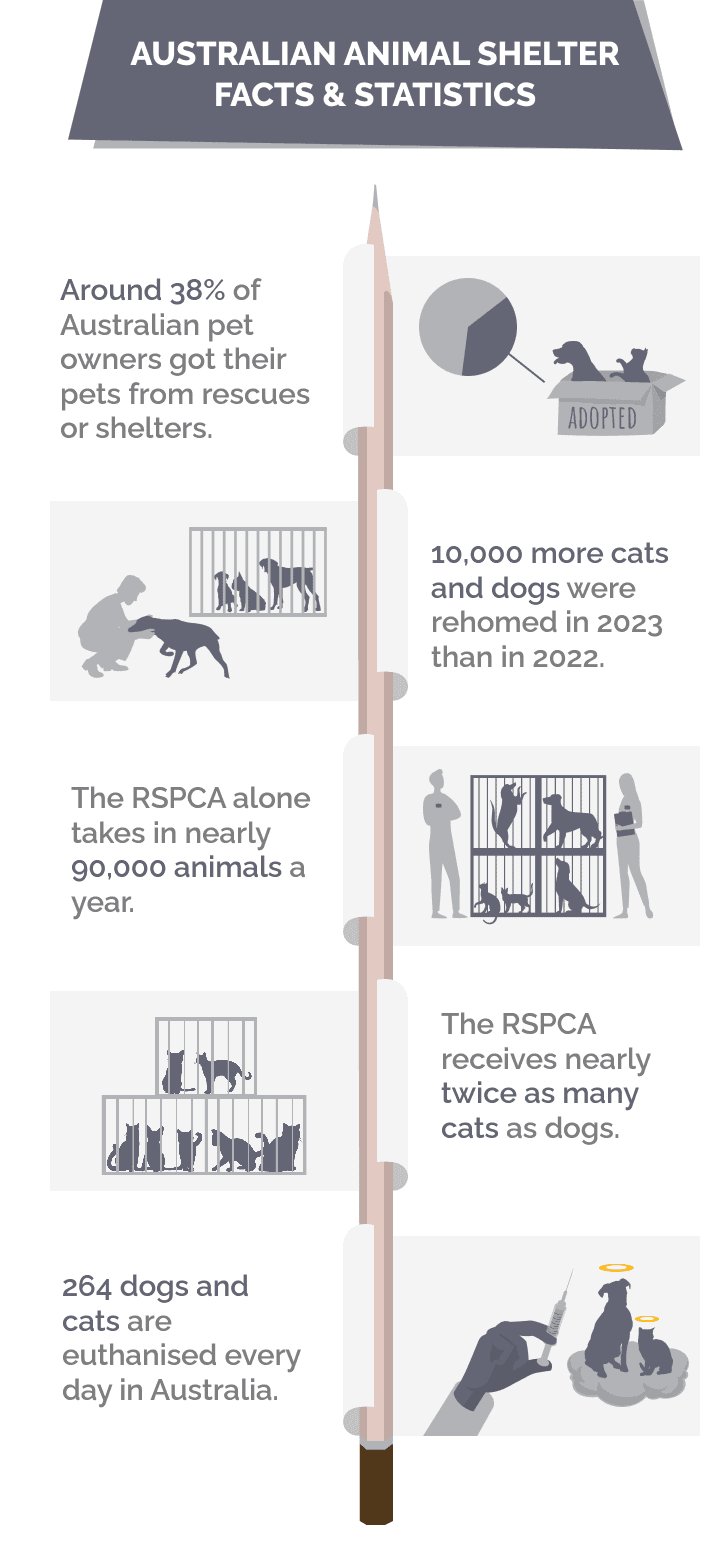
Around 38% of Australian pet owners got their pets from rescues or shelters.
10,000 more cats and dogs were rehomed in 2023 than in 2022.
On average, it takes 21 days for a dog to be adopted and 14 days for a cat.
The RSPCA alone takes in nearly 90,000 animals a year.
The RSPCA receives nearly twice as many cats as dogs.
264 dogs and cats are euthanised every day in Australia.
There are nearly 400 animal shelters in the country.
Approximately $250 million a year is spent trying to tackle the unwanted pet problem.
Victoria had the highest number of pet adoptions of any region.

Pet Ownership
1. 69% of Australian households have pets.
(Pet Memorial Australia)
Australia is a nation of animal lovers with more than two-thirds (69%) of all households in the country keeping pets of some sort.
This figure includes households that keep multiple pets, as well as those that have one, and it includes keepers of all types of pets including cats and dogs, which are the species found in most homes, as well as fish, which is the pet with the highest total population number.

2. There are 6.3 million pet dogs and 5.3 million pet cats in Australia.
(Pet Memorial Australia)
Dogs and cats are the most commonly kept pets, in terms of the number of households they are found in. In total, there are 6.3 million pet dogs, found in 4.8 million, or just under half of all homes. Only around one-fifth of dog owners keep more than one dog, with more than three-quarters of owners having a single dog.
There are 5.3 million pet cats kept in 3.3 million homes and the average cat owner has 1.6 cats. However, it is fish that are the most populous pet species, with an estimated total of 11.2 million fish kept in or outside homes across Australia. This population is kept in 1.2 million households.
3. Around 38% of Australian pet owners got their pets from rescues or shelters.
(Statista)
In total and including all animal types, there are approximately 30 million pets in Australia. When it comes to where those pets came from, 43.9% said they got their pets from breeders, making this the single largest source of animals. However, when shelters and adoption agencies are combined, this accounts for 38% of the pet population.
Other owners said they received their pets as gifts. The figure doesn’t differentiate between breeders and people selling or giving away their pets on social media or online marketplaces, which have been increasingly commonplace.
Pets In Shelters
4. 10,000 more cats and dogs were rehomed in 2023 than in 2022.
(Pet Rescue)
The main aim of shelters is to either return lost pets to their original owners or find them new homes, but the number of animals that find their way into shelters vastly outweighs the number of pets that are rehomed.
In 2023, though, there was an increase in the number of pets that were adopted or rehomed. 62,653 pets were adopted during the year, which is 10,000 more than the 52,593 that were adopted in 2022.
5. On average, it takes 21 days for a dog to be adopted and 14 days for a cat.
(Pet Rescue)
The longer a pet remains in the shelter, the harder it can become to rehome them because they become institutionalised. Any species of animal can become anxious when kept in shelters, which are typically overcrowded, loud, and somewhat imposing locations.

6. The RSPCA alone takes in nearly 90,000 animals a year.
(RSPCA)
The RSPCA is the country’s largest animal charity. It is an independent charity that is represented in every territory of Australia. As well as rehoming pets, it also attempts to deal with animal welfare issues and educate potential owners. The group also deals with animal welfare cases, investigating reports of abuse and mistreatment, and potentially helping to prosecute perpetrators.
As the largest charity of its kind in the country, the RSPCA alone takes in around 90,000 animals a year in its centres across Australia.
7. The RSPCA receives nearly twice as many cats as dogs.
(RSPCA)
The RSPCA does release annual reports from its member centres, including information on the number of animals they take in and the outcome for these animals. The group reports that during the 2022/23 year, they took in 18,778 dogs but 33,747 cats. Of the approximately 19,000 dogs, more than 4,500 were reunited with their owners, more than 7,500 were rehomed, and more than 1,500 were still in the group’s care when the figures were reported.
When it comes to cats, a much smaller percentage are reunited with their owners. Of the 33,000 cats taken in, just 1,500 were reclaimed and nearly 22,000 were rehomed.
8. 264 dogs and cats are euthanised every day in Australia.
(NALZO)
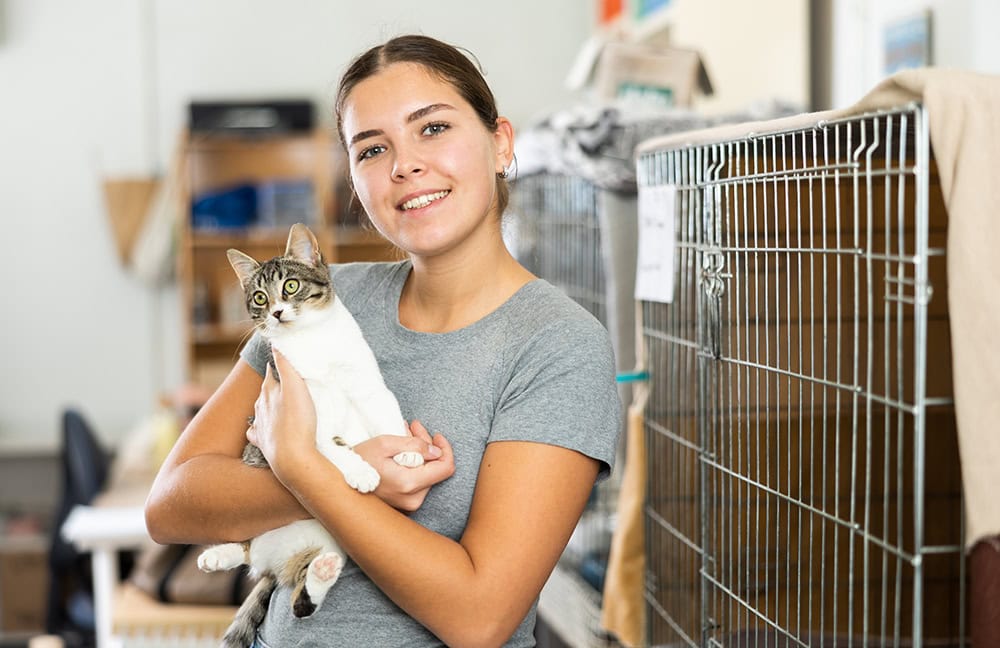
Unfortunately, the large gap between the number of pets that are relinquished to charities and the number that are adopted means that large populations of animals are euthanised.
Although many adoption centres have taken steps to try and reduce the number of animals euthanized, there are still an estimated 264 dogs and cats put to sleep every single day because there aren’t enough homes or owners for them.
Shelter Statistics
9. There are nearly 400 animal shelters in the country.
(Smartscrapers)
Including the RSPCA as well as other national groups and local adoption centres, there are approximately 400 animal shelters across the country. Some of these shelters specialise in certain types of animals, while others will take any animal they can handle.
There are also likely to be many shelters and rescues that are unaccounted for or that do not publish numbers, so the figure could be much higher than this.
10. Approximately $250 million a year is spent trying to tackle the unwanted pet problem.
(Pet Welfare)
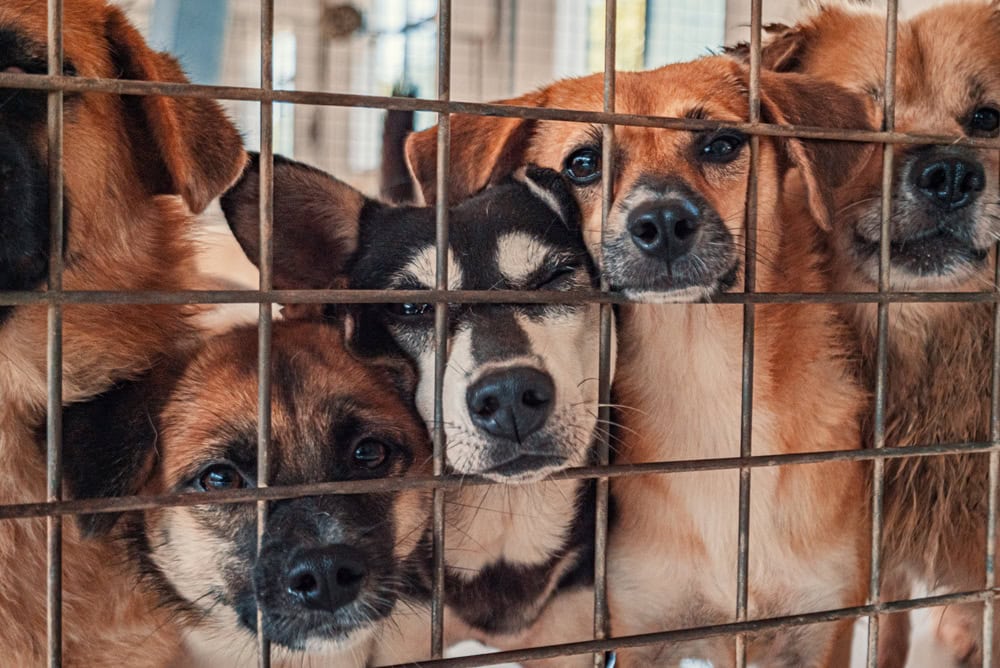
The unwanted pet population is a problem that is difficult to tackle. As well as stray and feral pets that continue to reproduce, events like pandemics and cost-of-living crises mean that the number of animals relinquished by owners is high.
Campaigns to try and increase neutering and spaying rates, as well as microchipping, and greater education, can help to reduce the population of unwanted pets, but these campaigns all cost money. Currently, around a quarter of a billion dollars a year is spent to reduce unwanted pet numbers.
11. Victoria had the highest number of pet adoptions of any region.
(Pet Rescue)
New South Wales has the largest population of humans in Australia, but it is Victoria where potential owners are most likely to adopt pets rather than buy them or get them through other means.
Victoria had the highest number of pet adoptions of any territory in 2022 with 24,625 pets adopted. Queensland saw 14,079 adoptions while 13,993 pets were adopted in New South Wales.
Frequently Asked Questions (FAQ)
Why do animals end up in shelters?
There are lots of reasons why animals end up in shelters. Some are born on the streets as ferals, while others are lost or abandoned by their owners. Reasons for relinquishing pets include a change in personal circumstances that means owners no longer have the time to care for their pets.
The cost-of-living crisis has seen prices rise while wages have not risen in line, which means that some owners don’t have the money to keep their pets any longer. Unwanted litters of puppies and kittens is another possible cause for animals ending up in shelters.
What can be done to reduce unwanted pet numbers?
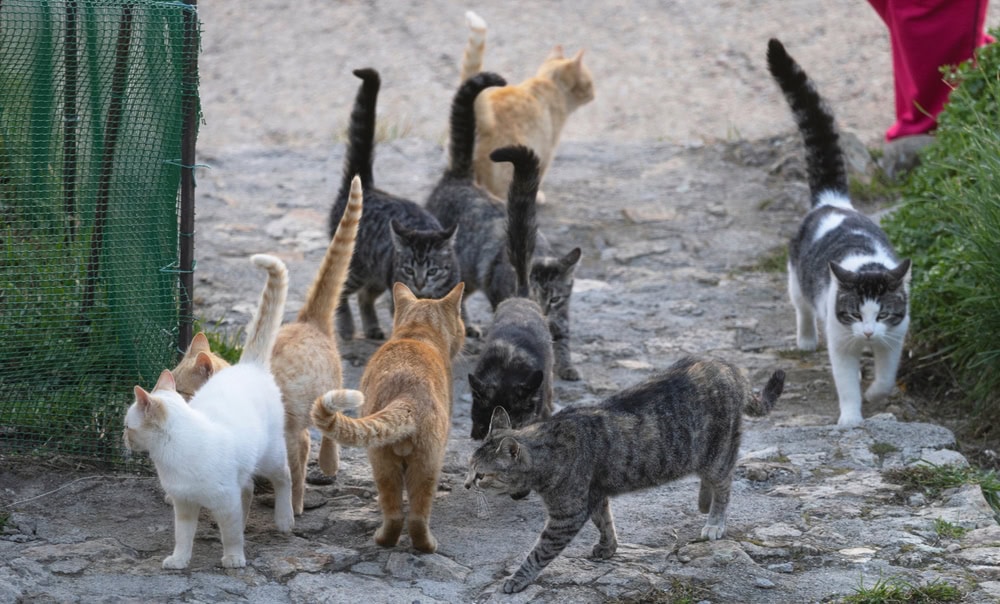
Pets can be neutered or spayed, which will help reduce the number of pets that are born every year. This not only helps reduce the number of unwanted animals, but it also means more potential owners will look to adopt rather than buy.
Microchipping increases the likelihood of pets being returned to their original owners when they are lost, too.
Do shelters take animals other than dogs and cats?
Although some shelters and rescue centres specialise in dogs, cats, or other types of animals, there are rescue centres that take all animals as well as those for birds, fish, or exotic pets. If you can give an animal of any type a loving home, there is likely to be a rescue centre that has the type of pet you’re looking for.

Conclusion
The vast majority of pets lead happy and healthy lives in their homes, staying with a single family or owner for the whole of their lives. However, this isn’t the case for all pets, and many find themselves in shelters through no fault of their own.
While many pets currently in Australian homes were adopted, rather than bought from breeders, there is still a huge overpopulation problem with hundreds of thousands of pets being relinquished or lost every year.
See Also:
Get Hepper In Your Inbox


Pet care tips from our vets and experts, straight to your inbox.
You may opt-out at any time. View our Privacy Policy for more information.

Visnja is a content writer that covers various topics such as DIY, pets, home improvement, travel, gardening, and more.
She is a young mom and a college student, who didn’t have enough time to balance her personal and work life, so after multiple years of working a regular 9 to 5 job, she decided to pursue her passion and make a living out of it. She has been writing for a couple of years, helping people find valuable and interesting information online.
Join the conversation
Ask a question, share your story, or send private feedback.