Hepper is reader-supported. When you buy via links on our site, we may earn an affiliate commission at no cost to you. Learn more.
Can Cats Eat Nectarines? Vet Reviewed Nutrition Facts & FAQ
Arguably the best part of summer is all the delicious fruit that ripens to juicy perfection in the hot months. Our homes have fruit bowls busting full of stone fruit for snacking—nectarines being one of these popular sweet summer treats.
Sure, you can share these fruits with your human friends, but what about your feline pals? Can cats eat nectarines?
Yes, cats can eat nectarines. However, they should only eat the fleshy part of the fruit and never the stone, leaves, or stems as these contain cyanide1 which is toxic to cats in concentrated doses. If any fruit is given to cats, it should always be given in small amounts and infrequently as a treat as it does not align with their natural diet.
Feeding nectarine to your cat will usually be fine, but there are a few key considerations to ensure your cat’s health and safety. Keep reading to learn more!

Are Nectarines Safe for Cats to Eat?
Unlike canine, cats don’t tend to be drawn to sweeter human foods, such as fruit. The reason behind this is that cats cannot taste or recognize sweetness.
So, if you offer your cat nectarines, you may be met with indifference. Alternatively, some cats just like to try the foods they see us eating or are simply curious, so they may accept a taste of nectarine.
There is little to be concerned about cats indulging in some nectarines, as nectarines are mostly safe for them to eat. The fleshy part of the fruit is completely safe for cats to consume, while the skin is safe if it is cut into small pieces. The leathery skin can be a choking hazard if offered in inappropriate sizes.
However, the pit, leaves, and stems of nectarines are not safe for cats. All these parts of the fruit contain cyanide, and all are choking hazards. The cyanide is unlikely to cause a severe issue unless consumed in large amounts, so if your cat ingests a small amount, don’t panic!
There are a handful of other fruits that also have cyanogenic glucosides in their seeds or pits, such as:
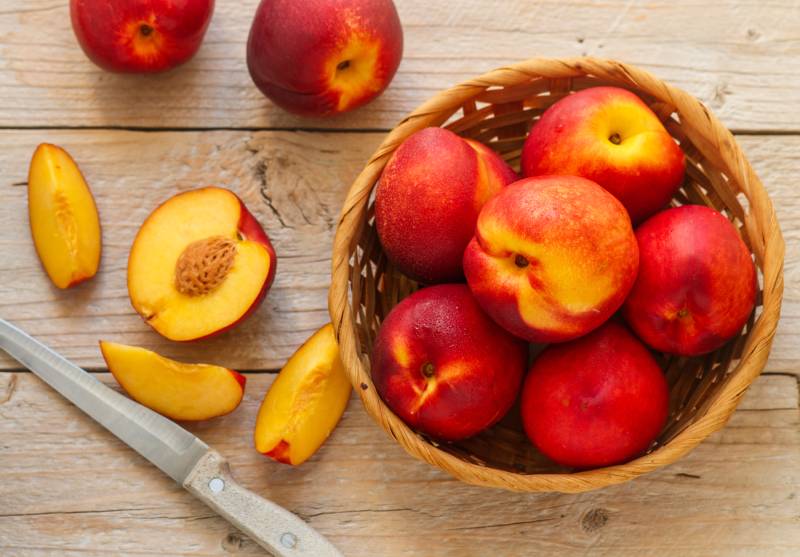
Some of these stone fruits, including nectarines, come in two different varieties: free-stone and cling-stone. Free-stone means that the large pit is not connected to the fruit’s flesh and can be removed easily by cutting open the fruit. Cling-stone varieties have the same pit, but it is attached to the flesh inside the fruit, making it hard to remove all traces of the pit.
Free-stone varieties are the best choice in nectarines if you are going to be offering some to your cat as there will be no residual seed compounds on the flesh, which may be harmful.
Can Cats Be Allergic to Nectarines?
We could not find any instances of cats being allergic to nectarines. But we also could not find evidence that there is no risk of allergic reaction.
It’s better to introduce new foods to your cat with caution, as while fruits may not be a prevalent allergen for cats, they cannot be ruled out. Additionally, cats may have digestive intolerances to fruits such as nectarines and experience discomfort in eating them.
When you feed your cat nectarine for the first time, you should only feed a tiny amount and then monitor your cat closely for any adverse signs.
Health Benefits of Nectarines
Cats are entirely obligate carnivores, so they do not need any plant matter, such as fruit, in their diet. They can live solely on a meat diet and synthesize all the essential amino acids they require from animal matter.
If nectarines are given as a treat, the cat will benefit from them. But since they should only receive fruit in minimal amounts, these benefits will likely make any noticeable difference to your cat’s health.
Nectarines are high in vitamins, particularly vitamin A and C. Vitamin C is not required in a cat’s diet as they can synthesize this particular vitamin in their liver. Vitamin C is well known for boosting the immune system and helping to absorb iron in the body, so that additional vitamin C may be of some benefit to your cat.
Nectarines also contain a lot of fiber and water. Fiber will help support a healthy digestive system, and additional water will help keep your cats hydrated.
As mentioned, nectarines should only be fed to cats as a rare treat. Like many other fruits, nectarines are high in sugars, mainly sucrose and fructose, which cats do not need. Excess sugar can contribute to obesity and diabetes. Additionally, excess fruit can reduce the consumption of the appropriate diet for your cat, and they may suffer from malnutrition.
Now that you know what you can safely feed your cat, it’s just as important to find a bowl that supports their health and well-being. With whisker-friendly bowls and a wide tray to catch any spills, our Hepper NomNom Cat Bowl is our favorite option.

- NO MESS - The 360° tray on this cat food and water bowl set has a raised design to catch and contain stray crumbs and drips. Protect your indoors and floors from wet and messy meals!
- WHISKER FRIENDLY - Shallow and wide metal containers with flat bottoms ensure your kitty can enjoy mealtime free from whisker fatigue!
- CHEW-SAFE MATERIALS - Kittens and cats love chewing on silicone and soft rubber - but it's a choking hazard. Our cat feeding station materials are anti-chew for a 100% safe feeding frenzy!
Final Thoughts
As tempting as it may be to share your human foods with your cat, you should limit the amount of “people food” you offer them. Fruit such as nectarines will not harm your cat if given to them in small amounts, if given infrequently, and if prepared safely.
Nectarines may offer a slight health boost when given as a rare treat, and they may also provide fun and enrichment to your curious kitty!
Related Reads:
Featured Image Credit: ExplorerBob, Pixabay
Get Hepper In Your Inbox


Pet care tips from our vets and experts, straight to your inbox.
You may opt-out at any time. View our Privacy Policy for more information.

After an early start in the veterinary industry and as a conservation educator at Disney’s Animal Kingdom in Florida, Sophie has since been a successful Zookeeper and Conservationist, specializing in native New Zealand species. When she’s not bird watching in native forests or crawling through the underbrush at midnight searching for rare frog species, she can be found with her farmer husband on their sheep and beef station, far from civilization. Alongside them, they have 2 cats, 9 chickens, and 11 dogs (most notably, her sidekick, a black Labrador aptly named Jellybean). Sophie enjoys her writing career as it provides opportunities to help and support pet owners of all kinds to give animals the best welfare possible. The only downside is the long list of strange searches in her internet history!
Join the conversation
Ask a question, share your story, or send private feedback.