Hepper blog

Search our database of over 9,984 posts with up-to-date information from our experts and veterinarians.

Hepper is reader-supported. When you buy via links on our site, we may earn an affiliate commission at no cost to you. Learn more.

Can Dogs Eat Sunflower Oil? Vet Reviewed Facts & FAQ

By Chris Dinesen Rogers · Reviewed & fact-checked by Dr. Lauren DemosVet Approved
Dr. Lauren Demos
Reviewed & Fact-Checked byDr. Lauren DemosVeterinarian
As a veterinarian, Lauren is happy to share her experience in emergency medicine and cats, with everyone. She enjoys sharing insightful, real life tips for having cats as part of your life, and what to do in critical situations with your pets.View authorThe information is current and up-to-date in accordance with the latest veterinarian research. Read about our vets
Share
Ask us a question in the comments
Can Dogs Eat Sunflower Oil

Perhaps you’ve read about the purported health benefits of sunflower oil. They stem from its high content of monounsaturated and polyunsaturated fatty acids, which may lower cholesterol and, thus, reduce your risk of heart disease1. You would probably want the same thing for your canine companion as a pet owner.

However, while sunflower oil isn’t toxic to dogs, it’s best to limit how much you give your pet. The reason rests with its fat content and the impact it can have on your pup’s health2.

The Nutritional Value of Sunflower Oil

Fats are a vital part of your pet’s diet. They provide an excellent energy source, with roughly 2.25 times the yield of carbohydrates and protein. They also serve as a means to store fat-soluble nutrients, such as vitamins A and D. Sunflower oil does not contain many nutrients other than small amounts of vitamins E and K. However, it does have fat—about 13.6 grams per tablespoon.

The latter accounts for its high-calorie count of 120 calories in the same serving size. Notably, all fat, including butter, has a similar amount. Even though humans and dogs share 84% of our DNA, that doesn’t mean we have the same dietary requirements. Sunflower oil contains omega-6 fatty acids, including one called linoleic acid.

The recommended allowance is 2.8–16.3 grams of linoleic acid for canines per day. This nutrient is essential for good skin and reproductive health. It also forms part of the cellular structure and membranes. Sunflower oil contains between 44–75% linoleic acid, or about 5.98–10.2 grams per tablespoon. These figures are well within the recommended allowance.
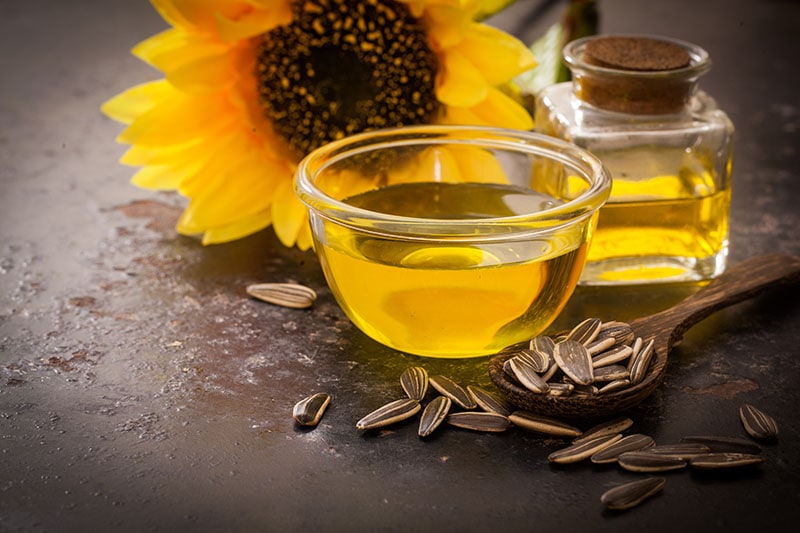
Sunflower oil in bottle glass with seed
Image Credit: naito29, Shutterstock

Sunflower Oil and Obesity

We also have to address the elephant in the room when it comes to discussing the dietary value of sunflower oil. It’s at the crux of our answer regarding safe consumption. While this fat is not toxic, it is still fat that packs a significant calorie punch. That’s particularly true when you put it in context with a dog’s recommended caloric intake.

For example, a 50-pound pup should get between 700–900 calories per day. A 1-tablespoon serving of linoleic acid would make up 13.3–17% of your pet’s total recommended calorie intake. It’s even greater with smaller pets. Remember that other than the fat, sunflower oil is not providing a lot of nutritional value. That’s why your pup’s dog food should provide the bulk of its caloric intake as a complete and balanced source.

Even humans should limit their intake of omega-6 fatty acids to no more than 5–10% of their caloric intake. Therefore, it’s easy to see why you should limit how much your pet gets outside of its regular diet. Their food has them nutritionally covered for omega-6 fatty acids. If your dog has allergies or a skin condition, your vet may recommend a supplement. However, sunflower oil isn’t a necessary addition.

a fat dog lying on grass
Image Credit: danbar44, Pixabay

Final Thoughts

Many dog owners consider their pets more than mere companions. It’s understandable why some may want to share their foods with them. Nevertheless, it’s best for your pup’s health to stick with its regular diet. The harm of offering your pooch sunflower oil isn’t its toxicity. Instead, it rests with the added calories that could lead to obesity and its associated health risks.

Sources

Get Hepper In Your Inbox

Pet care tips from our vets and experts, straight to your inbox.

List

Select all that apply.

You may opt-out at any time. View our Privacy Policy for more information.

Chris Dinesen Rogers
Authored by

Chris Dinesen Rogers

Join the conversation

Ask a question, share your story, or send private feedback.

Rate this post
Required to post. Only our editors see your rating.
Who should see this?

A human reviews every comment before it appears. Your email is never published.

Picked to go with this article

Can Dogs Eat Vegetable Oil? Vet Approved Facts & FAQ

Can Dogs Eat Vegetable Oil? Vet Approved Facts & FAQ

Have you ever wondered if you can share some vegetable oil with your furry friend? We humans use an incredible amount of vegetable oil each year—worldwide vege…

Nicole Cosgrove
By Nicole Cosgrove ·
Can Dogs Eat Sunflower Seeds? What You Need To Know!

Can Dogs Eat Sunflower Seeds? What You Need To Know!

Sunflower seeds are an excellent source of iron, vitamin E, and copper for humans, but can dogs eat them too? The short answer is, yes, dogs can eat sunflower…

Nicole Cosgrove
By Nicole Cosgrove ·
Can Dogs Eat Sunflower Butter? Vet-Approved Health Review

Can Dogs Eat Sunflower Butter? Vet-Approved Health Review

Our dogs want to eat several human foods, but that doesn’t always mean that they should eat them. However, if your dog has been begging for a bite of sunflower…

Jordyn Alger
By Jordyn Alger ·
Can Dogs Have Olive Oil? Vet-Reviewed Nutrition Facts & Safety Guide

Can Dogs Have Olive Oil? Vet-Reviewed Nutrition Facts & Safety Guide

If your dog suffers from itchy, dry skin, you may have heard that adding oil to their food can help. Due to its popularity for cooking, many of us already have…

Elizabeth Gray
By Elizabeth Gray ·

Keep reading

More stories you might like

Is Coconut Oil Safe for Dogs? Our Vet Explains

We live in an age of an almost infinite number of products, treatments, supplements, and remedies, and with the voices of influencers often drowning out those…

Dr. Karyn Kanowski
By Dr. Karyn Kanowski ·
Is Coconut Oil Safe for Dogs? Our Vet Explains

Can Dogs Eat Canola Oil? Vet-Verified Facts & FAQ

Canola oil is a controversial ingredient in dog food. Many assert that it is a safe, healthy oil, while others insist it should be avoided altogether. While ca…

Jordyn Alger
By Jordyn Alger ·
Can Dogs Eat Canola Oil? Vet-Verified Facts & FAQ

5 Foods High in Vitamin E For Dogs: Vet-Approved Options

The right dose of vitamin E will boost and supplement your dog’s immune system and promote healthy muscles, heart, liver, skin, and coat. Vitamin E is also a p…

Cheryl Regan
By Cheryl Regan ·
5 Foods High in Vitamin E For Dogs: Vet-Approved Options

Hemp Oil for Dogs: Vet Reviewed Facts, Pros & Cons

Disclaimer: The information about these products has been fact-checked by one of our licensed veterinarians, but the purpose of this post is not to diagnose il…

Jessica Kim
By Jessica Kim ·
Hemp Oil for Dogs: Vet Reviewed Facts, Pros & Cons

Can Dogs Eat Sesame Oil? Vet-Approved Health Facts

Sesame oil is a staple in many Asian dishes and is considered one of the earliest plant oils cultivated by people. It has a distinct flavor profile that makes…

Brooke Billingsley
By Brooke Billingsley ·
Can Dogs Eat Sesame Oil? Vet-Approved Health Facts

What Is Crude Fat in Dog Food? Is It Needed?

Deciphering the crazy world of dog food is tricky enough without complicated and strange terms being thrown at you. When words like “crude fat” are suddenly ad…

Oliver Jones
By Oliver Jones ·
What Is Crude Fat in Dog Food? Is It Needed?

Benefits of Coconut Oil for Dogs: Vet Explains the Uses, Risks, & FAQ

With millions of products, opinions, choices, and misinformation out there, it has become increasingly difficult to decide what is right for you and your dog.…

Dr. Karyn Kanowski
By Dr. Karyn Kanowski ·
Benefits of Coconut Oil for Dogs: Vet Explains the Uses, Risks, & FAQ

Can My Dog Eat Hemp Seeds? Vet Approved Facts & FAQ

It is impossible to intuitively know everything that our dogs can and cannot eat, which is why so many of us spend time scrolling through articles to try and f…

Jordyn Alger
By Jordyn Alger ·
Can My Dog Eat Hemp Seeds? Vet Approved Facts & FAQ