Hepper is reader-supported. When you buy via links on our site, we may earn an affiliate commission at no cost to you. Learn more.
Can Dogs See Color? Vet-Reviewed Canine Eye Perception Facts



In this article
Some people have heard the myth that dogs see the world in black and white. While it's true that dogs don't see the same spectrum of color as humans, it's not untrue that they're incapable of perceiving all color. Total color blindness—seeing the world in only shades of gray—is an exceptionally rare trait.
Dogs have dichromatic vision, meaning they can see a spectrum of two colors. When compared to a human's trichromatic vision—a spectrum of three colors—the world's vibrance may pale, but dogs can see the world in shades of blue and yellow.

What Is Color Blindness?
Color blindness is an inability to perceive specific colors. In less severe cases, a person may only have difficulty discerning different shades of a color. However, in extreme cases, a color-blind person may see the affected colors as a muted brown because they are entirely unable to perceive the color.
Color blindness is caused by a defect in or a lack of the cone and rod cells in the eyes. The cones present in the eyes of a being with typical trichromatic vision, like us humans, enable them to perceive red, green, and blue.
In dogs' cases, they only have cones and rods to perceive blues and yellows; they are completely incapable of perceiving shades of red and green. This is referred to as dichromatic (two-color) vision.
There are two main kinds of color blindness present in humans. Red-green color blindness affects the ability to see and differentiate shades of red and green. Blue-yellow color blindness affects the blue and yellow channels of color. Total color blindness (achromatopsia) is rare in humans, affecting around one in 30,000 people.

Are Dogs Color Blind?
In the loosest sense, yes, dogs are color blind. For example, blue-yellow dichromatic vision is most similar to a human with red-green color blindness. However, it's hard to say that dogs are truly "color blind" because the term "color blindness" would require a deviation from the norm, and dichromatic vision is the norm for dogs.
What Does the World Look Like to Dogs?
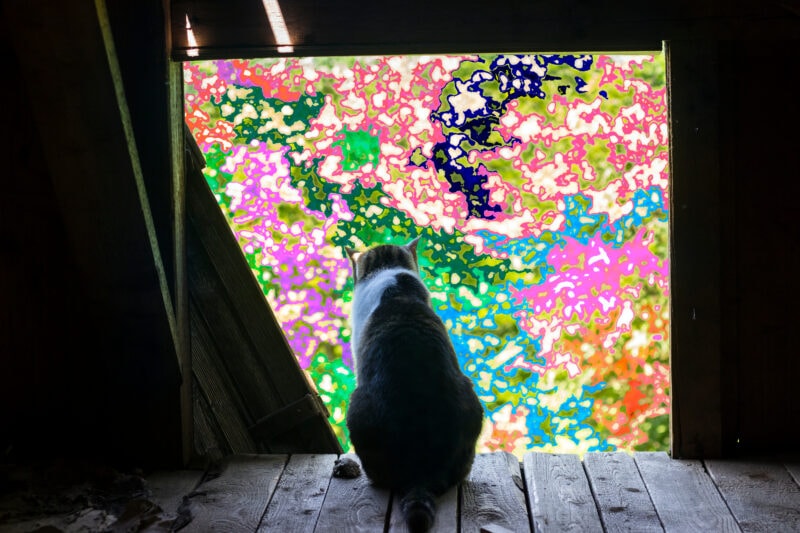
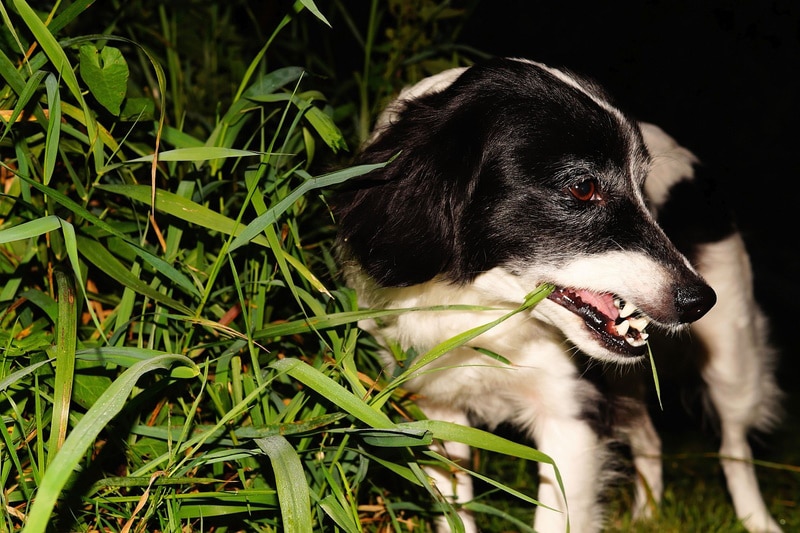
The world looks very different from the perspective of a dog. We see a vibrant green when we look at the grass, but dogs see a washed-out yellow. When we look at many grapes, we see a deep purple, but dogs can only see them as blue.
Additionally, dogs are shown to have only a fraction of the visual acuity of humans, meaning they can't see sharp images. When we look at a shape, we see a defined and sharp image, but dogs see a fuzzy, more amorphous form.
This doesn't mean that dogs are impaired, though. Dogs make up for what sight abilities they lack by having strength in their other senses. While dogs may not be able to see the same depth of color as humans, they can "see" much more of the world than humans do by utilizing their other senses.

How Do Dogs Use Their Senses to Navigate the World?
Dogs don't rely on their sight to navigate the world as strongly as humans do. Instead, a dog's most prominent sense is their sense of smell. A dog's nose is a force to be reckoned with, and even an untrained dog can use their sense of smell in ways humans would never be capable of.
Bloodhounds have 300 million scent receptors, making their sense of smell far more sensitive than a human's.
Dogs have such an acute sense of smell that they can smell changes in the ozone layer and sense an approaching storm. In addition to smelling changes in the ozone layer, dogs can smell changes in barometric pressure and electromagnetic fields. This acute sense of smell has led plenty of dog owners to feel that their dog has a "sixth sense" for changes in the weather. But there's nothing supernatural at play; your dog's sense of smell is just so powerful that it can smell the weather.
Dogs can also smell chemical changes in their owners' bodies. Many people find that their dog knows when they're not feeling well and will come to comfort them. It's because their dogs can smell the physical changes to their bodies when they're sick. Dogs may even be able to smell minute changes in hormones, enabling them to identify when you're feeling happy or sad by how you smell.

Dogs also have a remarkably reliable internal clock. As a result, they can learn your schedule quickly and adjust their behavior to match yours. So, for example, when your dog is waiting by the door to greet you, that's because they know it is time for you to come home.
However, your schedule isn't the most important part of your dog greeting you at the door. Your dog can smell you from hundreds of feet away. Your dog can smell you getting closer and knows that you're on your way home for playtime and snuggles.
Your dog's sense of smell isn't the only tool at their disposal. Dogs also have an incredible sense of hearing that enables them to listen to sounds as far as 1 mile away. This does make dogs more sensitive to loud sounds than humans; we can thank their supersonic hearing for their fear of fireworks. Still, this acute sense of hearing is what enables dogs to detect changes in their environment and react to danger accordingly.
Dogs aren't just able to hear softer or further away sounds. They can also more accurately determine how far away and what direction a sound is coming from. Dogs have over a dozen muscles that allow them to independently move and reposition their ears to help them determine where sounds are coming from.
Some scientists posit that determining the source of a sound may be the root cause of a dog's head-tilting behavior. As they move their heads, they change how the sounds they hear hit their eardrums and can better determine the source of the sounds.


Final Thoughts
Dogs can't see the same spectrum of color that humans do; however, they don't need to when you really look at how they interact with the world. Their sight may be fuzzy and less vibrant, but it doesn't hurt them because they can hear and smell for miles!
See also:
Get Hepper In Your Inbox


Pet care tips from our vets and experts, straight to your inbox.
You may opt-out at any time. View our Privacy Policy for more information.
Luxifa is a freelance writer with a passion for animal science and technology. She loves to share the world of animal science with people to help them make informed decisions for themselves and their pets. Luxifa has worked in professional pet care for over six years and realised she could help change the world of pet care by bringing the information people needed to them in terms they could understand. Knowledge is power and she loves to help everyone become the most informed they can be.
Join the conversation
Ask a question, share your story, or send private feedback.