Hepper is reader-supported. When you buy via links on our site, we may earn an affiliate commission at no cost to you. Learn more.
Can Parakeets See in the Dark? Interesting Bird Facts
In this article
How well an animal can see in the dark is dependent on the ratio of cones and rods they have. The latter is essential for vision in low-light conditions. For example, cats are superior to humans in this regard and can detect objects in one-sixth of the light we need. One of the main differences between felines and people is our lifestyle. We are active during the day and are diurnal, as are parakeets.
Being able to navigate your world is imperative to survival. Parakeets live in the grasslands, savannas, and forests of their native Australia. Their days begin with singing before dawn breaks. The rest of the day, they feed. Flocks reunite before sunset when they roost until the cycle begins the next day with sunrise. Their inactivity at night negates the need for seeing in the dark.

The Advantages of Night Vision and Camouflage
The main benefit of night vision is taking advantage of the cover of the night. Predators use it to stalk their prey stealthily and improve their chances of hunting success. The black-footed cat is one of the most successful, yet only gets its prey 60% of the time. Prey species also rely on night to evade capture, often with coloration that provides camouflage.
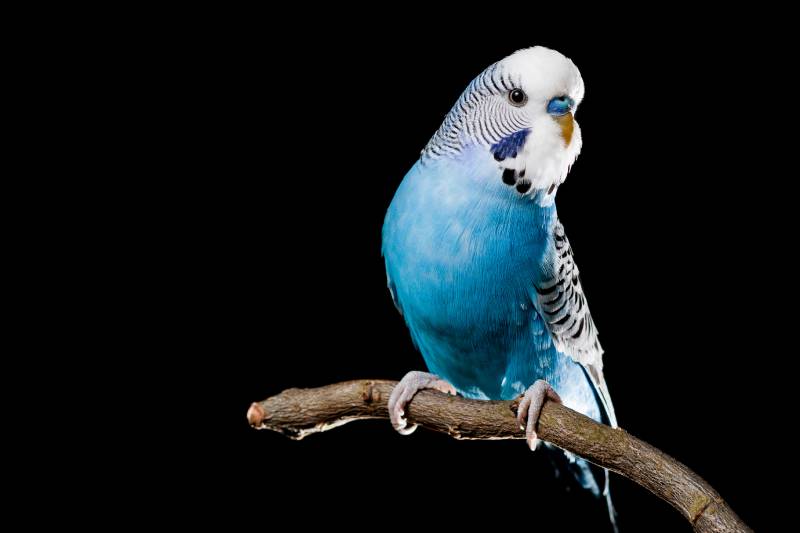
Parakeets use camouflage similarly but during the day. Being social and living in flocks is also living proof of safety in numbers. Their coloration speaks to their daytime activity when it would be most advantageous to these birds.
Parakeet Natural History and Vision
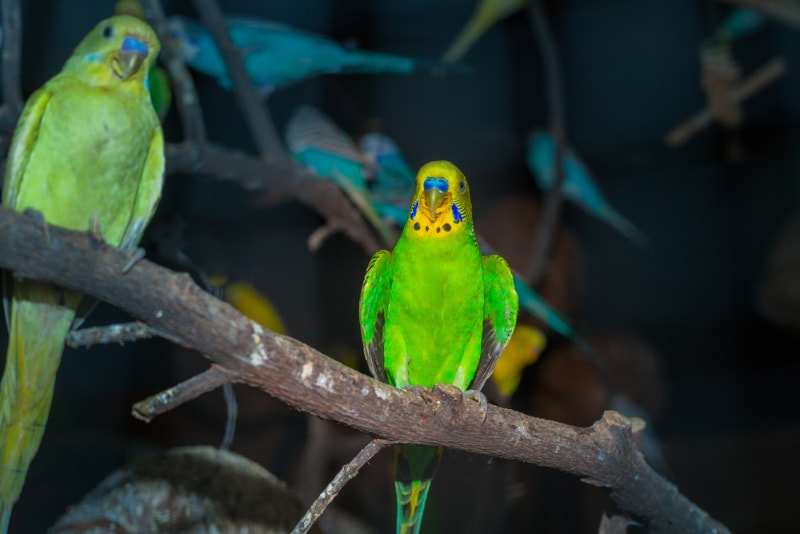
Parakeets feed on various foods in the wild, eating energy-dense nuts and seeds. Good vision is essential for finding these foods. Daylight also helps. These birds are nomadic and generally stay close to water. They are also opportunistic feeders that are ground foragers. All these traits make diurnal activity ideal for this species and their survival. Parakeets don’t see well in the dark because they don’t need it.
These birds spend their nights gathered in flocks. It’s a common strategy among prey species. Being in groups means more sets of eyes peeled to spot predators. Their mottled coloration makes it challenging for a bird of prey or snake to home in on a single bird.
Vision
Bird vision far exceeds that of other species, including humans. The size of their eyes relative to their heads is also larger. They have a structure within these organs called the pecten oculi that is unique to avian species. It optimizes nutrient transport and blood circulation. Moreover, birds have better color vision and temporal resolution for detecting objects in their world.
Budgerigars are cavity nesters, using pre-existing holes in which to raise their young. That suggests some ability to see in low-light conditions. Research has shown that these birds can discern objects in these environments, presumably to feed their chicks. However, that isn’t the same as seeing in the dark. It makes evolutionary sense for parents to tend to their young quickly for their survival.
Scientists have also learned that avian adaptation to full-dark conditions mirrors that of humans. Going from a fully lit room to an unlit one requires several minutes to adapt. The difference lies in Budgerigar’s ability to make adjustments during fast visual changes when entering a dark cavity. These birds can accomplish it, whereas people need extra time to get accustomed to the dark.
Researchers have concluded that it involves more than just the pupils dilating. It’s also worth noting that Budgerigar hatchlings can’t lift their heads until they are roughly 6 to 8 days old. Therefore, finding them in the dark cavities undoubtedly involves touch with sight to locate them, with the environment also playing a role.
Final Thoughts
Budgerigars are diurnal animals that make diurnal foraging beneficial. It allows them to find food and water quickly in often challenging conditions. They are also uniquely adapted to fast detection in low-light conditions, being cavity nesters. It’s vital for the survival of the young and parents. However, it’s not the same as seeing in the dark since they aren’t active at night.
See Also:
Where Are Parakeets From? Vet Approved Facts, Origin & Care Tips
Can Parrots See in the Dark? Vet-Approved Facts & Explanation
Sources
Featured Photo Credit: thaisign, Shutterstock
Get Hepper In Your Inbox


Pet care tips from our vets and experts, straight to your inbox.
You may opt-out at any time. View our Privacy Policy for more information.

Chris is an experienced pet writer specializing in science topics, with a particular passion for health and the environment. She has been a writer for over 15 years and lives with her husband and three cats in Michigan.
Beyond writing about cats and dogs, Chris loves to learn about wine. She has WSET 1 and 2 certifications and is currently pursuing her Certified Wine Specialist Award (CSW).
Join the conversation
Ask a question, share your story, or send private feedback.