Hepper is reader-supported. When you buy via links on our site, we may earn an affiliate commission at no cost to you. Learn more.
Can Rabbits See in The Dark? Vet-Reviewed Facts



A rabbit's vision and eye anatomy are, in certain features, entirely different from ours. Rabbits have limited color vision but can see much better in low light than humans can. While rabbits have excellent vision in dim light, they cannot see in pitch black like most other crepuscular mammals. They lack a particular structure called the tapetum lucidum which allows some mammals to find their way around in extremely low light conditions. Many rabbit parents wonder how good the vision of their pets is and their cousins in the wild.
Learning more about rabbits’ unique visual capabilities will help us understand their behavior better. In the article below, you can find more exciting information about rabbits and their ability to see in the dark.

How Do Rabbit’s Eyes Work?
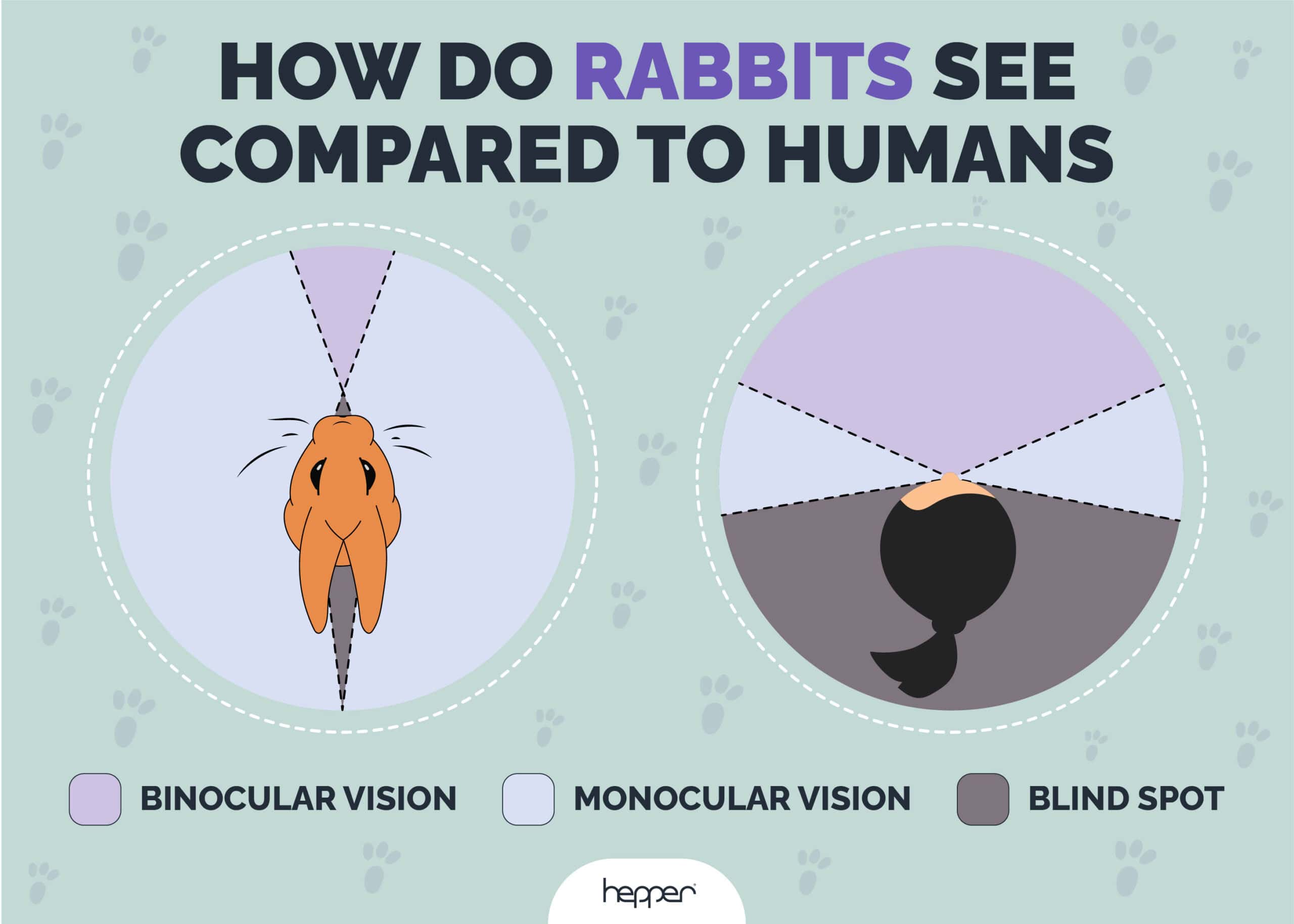
Rabbit vision has evolved to see predators from a distance and almost any angle. Their eyesight is not designed for hunting but rather for always being alert. Their eyes are placed on the side of the skull, very high, allowing the rabbit to have an almost 360-degree view of their surroundings. Since rabbits are farsighted, they can spot a predator from very far away, even when a human might not be able to see it. While rabbits can see far, they have a minor fault—a blind spot directly in front of their face, blocking their entire view straight ahead. An excellent sense of smell and hearing compensates for this minor issue in their vision.
Can Rabbits See in the Dark?
Rabbit’s eyes are made up of the two types of photoreceptor cells most animals have—rods and cones. Photoreceptors are light-sensitive cells located in the retina. Rod cells allow rabbits to operate under dim light conditions, and they are also sensitive to subtle movements. While cone cells are responsible for color vision and functioning under bright light conditions, rods start working when it's time to see in the dark. If you’ve ever found yourself in a dark room abruptly, and you noticed how your vision slowly starts coming back, allowing you to orient yourself in the dark, rods are the cells responsible for this. But do our furry bunny friends have the same capability?
Yes, rabbits can see better in the dark than humans. Rabbits have a higher ratio of rods to cones than humans, meaning that their vision in the dark is excellent. While they can’t perceive colors like humans, they can certainly find their way in the dark
But while rabbits can see better in the dark than humans can, they still can’t see in pitch black because they lack the tapetum lucidum, which for some animals, like dogs and cats, enhances the sensitivity under low light conditions. When the light conditions are almost pitch black, and the light doesn’t hit the rod photoreceptors in the retina, the tapetum lucidum acts as a reflective mirror that bounces the light back for a second chance. Rabbits lack this structure because they are crepuscular, so their vision in the dark is somewhat limited.
Can Rabbits See Colors?
As we’ve mentioned above, rabbits have two types of photoreceptor cells and cones are the ones responsible for color vision. Just like most animals, rabbits are capable of seeing various wavelengths of light, meaning they can perceive colors but not in the same ways as humans do. Rabbits are thought to have two types of cone cells, allowing them to perceive blue and green colors, while humans can perceive an additional red. While scientists still don’t know for sure how rabbits perceive color, rabbits can undoubtedly differentiate between blue and green.

Keeping Your Rabbit’s Vision Healthy
The rabbit's eyes are the window to its health, so if they are wide open, bright, and clear, it can indicate that your rabbit is healthy and happy. Healthy rabbit eyes are without watery discharge, with smooth eyelids and equally sized pupils. You can ensure your rabbit's eyes look like this by keeping a consistent and healthy diet and great mental and physical stimulation.
Their personal space needs to be big enough for them to move freely, and they should have access to an area where they can run and hop around. Make sure to clean their space regularly to avoid high ammonia levels and reduce bacteria that can irritate the eyes and respiratory tract. You can also ensure that your rabbit’s vaccinations are up to date and have regular vet check-ups to monitor their vision and eye health.
Final Thoughts
After learning how rabbits’ eyes work, you will hopefully understand your small furry companion better. While they cannot see in pitch black like nocturnal mammals, they don’t need that ability in their everyday life in any way. They can find their way in the dark much better than we can, so you shouldn’t worry about them being disoriented in the dark.
Related Reads:
Sources
Featured Image Credit: Rudmer Zwerver, Shutterstock
Get Hepper In Your Inbox


Pet care tips from our vets and experts, straight to your inbox.
You may opt-out at any time. View our Privacy Policy for more information.
I am a freelance writer with a restless and adventurous spirit. After graduating from the College of Fine Arts, I began searching for a medium to express my imagination. Content writing is a passion that took me by storm. When I am away from my peaceful writing nook, I work as a sculptor, painter, and woodworker in my workshop. I plan to continue nurturing my passion for writing and use it as a vessel for my neverending creativity.
Join the conversation
Ask a question, share your story, or send private feedback.