Hepper is reader-supported. When you buy via links on our site, we may earn an affiliate commission at no cost to you. Learn more.
Can Rabbits See Colors? Vet-Appproved Eye Facts


In this article
While rabbits require a certain level of care, they can make wonderful pets for people of all ages. Getting to know a new pet can give you the urge to learn everything about them. Perhaps you've wondered whether your rabbit can see in color?
The short answer is that rabbits do see in color, just not quite the way that we do. Here, we discuss everything about rabbits and their eyes, including the colors that they see and how they see the world in general!

What Colors Do Rabbits See?
Before we answer this relatively simple question, let’s go into a bit of technical talk. This will help us understand how animals see color 1.
All eyes—of humans and other mammals alike—have rods and cones, collectively known as photoreceptors. The cones and rods pick up light waves and turn them into information for the brain to process, such as color, motion, and shape.
The rods interpret the light in low light conditions and the cones interpret daylight and the colors. Different species of animals have various combinations of rods and cones as they have adapted to needing stronger vision at certain times of the day and certain colors.
Rabbits really only see two colors: blue and green, which means they are relatively colorblind if we compare them to humans. They have green and blue cones, which means they have two-color vision compared to humans, who have a three-color vision. Rabbits are unable to see green and red.
How Well Do Rabbits See in the Dark?
Rabbits definitely see better in the dark than humans. They have twice the number of rods in their eyes than we do, which enables them to see in low light.
Rabbits are crepuscular, which means they are most active at dusk and dawn. Their eyes enable them to see quite well at these times, so they can forage and keep watch for predators.
However, this also means they don’t see that well during the bright light of day or in the dark of night.
How Well Do Rabbits See Close Up?
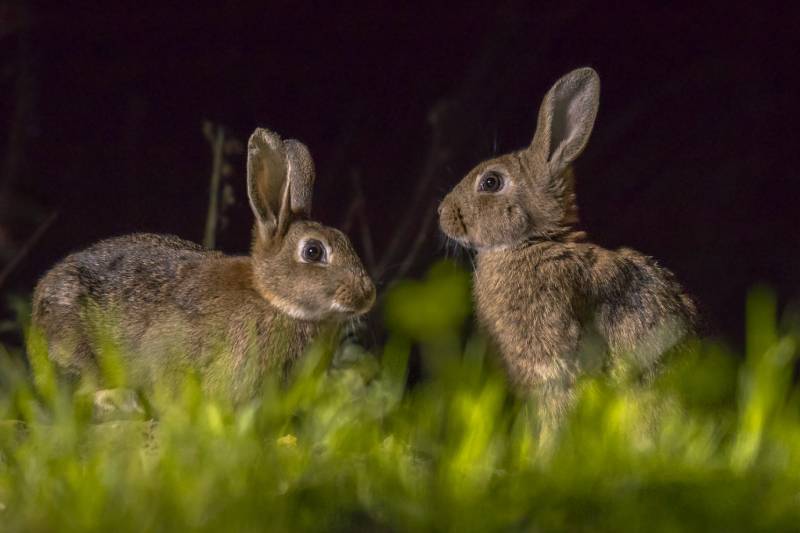
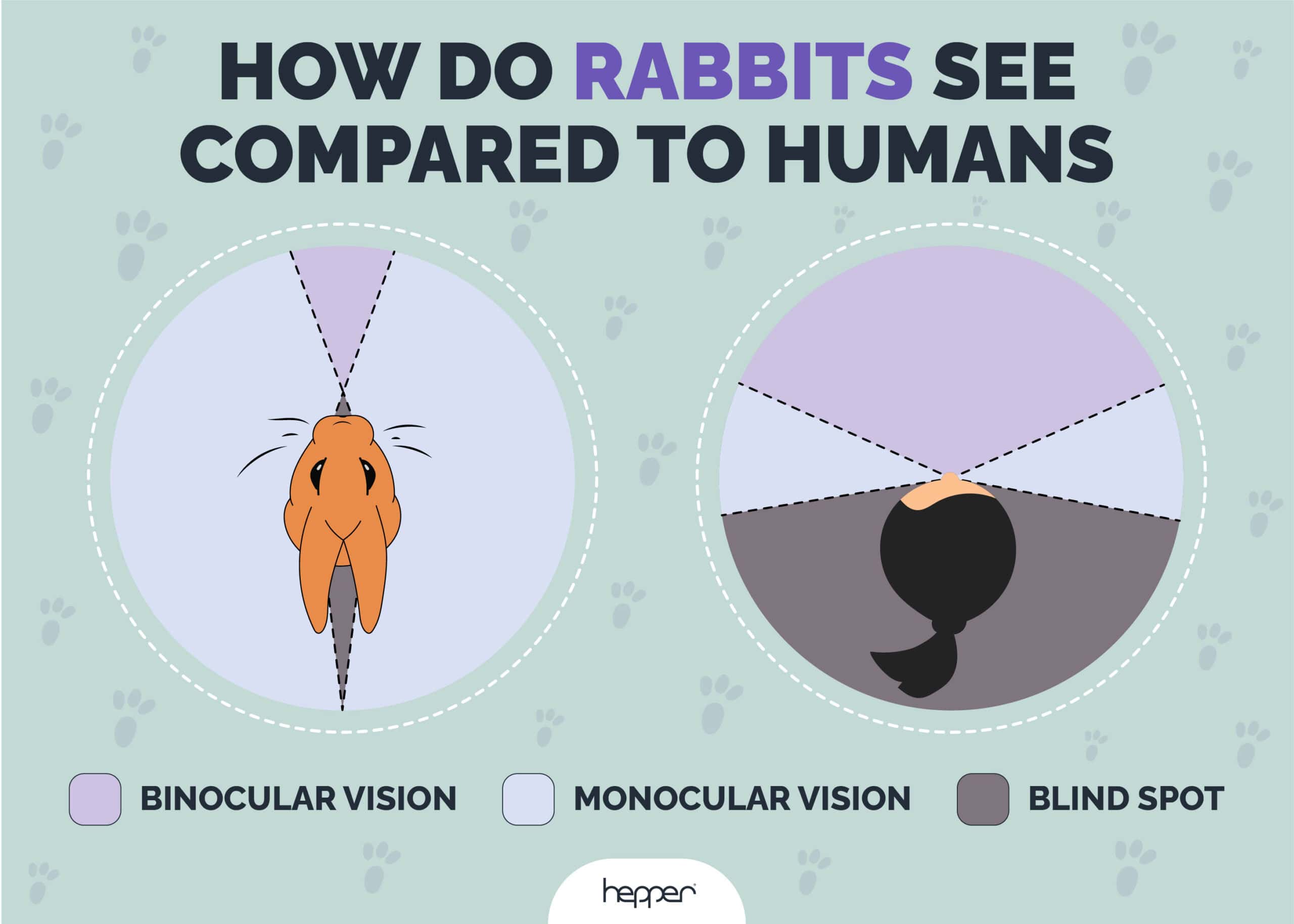
Rabbits are considered farsighted, which means they see things in the distance better than up close. Notice that a rabbit’s eyes are on either side of their head rather than on the front, like that of humans or cats. This means they have a blind spot about 10 degrees in front of their nose, and there’s an additional blind spot directly behind their ears.
Fortunately, their excellent senses of smell and hearing help make up for the blind spots. So, if you place a treat directly in front of your rabbit’s nose, they won’t see it, but they can use their sense of smell and whiskers to locate it.
What rabbits see up close is a grainy image, and it’s not quite as detailed as what we see. Also, rabbits see primarily in two dimensions instead of three. Binocular vision which only happens in the center of the rabbits visual field is needed for 3-D vision.

Why Are a Rabbit’s Eyes on the Sides of Their Head?
You might have noticed that predators tend to have their eyes on the front of their heads. This trait can be noticed in wolves, bears, cats, and even humans. Having eyes on the front of the head allows for binocular vision, providing a deeper depth of field and making pursuing prey easier.
But prey animals primarily have their eyes on the sides of their heads; just look at rabbits, deer, chickens, and squirrels. This gives them a wide field of vision—in fact, almost 360-degree vision. It enables them to see any potential predators sneaking up on them.
Their eyes are also capable of seeing independently from each other, which enables them to pinpoint movement at almost every angle. They can detect movement behind and above them too!
What Color Eyes Do Rabbits Have?
There are seven rabbit eye colors! The following list starts with the most common and ends with the rarest colors:
| Brown: | The most common eye color in rabbits is brown. The gene for brown eyes tends to be the most dominant, but there are varying shades of brown, from light to dark. |
| Amber: | Amber eyes aren’t common in domestic rabbits, but you’ll often see them in wild rabbits. Hares also tend to have amber eyes. |
| Blue: | Blue eyes result from a relative absence of pigment. Two pigments eumelanin, which is responsible for dark brown, and pheomelanin, which makes green, amber, or hazel. Due to the lack of pigment the way that light is reflected from the iris makes the eyes appear blue. They don’t contain blue pigment. |
| Blue Gray: | Rabbits with blue-gray eyes have less eumelanin but more pheomelanin, which gives the eyes a gray color. |
| Pink: | Pink eyes occur from a genetic mutation that dilutes the usual brown or blue eyes into pink. If you look carefully, you can see the blue or brown color that the rabbit might have had. |
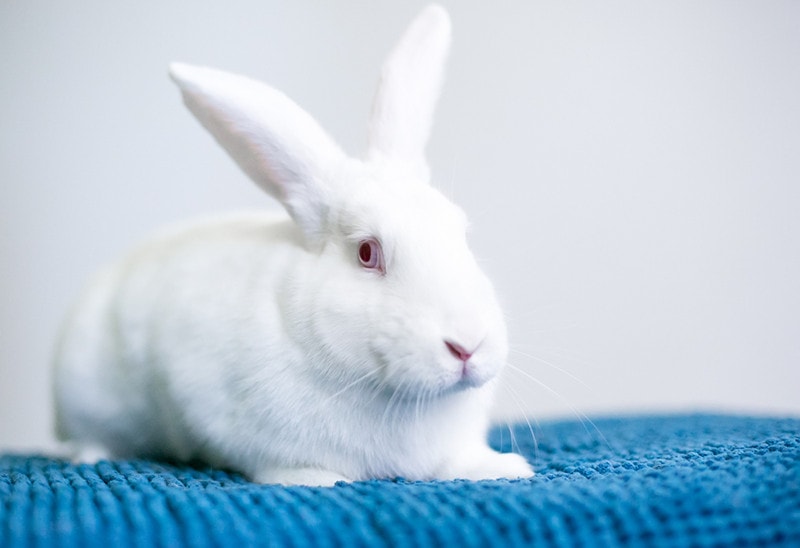
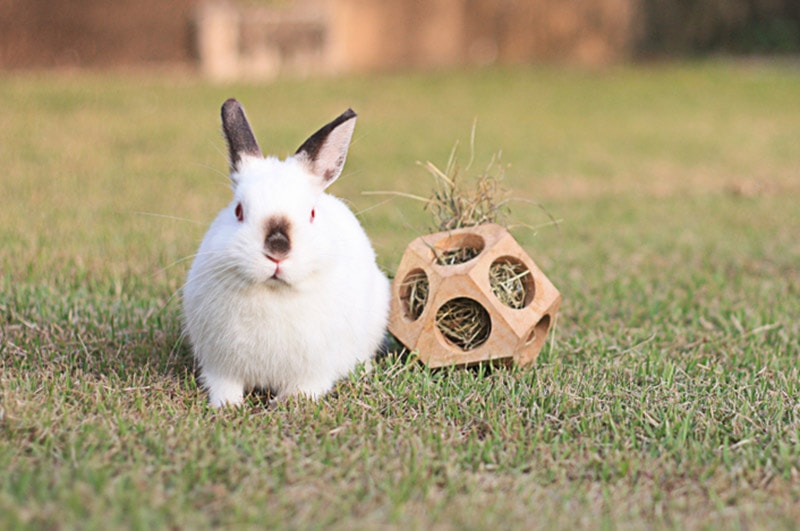
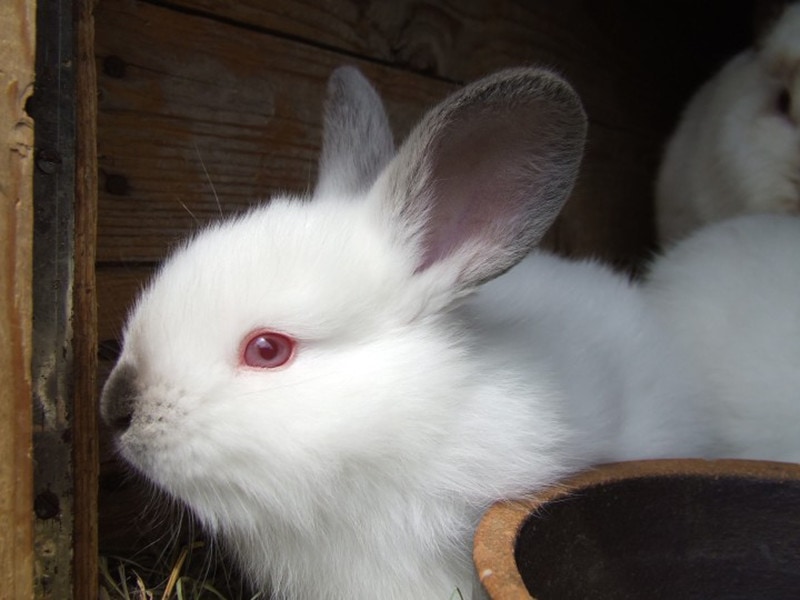
| Red: | Red eyes are a result of albinism, and the rabbits are always white. This is due to a lack of pigmentation caused by a recessive gene. You won’t find white rabbits in the wild except on rare occasions. It’s bred into the rabbit; the New Zealand White, Californian, and Himalayan rabbits are all albino breeds. |
| Marbled: | The rarest eye color is a genetic condition called sectoral heterochromia. It divides the iris into several sections, giving the eye a variety of colors, including blue, blue-gray, and brown. Each eye will have its own unique pattern. |
Conclusion
While rabbits might not have the same keen vision as humans, they have the advantage when it comes to their field of vision and low light levels. While they might only see blue and green, they don’t really need to see other colors in order to survive.
Rabbits see best in low light rather than in the dark or the brightest part of the day. Just remember that they have a blind spot directly in front of their nose. Also, since they have grainy vision, they don’t see things well close up. This can help explain why your rabbit might startle if they don’t see you initially. Also, if you ever see your rabbit bobbing their head up and down, this is their way of determining depth perception. Nature is amazing!
Sources
Featured Image Credit: Jumpstory
Get Hepper In Your Inbox


Pet care tips from our vets and experts, straight to your inbox.
You may opt-out at any time. View our Privacy Policy for more information.
Kathryn was a librarian in a previous lifetime and is currently a writer about all things animals. When she was a child, she hoped to work in zoos or with wildlife in some way, thanks to her strong love for animals. Unfortunately, she's not strong in the sciences, so she fills her days with researching and writing about all kinds of animals and spends time playing with her adorable but terribly mischievous tabby cat, Bella. Kathryn is hoping to add to her family in the near future – maybe another cat and a dog.
Join the conversation
Ask a question, share your story, or send private feedback.