Hepper blog

Search our database of over 9,984 posts with up-to-date information from our experts and veterinarians.

Hepper is reader-supported. When you buy via links on our site, we may earn an affiliate commission at no cost to you. Learn more.

Do African Bullfrogs Have Teeth and a Strong Bite? Vet-Verified Facts & FAQ

By Nicole Cosgrove · Reviewed & fact-checked by Dr. Luqman JavedVet Approved
Dr. Luqman Javed
Reviewed & Fact-Checked byDr. Luqman JavedDVM (Veterinarian)
Dr. Luqman grew up with an extreme fondness for animals and turned a childhood dream into reality by becoming a veterinarian. His goals are now focused on helping pet owners understand their pets better in order to ensure the best quality of life for all pets globally. He is passionate about wildlife, exotic pets, pet owner education, and animal welfare. Luqman has 3 years of professional experience working with a variety of animal species. He has skills in demonstrating proper animal husbandry and training some exotic species, such as parrots. Additionally, he has decades of personal experience with keeping many exotic pets: freshwater fish, parrots, songbirds, chickens, ducks, turtles, and hamsters.View authorThe information is current and up-to-date in accordance with the latest veterinarian research. Read about our vets
Share
Ask us a question in the comments
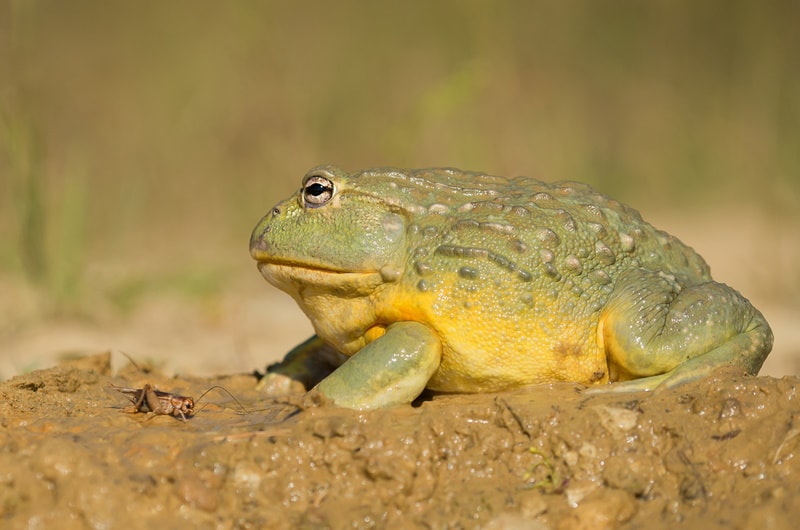
african bullfrog in the mud

African Bullfrogs are large frogs with wide mouths that, as you can probably guess, hail from Africa. African Bullfrogs can make extremely loud sounds, and they are often kept as exotic pets due to their size and rarity. But do these frogs have teeth? Do any frogs have teeth? The answer is yes, African Bullfrogs do have teeth (albeit different from human teeth), and they can use them to bite down very hard on prey. If that is surprising to you, you are not alone. Many people do not realize that frogs have teeth in the first place. Here is everything you need to know about African Bullfrog teeth including their bite and if they are dangerous to people.

African Bullfrogs at a Glance

Important
Please note that many states and jurisdictions may have legislation that prevents capturing or owning frogs. Always make sure you have permission to legally own an exotic pet before deciding to adopt one. Capturing wild animals is not advised, as this disrupts local ecosystems. In addition, amphibians may naturally harbor Salmonella and spread it to humans and other pets. These pets are not recommended to be kept alongside children, the elderly, pregnant individuals, or those with a compromised immune system. Hygiene is of utmost importance when dealing with amphibians.

If you are in the US, please refer to state laws before deciding to adopt an exotic or wild pet. Elsewhere, please refer to relevant jurisdictions in your area.

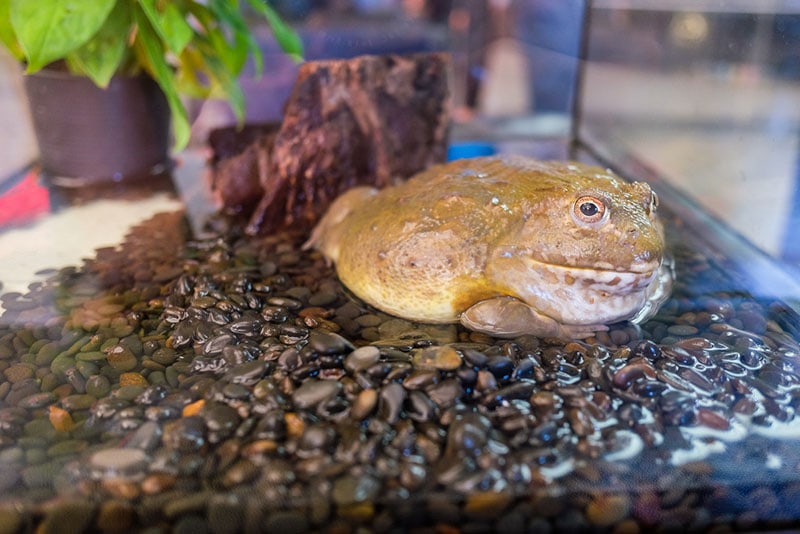
female pixie frog or african bullfrog inside the tank
Image Credit: Foodtographer, Shutterstock
Scientific Name:Pyxicephalus adspersus
Size:4–9 inches (females half as big as males)
Lifespan:30–40 years
Habitat:Wetlands of Southern Africa

Do African Bullfrogs Have Teeth?

Yes. African Bullfrogs do have teeth. They have three different types of teeth. African Bullfrogs have maxillaries, vomerine teeth, and odontoids. Many people don’t think of teeth when they think of frogs, but these frogs have many teeth. African Bullfrogs have teeth that line their entire mouth on both the top and the bottom. African Bullfrogs are some of the largest frogs in the world, and therefore, they have some of the largest frog teeth in the world. African Bullfrogs can live for up to 30 years in captivity and the wild, so they need strong teeth that can hold up over years of usage.

What Do African Bullfrogs Use Their Teeth For?

African Bullfrogs use their teeth to trap prey. African Bullfrogs are carnivores. They eat other small animals, such as other frogs, birds, and mice. African Bullfrogs use their large, curved teeth to grip and trap their prey inside of their mouth. Other teeth are short and flat and are used to grind up things like wings and skulls, crushing the prey so that the bullfrog can eat it at its leisure. African Bullfrogs don’t rip and chew like other animals such as dogs, cats, and humans. They primarily trap and grind.
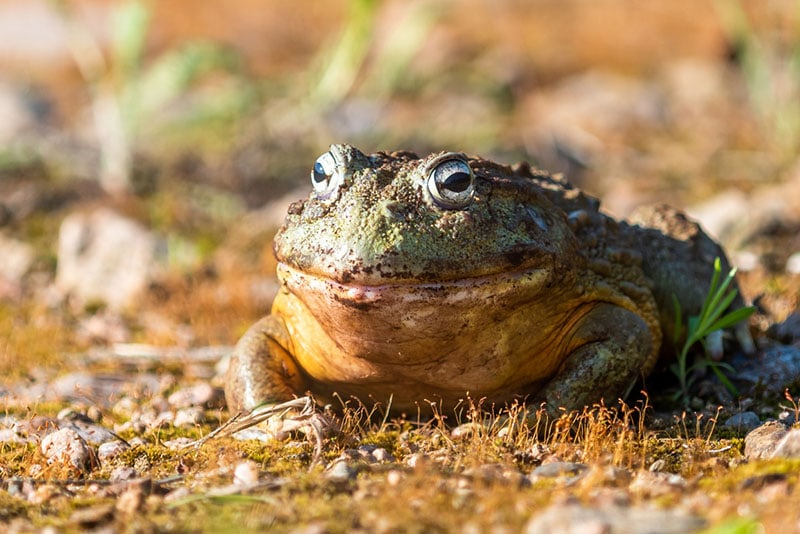
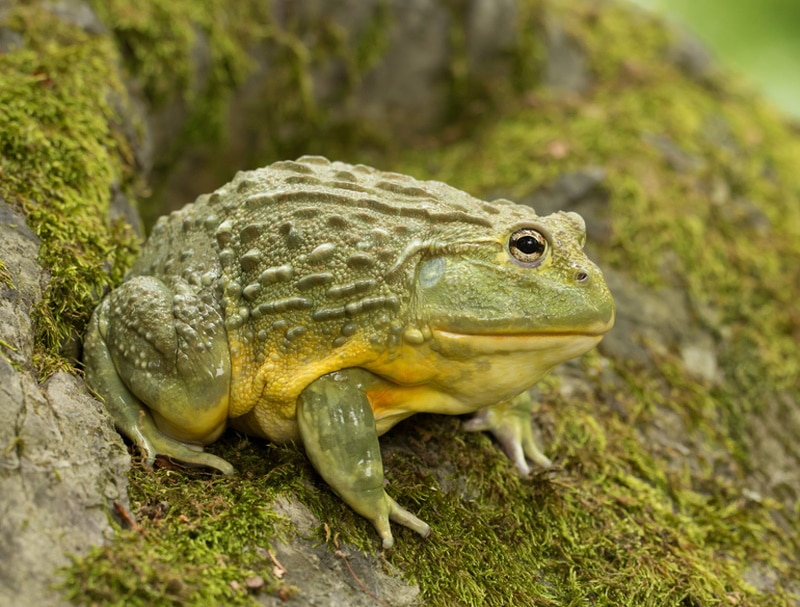
giant male african bullfrog or pixie frog sunbathing outdoor
Image Credit: Vaclav Sebek, Shutterstock

True Teeth vs. Bony Extrusions

As mentioned, African Bullfrogs have three different types of teeth. Technically, only one of these three is considered to be a true tooth. True teeth are made up of dentin and enamel. Human teeth and dog teeth are classic examples of true teeth. Other things, such as bony extrusions without any pulp or enamel, are not considered to be true teeth, even if they are used as such. Technically, odontoids and vomerine teeth are not true teeth. They are lumps and bumps and extrusions connected to the skull and jaw of the frog.

Do African Bullfrogs Bite?

Yes. African Bullfrogs do bite. Most animals with teeth can and will bite. African Bullfrogs are no different. Many people don’t expect to be bitten by a frog, but it can happen. Most frogs have teeth that are so small or so dull that they cannot really bite humans. African Bullfrogs are large enough and have enough teeth with which they can bite humans, and it can hurt. African Bullfrogs can bite if they are startled or if they are trying to eat something out of your hand.

African Bullfrogs can bite if they feel threatened or if they do not want to be handled. Since African Bullfrogs are sometimes kept as pets, many people learn the hard way that these animals can bite when they don’t want to be picked up.
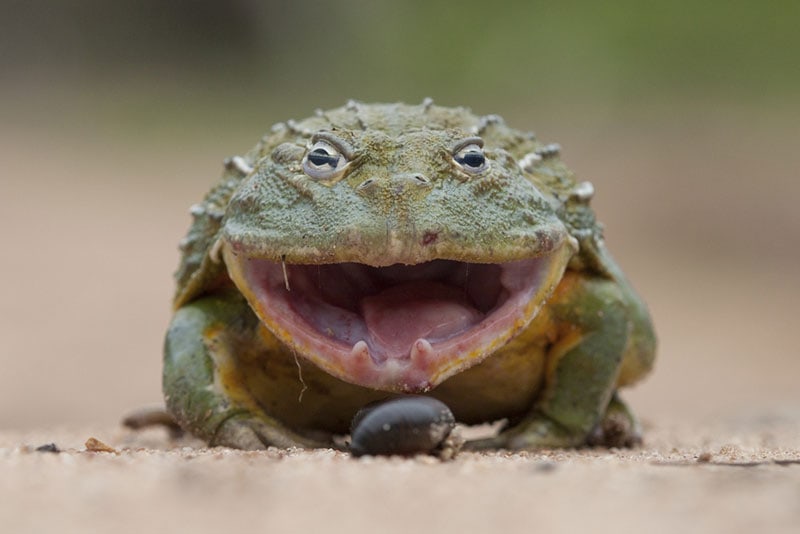
giant african bullfrog with mouth open
Image Credit: Stu Porter, Shutterstock

Do African Bullfrogs Have a Strong Bite?

Yes. African Bullfrogs have a strong bite. Since the teeth of the African Bullfrog are designed to trap and hold prey, they can produce a lot of force with their teeth. If you are not expecting it, an African Bullfrog can get a good bite in on your finger. Sometimes, a bullfrog will bite and trap your finger, thinking that it is a worm or other type of prey. This can be painful and even draw blood depending on the size of the frog and the angle of the bite.

Are African Bullfrogs Dangerous to Humans?

No. African Bullfrogs are not dangerous to humans. The bite of an African Bullfrog can be startling. In the worst-case scenario, the bullfrog could draw blood or even cause a bite deep enough to warrant stitches. However, most of the time, African Bullfrogs are harmless. They are not toxic, they are not poisonous, and their bites are not strong enough to cause lasting damage. That means that overall, these animals are not dangerous to humans. A painful but temporary bite is all that they can muster against an adult human.

Important:

In the worst-case scenario, the bullfrog could draw blood or even cause a bite deep enough to warrant stitches. If a frog’s bite draws blood, you should have yourself checked by your doctor.

Conclusion

African Bullfrogs have three different types of teeth that they use to capture, hold, and kill their prey. African Bullfrogs are carnivores that use their teeth to help them hunt and eat their food. If you are not careful, African Bullfrogs can bite you, which can be a nasty shock. The bite of an African Bullfrog is not dangerous, but it can be very painful and quite surprising.

Sources

Featured Image Credit: MZPHOTO.CZ, Shutterstock

Get Hepper In Your Inbox

Pet care tips from our vets and experts, straight to your inbox.

List

Select all that apply.

You may opt-out at any time. View our Privacy Policy for more information.

Nicole Cosgrove
Authored by

Nicole Cosgrove

Join the conversation

Ask a question, share your story, or send private feedback.
Rate this post
Required to post. Only our editors see your rating.
Who should see this?

A human reviews every comment before it appears. Your email is never published.

Picked to go with this article

Do Frogs Bite? Vet Reviewed Reasons, Species & FAQ

Do Frogs Bite? Vet Reviewed Reasons, Species & FAQ

There is a good chance that you may encounter a frog at some stage during your life if you haven’t already. You may even have to rescue one that has become tra…

Eleanor Glaum
By Eleanor Glaum ·
Do Frogs Have Teeth? Fascinating Facts & FAQs

Do Frogs Have Teeth? Fascinating Facts & FAQs

Frogs are one of nature’s strangest, quirkiest residents, and their teeth are just as weird. Yes, frogs do have teeth - a feature which helps distinguish some…

Codee Chessher
By Codee Chessher ·
African Bullfrog: Care Guide, Diet, Pictures & Lifespan (Vet-Verified Info)

African Bullfrog: Care Guide, Diet, Pictures & Lifespan (Vet-Verified Info)

The African Bullfrog (Pyxicephalus adspersus) is a gigantic frog commonly kept in domestic environments. Many keepers love these amphibians because they are in…

Ashley Bates
By Ashley Bates ·
Do African Bullfrogs Make Good Pets? Facts & FAQ

Do African Bullfrogs Make Good Pets? Facts & FAQ

African Bullfrogs are also known as Pixie Frogs. Unlike American Bullfrogs that are protected environmentally, African Bullfrogs are available in the pet trade…

Ashley Bates
By Ashley Bates ·

Keep reading

More stories you might like

Do Pacman Frogs Have Teeth? Vet-Verified Amphibian Anatomy Facts

Pacman Frogs are very popular pet frogs. They are fun to watch, relatively easy to care for, and readily available. However, owners are discouraged from handli…

Oliver Jones
By Oliver Jones ·
Do Pacman Frogs Have Teeth? Vet-Verified Amphibian Anatomy Facts

Can Frogs Eat Fruit? Vet Approved Nutrition Advice

Generally, adult frogs are obligate carnivores, which means that they only eat meat. As such, adult frogs should not be given fruit as part of their diet. Howe…

Oliver Jones
By Oliver Jones ·
Can Frogs Eat Fruit? Vet Approved Nutrition Advice

Male vs. Female Pixie Frog: The Differences (Vet-Verified Info With Pictures)

The African Bullfrog is the second largest frog in the world, only behind the aptly named Goliath Frog. Because of their scientific name, Pyxicephalus adspersu…

Codee Chessher
By Codee Chessher ·
Male vs. Female Pixie Frog: The Differences (Vet-Verified Info With Pictures)

Can You Keep a Toad as a Pet? Vet-Reviewed Species Info & Basic Requirements

Toads can make for interesting pets, but their shy nature combined with the production of bufotoxin and the fact that soap, oil, and other substances commonly…

Nicole Cosgrove
By Nicole Cosgrove ·
Can You Keep a Toad as a Pet? Vet-Reviewed Species Info & Basic Requirements

Is a Frog an Herbivore, Carnivore or Omnivore? Vet Approved Facts & FAQ

Frogs are extraordinary creatures! All frog species have their own way of operating. They can be brightly colored to warn predators or camouflaged to suit thei…

Ashley Bates
By Ashley Bates ·
Is a Frog an Herbivore, Carnivore or Omnivore? Vet Approved Facts & FAQ

Are Toads Poisonous to Humans? Vet-Approved Safety Facts & FAQ

You can find toads worldwide, and they are often part of myths and misconceptions, particularly regarding their toxicity to humans, with many believing that th…

Ed Malaker
By Ed Malaker ·
Are Toads Poisonous to Humans? Vet-Approved Safety Facts & FAQ

Budgett Frog Care Guide: Lifespan, Diet, Pictures & More

Also called the Paraguay horned frog or Budgett’s frog after the British zoologist who discovered them, the Budgett frog is one of the less popular amphibian p…

Codee Chessher
By Codee Chessher ·
Budgett Frog Care Guide: Lifespan, Diet, Pictures & More

Can Frogs Breathe Underwater? Vet Approved Facts & FAQ

Frogs are amazing creatures considering their minuscule size. They are one of the few animals that start life as one type of creature, a tadpole, and then chan…

Gregory Iacono
By Gregory Iacono ·
Can Frogs Breathe Underwater? Vet Approved Facts & FAQ