Hepper is reader-supported. When you buy via links on our site, we may earn an affiliate commission at no cost to you. Learn more.
How to Tame a Parrot: 7 Effective Vet-Approved Steps


In this article
Most people who adopt a parrot into their family desire to have a tame, affectionate, and interactive bird as a pet. Unfortunately, this can be difficult if the bird you've adopted is skittish and afraid of humans. While training a parrot can be tedious, requiring much time, patience, and effort, the result will be more than worth the work.
Read on to find our tips on taming your parrot so you can develop a closer bond with your pet and help him feel more secure in his new home.

Note
Before You Begin
Before you begin taming your parrot, there are some things you need to know.
Recognize the Signs of Stress
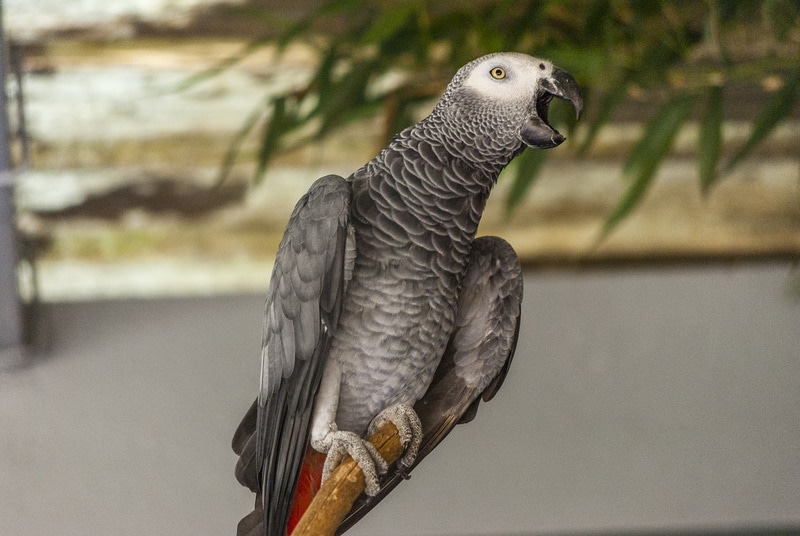
If your bird exhibits any signs of stress, you may need to dial back your training regimen and allow him some time to cool off. Signs of stress include:
- Screaming
- Biting
- Feather picking
- Self-mutilation (e.g., chewing on skin)
- Decreased appetite
Recognize Signs of Fear
Taming your parrot requires patience, and forcing a fearful bird to participate in training sessions will not only make him deem you untrustworthy, but it can make him defensive. Signs of fear include:
- Crouching down
- Leaning away
- Stepping away
- Flattening feathers
- Pinning the iris and lashing out to bite.
Set a Realistic Timeline
You cannot expect to take a previously wild parrot and tame him in a few weeks time. Even hand-fed birds will require time and patience to be tamed. It's best not to set any expectations or timeline for your parrot's training regimen.
Keep Training Sessions Short
Once you've progressed to the point in your training regimen where you're teaching your parrot to step up, aim to keep your sessions short. Each session should be just 10 minutes long, though you can offer two or three of them throughout the day.
Sessions can be extended, but only if your parrot is enjoying them. Likewise, at times, 10 minutes might be unacceptable for some parrots, and in such a scenario, you’d have to respect your parrot’s choice and stop the session altogether.
Always Have Rewards on Hand
As with training other animals, rewards are an important part of taming your parrot. Give him a treat whenever he steps onto your finger, even if he is only there for a split second before flying away. Reward any progress, no matter how small.
Bird Proof Your Room
Though your parrot won't leave his cage for training sessions for a few weeks, it's never too early to bird proof his room. Keep all windows and blinds closed to prevent escapes and window strikes. Remove any other pets and hazards like heaters. Keep ceiling fans off. Parrots are very sensitive to fumes and inhalants, these should be removed as part of the bird proofing process.
How to Tame a Parrot
1. Give Him Time to Acclimate to Your Home
Your parrot will need a few weeks to fully acclimate to his new environment, so don't rush into handling or trying to train him the day you bring him home. Some birds need longer than others to become comfortable in their new environment.
After the first few days in a quiet and cool room, we recommend placing his cage in a moderately active spot in the home. Though it may seem best to leave your pet in a quiet room so he has time to get used to the environment in peace, putting him in a somewhat busy area will allow him to become more comfortable with human activity faster.
- Note: Please don't put your bird's cage in the kitchen. Nonstick appliances and cookware release toxic fumes that can kill your bird.
2. Spend Time With Him
Talking to your bird in a quiet, calming voice will help him get used to you faster. An essential part of getting your parrot to trust you is making him feel comfortable in your presence. You don't even have to talk directly to him. Read a book or your morning newspaper aloud to get him used to your voice. You can even try singing to him soothingly to help him realize you're not a threat.
Parrots eat together when they feel safe, so try offering your parrot his meal while you're eating. This can help him begin looking at you as a member of his flock instead of as a predator.
3. Approach Slowly
Moving quickly or unpredictably around your bird is a surefire way for him to learn you can't be trusted. Birds are naturally skittish creatures, so any sudden movements can spook him and make him suspicious of you. Instead, be gentle, slow, and deliberate when approaching your pet.
4. Get Him Used to Your Hand
Hand taming is a common method for taming birds, but most are naturally terrified of hands at first. Parrots acquired from pet stores may associate hands with capture, making them even more afraid of handling.
To get your parrot used to the idea of your hands, place it where he can see it near or in his cage. Talk or sing to him soothingly while holding your hand near his cage. Slowly increase how often you expose your bird to your hand. This may take time and patience, especially if the parrot you've adopted has come from an abuse or neglect situation.
Once you feel he is comfortable with your hand on his cage, try placing it inside. Ensure you're moving very slowly and deliberately when putting it in the cage and talking quietly and soothingly. Try not to make direct eye contact with your parrot as you take this next step; otherwise, you may appear threatening to him. At this early stage, do not try to touch him just yet.
If you’re worried about a bite, try wearing a very large glove that extends beyond your fingers at first. This can save you from a nasty bite in case your parrot lunges at your hand. Though intimidating, it is very important that you remain calm and not pull your hand out of your parrot’s cage should they ever lunge and bite you; doing so only reinforces this behavior. For extremely nervous or aggressive birds, it’s best to seek the help of a professional trainer.
5. Offer a Treat
Once your bird is comfortable with your hand in his cage, you can take the next step by offering him a treat from your hand. All parrots are unique, so you may need to try several different treats to see which your bird prefers. I have a conure (a medium-sized parrot), and she loves dried papaya and fresh apples. Some birds love millet spray or leafy greens like spinach. It would be best if the treat you offered is already something your parrot is familiar with and enjoys.
Hold whatever treat you decide on in the palm of your hand and extend it into your pet's cage. Hold as still as possible. Depending on how skittish your bird is, it may take a few tries before he shows interest in what you're offering him.
Offer the treat several times per day and whenever you change his water and food bowls.
6. Teach Him to Step Up
The "step up" command is to birds what "sit" and "stay" is to puppies. It's one of the first vocal commands you should try teaching your parrot, as it's something you'll use a lot in your adventure as a bird parent.
There are two accepted methods for teaching a bird to step up. One involves using your hand, and the other requires a perch. Which you use will depend on how comfortable your bird is with you at this point in your training sessions. If you feel he is comfortable with your hand, use your hand. If not, use a perch.
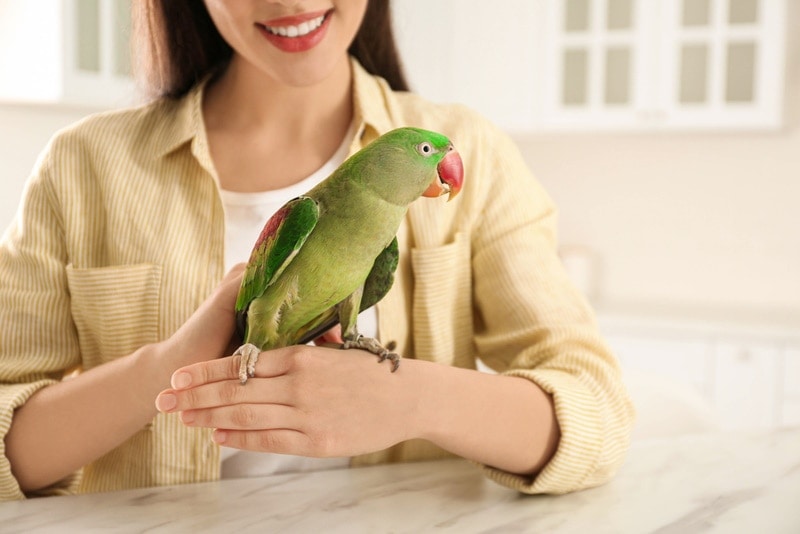
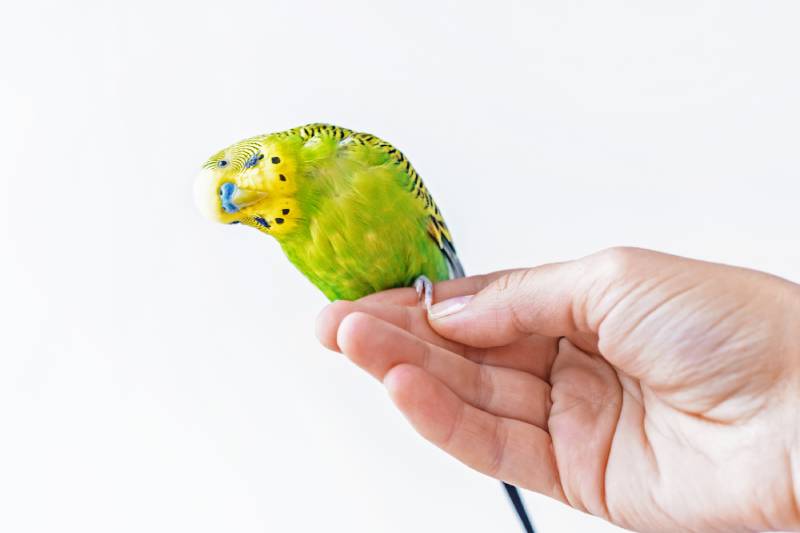
Put your hand (or the perch) inside the cage and position it with the index finger like the perch. Move your finger very slowly toward your parrot and hold it still just above his feet. Encourage him to step onto your finger, but don't be pushy. He will probably fly away from you or nip at you the first few times. If so, remain calm and try again later.
Provide extra encouragement to step up by holding a treat in your other hand, kept far enough away from your "perch finger" that he'd need to step onto your finger to reach it. Add the verbal "step up" command so your bird can learn to associate your extended finger with the action you want him to perform.
Once your parrot is comfortable stepping up inside his cage, you can teach him to do so when he's spending time outside his cage. This is an essential step in taming your bird, as you'll always find yourself using this skill to get your pet back into his cage or out of trouble.
- Note: You must remember that birds, especially parrots, use their beaks as a third hand. If your parrot reaches out to you with his beak, don't pull away, fearing that he will bite you. Show confidence and try not to move. Pulling away suddenly can frighten your pet and may cause him to bite even if he had no intention to in the first place.
7. Teach Him to Step Down
Stepping down is a great command to teach as it will assist you with placing your parrot in places (e.g., back in his cage). A treat is a helpful tool to have on hand for this, as it will encourage your parrot to leave your perch finger and lure him to wherever it is you're trying to have him go. Use the cue "step down" as you teach him so he will learn to do it by vocal command.
Can My Parrot Learn to Talk?
Some parrot species can talk or mimic speech, but some speak better and easier than others. However, some individuals won't talk regardless of species. Some birds will develop an extensive vocabulary and learn to mimic electronic noises like microwaves or telephones, while others will never learn to say a word. Generally speaking, males are considered better talkers, but that's not to say that females can't become fantastic conversationalists.
Final Thoughts
Taming your parrot requires him to learn the basic commands: step up and down. Once mastered, you can move on to other skills like mimicking speech or laddering. Remember, it takes time, patience, and a lot of repetition to tame and train a bird. Let your parrot dictate the length and speed of your training sessions, and never force him into doing something he doesn't yet have the capacity for.
Featured Image Credit: TigerStocks, Shutterstock
Get Hepper In Your Inbox


Pet care tips from our vets and experts, straight to your inbox.
You may opt-out at any time. View our Privacy Policy for more information.
Chantelle's life revolves around two passions: writing and animals. Raised on the prairies of Canada amidst a menagerie of pets, she now lives with five cats, two guinea pigs, and a bearded dragon. Together with her husband and child, Chantelle delights in being an exemplary animal parent, going as far as installing wall-mounted cat shelves to give their cats an indoor playground. When she's not cozying up with her cats or snapping their amusing antics, she enjoys venturing into the Rocky Mountains, binge-watching her favorite Netflix shows, and indulging in spontaneous reading adventures.
Join the conversation
Ask a question, share your story, or send private feedback.