Hepper is reader-supported. When you buy via links on our site, we may earn an affiliate commission at no cost to you. Learn more.
Lethal White Australian Shepherd: Does it Exist? Myths Unveiled

In this article
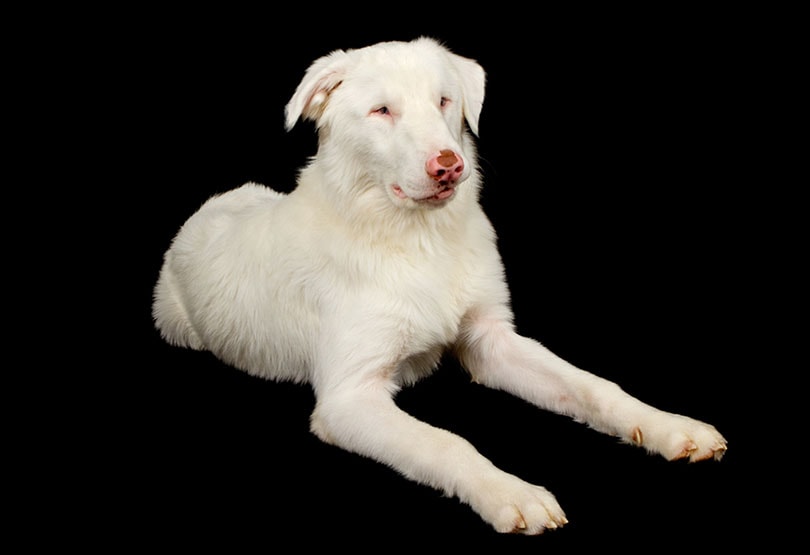
Australian Shepherds are renowned for their gorgeous and unique coat color patterns, which causes dog lovers to wonder why some Australian Shepherds are born mostly white. Added to this, the fact that these dogs are—inaccurately—referred to as “lethal white Aussies” may put some people off adopting a White Australian Shepherd, which is a real shame.
In this post, we will discuss what the lethal white gene is and the truth about what causes some Australian Shepherds to be born almost completely white.

Lethal White Australian Shepherd Explained
Though white Australian Shepherds are thought to carry the lethal white gene, this is actually untrue. The lethal white gene is real, but it typically affects paint horses and is known as overo lethal white syndrome¹. It causes foals to be born with a dysfunctional colon, and this sadly causes death within a few days. These foals are also mostly white, which explains the “white” part of the term.
Australian Shepherds born almost completely white have two copies of the merle gene. “Merle” is a coat pattern combination describing dogs with a solid base color and red, blue, or gray patches. This is what makes them appear “speckled” or “mottled” and is what’s called a “diluted” color. These dogs also often have blue eyes.
When an Australian Shepherd is born with double merle genes (MM), it results in an almost completely white coat. This is called “homozygous merle” and is caused by breeding between two merle dogs. It is sometimes confused with albinism¹, but this is a different condition. Also, it’s important to bear in mind that just because a dog is white, it doesn’t necessarily mean that they’re a double merle.
How Do Australian Shepherds Get the Double Merle Gene?
This is where it gets a tad tricky. When it comes to genetics, we use the terms “dominant” and “recessive”, and the merle gene is dominant while the solid gene is recessive. To show which gene is dominant, we use a capital letter (M), and to show which gene is recessive, we use a lower case letter (m).
The three possible gene combinations are:
When two regular merles are bred, the odds of getting double merles in the litter is 25%. However, if a merle and a solid, a solid and a solid, or a double merle and a solid are bred together, there is no chance that the litter will contain double merles—only regular merles.
In brief, white Australian Shepherds occur when they acquire the double merle gene (MM) from their regular merle parents.

How Is the Lethal White Gene Different from the Double Merle Gene?
When a foal is born with the lethal white gene, it affects the colon, causing death in a matter of days. This is not the case with dogs born with the homozygous merle gene. While there are health issues—which we will discuss further down—connected with homozygous merles, the condition is not fatal.
Contrary to what many think, homozygous merles can live happily with a great quality of life with loving dog parents who take care of them well. Sadly, some choose to kill homozygous merle puppies at birth or when their permanent whiteness becomes apparent due to the incorrect use of the term “lethal white”.
For this reason, how commonly this term is used is very harmful to Australian Shepherds and other dog breeds born with the double merle gene, which is why it’s important for people to learn the difference between the lethal white gene and the homozygous merle gene.
Why Are White Australian Shepherds Called “Lethal Whites”?
The reason Australian Shepherds with the homozygous merle gene started to be referred to as “lethal whites” is that historically, they were usually born on farms and ranches where they were used as working dogs.
Those who ran ranches were familiar with the lethal white gene that affects horses, and the close resemblance between dogs born with the double merle gene and horses born with the lethal white gene is what started the term being linked to white dogs.
Which Health Issues Are Linked to Double Merles?
Though double-merle Australian Shepherds are unlikely to die soon after birth, they are still prone to certain health issues. Two of these health conditions are blindness and deafness. In some cases, white Australian puppies are born with one of these conditions, or occasionally both.
Not every double merle will experience these issues, but there is a much higher chance for them to occur than in dogs with other coat colors. Luckily, just because a dog is blind and/or deaf, doesn’t mean they can’t have a good quality of life as long as they’re taken care of properly.
Double merles are also known for being prone to heart problems, bone problems¹, and reproductive issues¹, which is why breeding two regular merles is not encouraged.
Final Thoughts
To sum up, white Australian Shepherds do not have the lethal white gene sometimes found in paint horses but are rather the recipients of double merle genes. Contrary to common belief, white Australian Shepherds do not typically die within days of birth and can live long, happy lives with the right care, even if deaf or blind.
On the other hand, it's not encouraged to deliberately breed double merle dogs due to the health conditions that have been linked to them. However, their average life span (12–15 years) is no different from any other Australian Shepherd, and if you are considering adopting a double merle Australian Shepherd, they’re still sure to show you the same amount of love as any other dog and there’ll be many happy times ahead.
Sources
https://www.dvm360.com/view/canine-reproductive-diseases-and-abnormalities-proceedings
https://zoomroom.com/admin/dogs-with-disabilities-myths-truths/
https://en.wikipedia.org/wiki/Lethal_white_syndrome#Homozygotes
https://www.australian-shepherd-lovers.com/lethal-white.html
http://www.amazingaussies.org/Welcome/frequently-asked-questions/
https://www.merle-sine-insertion-from-mc-mh.com/myths-and-speculations/
https://ceh.vetmed.ucdavis.edu/health-topics/lethal-white-overo-syndrome-lwo
Featured Image Credit By: GoodFocused, Shutterstock
Get Hepper In Your Inbox


Pet care tips from our vets and experts, straight to your inbox.
You may opt-out at any time. View our Privacy Policy for more information.
Kit Copson is a freelance writer and lifelong animal lover with a strong interest in animal care. She has parented various furry beings over the years and is currently a proud cat mom of two—one skittish but adorable Domestic Shorthair and very chilled (unless hungry) Siamese and a —and dog mom of one—an adopted Bichon Poodle cross. When not writing about or spending time with pets, Kit can be found doodling in her sketchpad, reading, or more often than not, drinking tea.
Join the conversation
Ask a question, share your story, or send private feedback.