Hepper is reader-supported. When you buy via links on our site, we may earn an affiliate commission at no cost to you. Learn more.
13 Incredible UK Service Dog Statistics & Facts: Updated in 2026

In this article
Note: This article’s statistics come from third-party sources and do not represent the opinions of this website.
The partnership between dogs and humans isn’t a new one. We’ve been working alongside one another for thousands of years, but now the jobs have changed slightly. Some dogs can be used in the police, military, or as service and therapy dogs. The role of a service dog itself can vary drastically, from dogs being used to detect changes in a human’s blood sugar levels to those that help their owners navigate the world around them safely.
In this article, we’ll go through some incredible statistics and facts about service dogs. We’ve separated these facts and statistics into sections:

Top 13 Incredible UK Service Dog Statistics & Facts
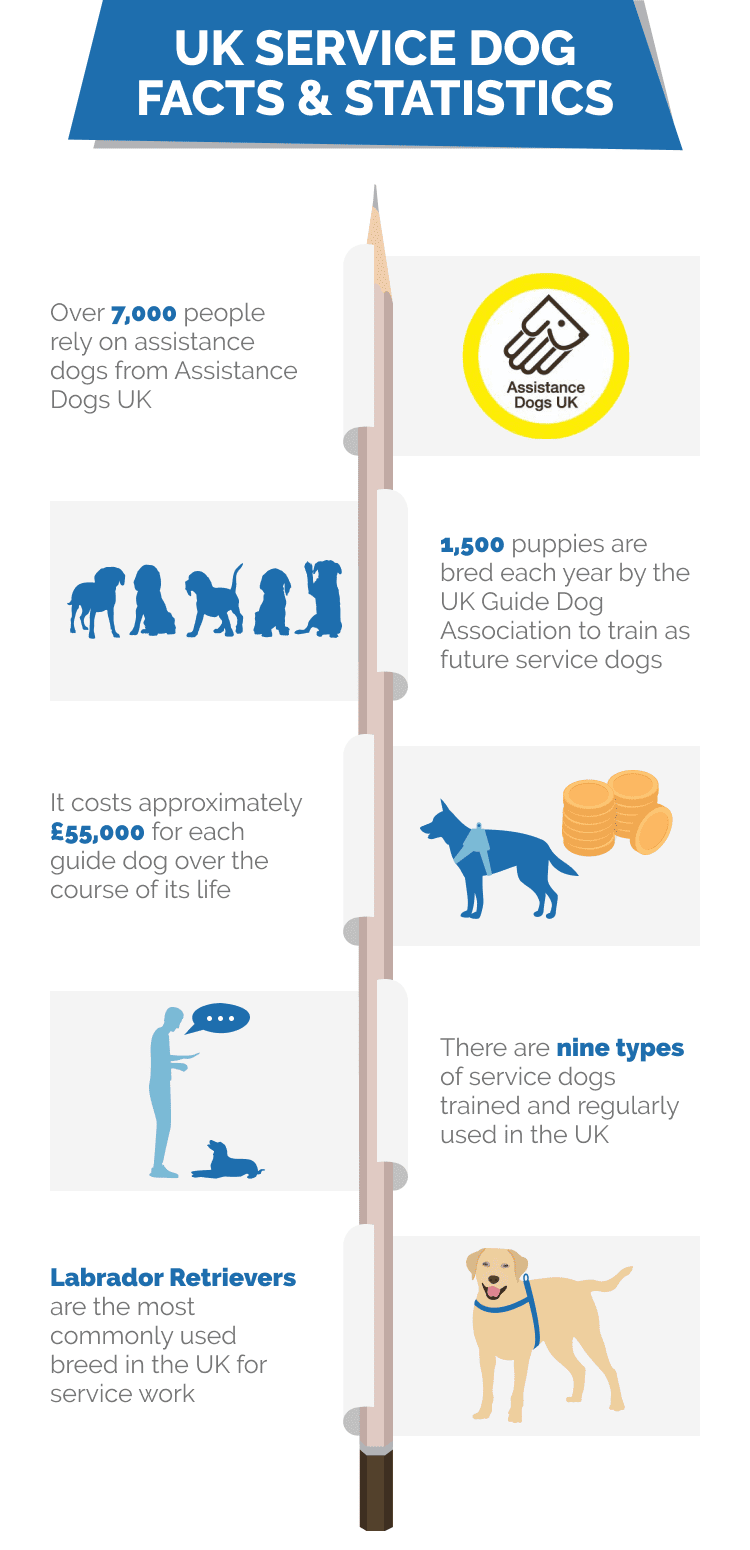
Over 7,000 people rely on assistance dogs from ADUK’s members.
ADUK lists six unaccredited candidates that you can contact directly to get a service dog.
In 2021, Guide Dogs created 37% more new guide dog partnerships than the previous year.
1,500 puppies are bred each year by the UK Guide Dog Association to train as future service dogs.
It costs approximately £55,000 for each guide dog over the course of its life.
There are nine types of service dogs trained and regularly used in the UK.
Diabetic Alert dogs are trained to detect and alert their owners of potential episodes of hyperglycemia when blood sugar levels are too high.
It takes 9–12 months to train a Post-Traumatic Stress (PTSD) assistance adult dog.
50%–60% of Guide Dog puppies complete their training and become guide dogs.
Labrador Retrievers are the most commonly used breed in the UK for service work.
Medical detection dogs had a 94% accuracy rating in a study to detect Covid-19 infections.

ADUK Member and Candidate Statistics and Facts
1. Over 7,000 people rely on assistance dogs from ADUK’s members.
(ADUK)
Assistance Dogs UK (ADUK) is a coalition of assistance dog organizations that are all accredited by Assistance Dogs International (ADI) or The International Guide Dog Federation (IGDF). As the UK doesn’t have an official registry for assistance dogs, ADUK acts as an umbrella organization for a collection of service dog training groups.

2. ADUK lists six unaccredited candidates that you can contact directly to get a service dog.
(ADUK)
To become a full member of ADUK, organizations must gain accreditation from either ADI or IGDF and prove they work to the highest training and welfare standards. While some training programs are at different stages of their accreditation journey, they are still listed on the website for you to contact. In total, 11 member organizations have been accredited by ADI and IGDF.
3. In 2021, Guide Dogs created 37% more new guide dog partnerships than the previous year.
(Guide Dogs)
Guide Dogs supported over 4,000 guide dog partnerships and provided support and advice on more than 42,000 occasions through their expert helpline Guide Line.

4. 1,500 puppies are bred each year by the UK Guide Dog Association to train as future service dogs.
(Guide Dogs)
Since 2011 when Guide Dogs opened its breeding center, they’ve bred almost 11,000 puppies. They mostly breed Labradors, Golden Retrievers, and German Shepherds. There are also some curly-coated Retrievers and Standard Poodles to create lower-shedding guide dogs.
5. Canine Partners place approximately 78 dogs per year.
(Canine Partners)
There are more than 1.2 million wheelchair users in the UK. In 2021, Canine Partners received over 500 emails and phone inquiries about applying for a canine partner. They currently have 11 puppy training groups in the country, and it takes 20–24 months to train and place a dog.

Service Dog Training Facts and Statistics
6. It costs approximately £55,000 for each guide dog over the course of its life.
(Guide Dogs)
This money is raised by donations from the general public. When a dog and owner are successfully paired, the new owner has to hand over 50p, which covers the legal transfer of the dog to the owner.

7. There are nine types of service dogs trained and regularly used in the UK.
(Purina)
Service dogs offer various types of support and are trained to offer freedom to people all over the UK. The most common types of service dogs are:
8. Diabetic Alert dogs are trained to detect and alert their owners of potential episodes of hyperglycemia when blood sugar levels are too high.
(Hypo Hounds and WebMd)
A study in 2016 showed that dogs could alert their owners to changes in their blood sugar levels. Scientists believe that dogs can smell chemical changes in your breath, sweat, and saliva when your blood sugar levels change.
9. It takes 9–12 months to train a Post-Traumatic Stress (PTSD) assistance adult dog.
(Working Dogs UK)
Instead of using puppies, Working Dogs UK works exclusively with rescue dogs that are matched with a member of the armed forces or an emergency worker suffering from PTSD. These dogs help their owners manage emotional trauma, anxiety, and mental health disorders.
10. 50%–60% of Guide Dog puppies complete their training and become guide dogs.
(Sky News)
Guide Dogs UK is working on a genetic study involving 3,000 puppies to identify the ideal guide dog traits to increase success levels. Dogs that don't pass the assessment are currently placed as pets or go into other service work, like medical detection.

Other Service Dog Statistics and Facts
11. There are around 14.6 million disabled people in the UK, but some still feel they and their service dogs are discriminated against.
(Scope and Research Briefings)
The Equality Act 2010 and Disability Discrimination Act 1995 (NI) and The Equalities Act 2010 and Disability Discrimination Act 1995 (NI) protect disabled people and their rights to services. For instance, a shop with a “no dogs allowed” policy cannot refuse entry to a service dog.

12. Labrador Retrievers are the most commonly used breed in the UK for service work.
(Purina)
Labs have had many jobs, like guide work, drug and bomb detection, and search and rescue operations. They’re such an intelligent breed that they even know when to disobey a command and act in the best interest of their handler.
13. Medical detection dogs had a 94% accuracy rating in a study to detect Covid-19 infections.
(Plos One)
Medical Detection Dogs is now training Covid detecting dogs; the dogs learn to detect Covid-19 in urine and saliva samples. As training improves, hopefully, the success rate of medical detection rates will climb closer to 100%.
Frequently Asked Questions About UK Service Dogs
Do You Need to Prove Your Dog Is a Service Dog?
There isn’t a certification or registration for assistance dogs in the UK, so there is no way to prove your dog is a service dog. However, if your dog is trained by ADUK, you’re issued an ADUK Identification Booklet. (ADULT)
Can People Train Their Dogs to Be Service Dogs?
Generally, when you’re partnered with a service dog, it becomes yours, but sometimes this isn’t the case. Hypo Hounds trains dogs to assist children with managing their diabetes and retains ownership of the dog. (ADUK and Hypo Hounds)

How Are Therapy Dogs Different From Service Dogs?
Therapy dogs are technically not the same as service dogs. They don’t need as much training as a service dogs and are not trained to live with a specific handler. They also don't have the same permission to enter public spaces as other assistance dogs.
Therapy dogs generally go to hospices, hospitals, nursing homes, schools, and mental health facilities to offer companionship and comfort. Therapy animals must be calm in busy, unpredictable environments, and they need to be relaxed about being handled by a variety of people. (Purina)
Conclusion
Service dogs in the UK are highly trained, carefully selected, and provide an invaluable service to their handlers. They give people freedom and support who otherwise might feel vulnerable on their own. It’s clear that as trainers and scientists discover new ways that dogs can support people, the roles of service dogs will continue to expand.
Sources
Featured Image Credit: gemphoto, Shutterstock
Get Hepper In Your Inbox


Pet care tips from our vets and experts, straight to your inbox.
You may opt-out at any time. View our Privacy Policy for more information.

Kerry-Ann lives in Scotland and wishes her garden was bigger so she could have her very own Highland cow. But her dogs probably wouldn’t like that very much. She has a La Chon called Harry who was poorly with a liver shunt when he was a puppy. It wasn't likely he would make it into adulthood, which was difficult, but he beat the odds and is a healthy old man now. She also has a Pug called Maddie who is a big foodie. She’s small, sassy, and every day she finds a new way to mess with her brother.
When she isn’t writing you can find Kerry-Ann going for long walks when the weather isn't bad, reading, or watching cartoons when she should be tidying her house. She would one day like to be a tourist in her own country and travel through the Highlands with her family.
Join the conversation
Ask a question, share your story, or send private feedback.