Hepper is reader-supported. When you buy via links on our site, we may earn an affiliate commission at no cost to you. Learn more.
5 Bull Terrier Health Issues to Know About (Vet Answer)


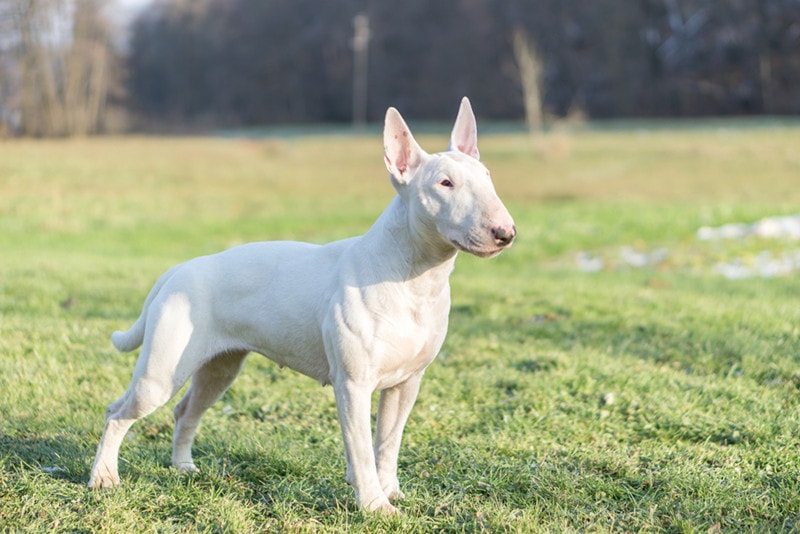
When people hear “Bull Terrier”, many people assume that it is a Pitbull or Pitbull type dog. But the Bull Terrier is actually a separate breed. Originally bred to be entertainment during bull fights, they quickly became popular domesticated pets following outlawing these fights in many countries. While Bull Terriers have changed over the years, they're still fairly hardy, loyal companions. But Bull Terriers aren’t without their health problems, and we will discuss some of the most common ones in this article.

The 5 Bull Terrier Health Issues
1. Luxating Patellas
The patella is another name for the kneecap. Each dog has two patellas which sit in the middle of each of their knee (stifle) joints on the back legs. The patella helps with bending and straightening the knee, and also helps protect the knee joint. If a Bull Terrier has a luxating patella, one or both kneecaps will move to either the inside or the outside of the knee, instead of staying in the center. This can be congenital in Bull Terriers when they are born with their patellar groove (the area where the kneecap sits) being too shallow to hold the patella in place.
Patellar luxation can also occur after a trauma to the knee. You’ll notice that your Bull Terrier is in significant pain, often unable to bend and/or straighten their knee normally, and may have swelling around the knee as well. Traumatic patellar luxations often just occur to one knee, while congenital patellar luxation can occur in one or both.
Most of the time the luxation, or abnormal position of the kneecap, will occur when the knee is bent and/or flexed, or during movement. However, sometimes the patella will become stuck in an abnormal position. When this occurs, your Bull Terrier will be in significant pain. If the issue is more chronic, your Bull Terrier may not show any signs until later in life, when arthritis has set in.
Keeping your Bull Terrier on appropriate joint supplements, anti-inflammatories, and managing their weight can help with pain. If severe, a luxating patella may require surgery to fix.
2. Deafness
There are many causes of decreased hearing and/or complete deafness in dogs. For the purpose of this article, we are going to focus on inherited or congenital deafness. This is when a deaf parent (or both), passes on deafness to their offspring. A good, reputable breeder will stop breeding an affected dog once deafness is identified in the adult and/or any of their offspring. If you are planning on working with a breeder to buy a Bull Terrier, ask them about the parents’ hearing ability. Also inquire if any of the puppies were born deaf in any previous litters.
Testing for decreased hearing and/or deafness can be difficult. If your puppy does not react normally, or does not seem to react to normal sounds, this may give you an indication they have poor hearing. However, advanced testing for hearing ability is performed at very few facilities, many being veterinary teaching hospitals.
3. Kidney Disease
Purebred Bull Terriers can be prone to two major types of kidney disease – polycystic kidney disease and hereditary nephritis. Polycystic kidney disease is congenital, or an inherited disease, in Bull Terriers. It can be inherited in a puppy when just one parent has the disease. Abbreviated PKD, polycystic kidney disease is when one or both kidneys develop cysts. This typically occurs at a young age and becomes progressively worse throughout life. Eventually the cysts will interfere with normal functioning kidney tissue. Unfortunately, once a dog has PKD, there is no cure. Your veterinarian can discuss supportive therapy for your Bull Terrier, but ultimately the condition will worsen.
Hereditary nephritis is also, as the name suggests, an inherited disease in Bull Terriers. Similar to PKD, it can be passed down if just one parent has it. Affected Bull Terriers will develop kidney disease at different ages. As with most types of kidney disease, it will progress with age. While supportive therapy may slow down the progression and keep your Bull Terrier comfortable, ultimately the affected kidney(s) will worsen.
4. Cardiac Disease
Any breed or mixed breed dog can be born with inherited cardiac disease. Others can develop degenerative valve disease as they age. In Bull Terriers, they have an increased incidence of mitral valve dysplasia. The mitral valve is a valve on the left side of the heart that helps separate and control blood flow from the left atrium into the left ventricle. Bull Terriers may be born with an abnormally formed mitral valve, causing backflow of blood into the left atrium instead of all of the blood being pumped forward into the ventricle. Over time, dogs with this condition will develop an enlarged left side of the heart, abnormal thickening to the heart muscle, and can go into congestive heart failure.
A Board Certified Veterinary Cardiologist, or Board Certified Radiologist, will be able to perform an echocardiogram on your Bull Terrier to determine if they have this condition. An echocardiogram is essentially an ultrasound or live imaging of your dog’s heart. Based on those results, your Bull Terrier may need to be on cardiac medications. Unfortunately, many dogs with mitral valve dysplasia will get progressively worse as they age and can be at risk for sudden death at any time.
5. Allergies
Allergies are unfortunately becoming more and more common across many dog breeds, including mutts. Despite what marketing has made many people believe about food and grain allergies, the most common cause of allergies in dogs is environmental. In dogs and cats, allergies tend to manifest as itchy skin, known as pruritus. This may cause your Bull Terrier to lick his or her paws constantly, lick or chew their lower legs and bellies, or even shake their heads from irritation. Fleas and allergies to fleas will cause very similar signs. Even if your dog “only goes outside to use the bathroom”, they can be susceptible to fleas.
There are advanced testing options to help determine what your dog is allergic to. These come with a high price tag and some even require a Board Certified Dermatologist to complete. Most veterinarians will start with putting your dog on a high quality, prescription flea prevention, treating any secondary skin/ear infections, and using now common prescription medications – typically available via a pill and injection at your vet’s office.

Conclusion
Bull Terriers were originally bred to be tough, hardy dogs. They are still considered as such and can make great pets. Unfortunately, Bull Terriers can be prone to many inherited health conditions such as kidney disease, heart disease, deafness, and luxating patellas. Other times they may be more prone to developing allergies, which has not yet been proven to be inherited. Asking your breeder what your Bull Terrier’s parents’ health is like, what they have or haven’t been tested for, and what any previous litters have been born with should be common practice. Maintaining the health of the breed should be a priority and affected parents should be taken out of the breeding program.
Sources
Featured Image Credit: koonsiri boonnak, Shutterstock
Get Hepper In Your Inbox


Pet care tips from our vets and experts, straight to your inbox.
You may opt-out at any time. View our Privacy Policy for more information.
Dr. Podlecki is a graduate of The Ohio State University College of Veterinary Medicine with more than 12 years of experience working with small animals in the US. Dr. Podlecki spent 10 years working almost exclusively in emergency and specialty medicine before transitioning to relief in general practice and the ER. She also owns her own veterinary consulting company (renewvetconsulting.com) that helps vet hospital improve their internal culture.
Join the conversation
Ask a question, share your story, or send private feedback.