Hepper is reader-supported. When you buy via links on our site, we may earn an affiliate commission at no cost to you. Learn more.
Can Bearded Dragons Eat Popcorn? Vet-Approved Facts & FAQ


In this article
Popcorn is a fun snack that a lot of us enjoy, whether at the movies, watching TV, or sitting around with friends. Popcorn can be salty with melted butter or sweet with a melted sugar coating.
So, while you are enjoying some popcorn at home, could you give one or two pieces to your bearded dragon? Unfortunately, no. You should avoid feeding popcorn to your beardie. The popped corn doesn’t offer any nutritional benefit to bearded dragons, and the kernels can be a choking hazard that can even prove fatal. Read on to learn more.

What Is Popcorn?
Popcorn kernels are dried corn—that is pretty straightforward! When people buy corn on the cob, the kernels are softer, making them more digestible when the corn is boiled, steamed, or roasted. But to get popcorn kernels, the corn stalks are dried out and then harvested. The kernels are removed from the cobs and kept stored until they reach 14% moisture content, the ideal moisture percentage for popcorn corn. The kernels are cleaned, polished, and packaged. This is the product you see at the grocery store.
To make popcorn, you need heat—around 450 degrees Fahrenheit. Popcorn can be popped using oil or heated air. Once the kernels have reached the ideal temperature, that remaining 14% moisture generates steam, causing them to pop. People can eat the popcorn simply air-popped or make it sweet, salty, or both!

Why Bearded Dragons Should Not Eat Popcorn
There are a few reasons that a bearded dragon should not eat popcorn.
- Corn itself is not recommended as a good food source due to the lack of nutritional value. Once the corn is popped, some of the kernel remains, and this hard shell can get stuck in the throat and may lead to choking.
- Popcorn is higher in phosphorus than calcium and, therefore, has an inappropriate Ca:P ratio for bearded dragons.
- Some store-bought popcorn contains some unhealthy ingredients. Think about all the butter-flavored sauce that is used on movie theater popcorn. That, plus the salt, makes even a few kernels an unhealthy snack for your beardie. Kettle corn and caramel corn have a high processed sugar content, which is not nutritious.
Therefore, with minimal nutritional benefits and the risk of choking, popcorn is not considered a viable food source for bearded dragons.
Frequently Asked Questions
Can Bearded Dragons Eat Corn on the Cob?
Bearded dragons can eat corn. It isn’t poisonous or toxic, but it doesn’t have much nutritional value for reptiles, and it has a very poor calcium-to-phosphorus ratio. Corn has more than 12 times as much phosphorus as calcium, which means that even calcium dusting won’t provide enough of a calcium boost.
Can Beardies Eat Scrambled Eggs?

Eggs are high in protein, and as long as your beardie is getting enough insects in its daily diet, it shouldn’t need any additional protein. Additionally, eggs have a poor calcium: phosphorus ratio of 1:3.8, which is less than ideal in a bearded dragon’s diet. Eggs are otherwise safe for bearded dragons as long as they are cooked, have had the shell removed, are not cooked in butter, or have no additional ingredients that would make them unhealthy, and are fed occasionally in small amounts.
Can Beardies Eat Grapes?
Grapes are considered toxic to cats and dogs, but they are not toxic to beardies so they can be safely fed in this regard. However, a bearded dragon’s diet should only include a small amount of fruit, so you should not feed too many grapes. Grapes are high in sugar, which can lead to weight gain, so be especially careful with the amount you feed. Make sure you cut the grapes in half and remove any seeds.
The 4 Tips for a Healthy Bearded Dragon Diet
1. Follow the 10-Minute Rule
Your bearded dragon will likely prefer its live feed to its salad, and some beardies tend to gorge themselves on insects.
When it’s time to feed a juvenile bearded dragon live insects, offer as many as your beardie can eat in 10 minutes and remove any that are left after this time. When you next come to feed, you will have a good idea of how many insects to put in the enclosure. As your bearded dragon becomes an adult, its diet should become more vegetable-heavy, so 10 to 20 insects three times a week should be enough.
2. Live Food Needs to Be Live
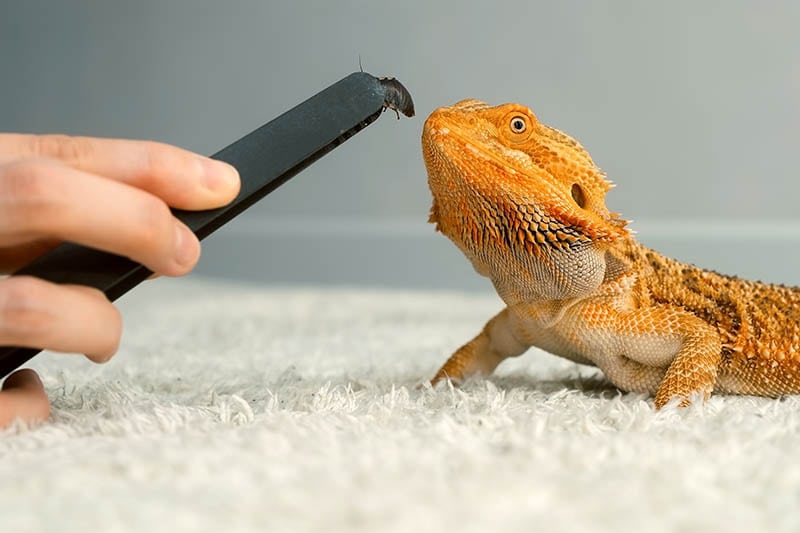
If you’ve watched your bearded dragon eat a live insect, you will have seen it tilt its head to get a better view. These reptiles rely on their sight to identify and target their prey, and insects grab their attention whenever they hop, wriggle, or move. As such, the insects you feed your bearded dragon need to be alive. If they are dead, they won’t move and get the attention of your dragon. If you’re not keen on the idea of feeding live insects, you may want to consider a different pet.
3. Mist for Hydration
Like all animals, beardies need water to stay hydrated. In the wild, they will typically get water from rain and drops of water falling off plant leaves and flowers, rather than from rivers or other water sources. As such, your bearded dragon may not notice or use a water bowl in its enclosure. Having a waterfall or some other method of moving the water can help to keep the environment humid.
Additionally, you can spray the plants and even your beardie 2–3 times a week so that it has a reliable and constant source of hydration.
4. Monitor Calcium to Phosphorus Ratio
Bearded dragons need calcium to maintain bones and skin. Phosphorus is also important and further aids in bone development, but it binds with calcium and prevents your beardie from being able to absorb and use the calcium in its diet. As such, beardies need to consume between 1.5 and 2 times as much calcium as phosphorus. Pet dragon diets are usually high enough in phosphorus but not high enough in calcium, which is why we lightly dust their food with phosphorus-free calcium powder. But you will also need to monitor the calcium and phosphorus levels of the foods you feed. Avoid those foods that are high in phosphorus and steer towards calcium-rich foods instead.
Conclusion
Bearded dragons have very specific dietary requirements. Typically, these are met through a combination of gut-loaded live insects, a selection of leafy greens, other vegetables, some fruit, and some supplementation.
However, while fresh corn is considered non-toxic for a bearded dragon, popcorn is not considered a good addition to the diet because the kernels can pose a choking hazard and may get lodged in your bearded dragon’s throat. It also offers very little in the way of nutrition for your bearded dragon, so it’s certainly not worth the risk.
Sources
Featured Image Credit: Georgia Vagim, Unsplash
Get Hepper In Your Inbox


Pet care tips from our vets and experts, straight to your inbox.
You may opt-out at any time. View our Privacy Policy for more information.
Nicole is a lover of animals of all sizes but is especially fascinated with the feline variety. She’s the proud mom of Baby, a Burmese, and works every day so he can relax in the sunshine or by the fire. She’s always had a cat in her home and has spent countless days with others, observing behaviors and softening up even the grouchiest of the lot. Nicole wants to share her kitty expertise with you so you and your cat can live happy, healthy, and care-free.
Join the conversation
Ask a question, share your story, or send private feedback.