Hepper is reader-supported. When you buy via links on our site, we may earn an affiliate commission at no cost to you. Learn more.
How Fast Can Hamsters Run? Vet Reviewed Rodent Speed Guide


In this article
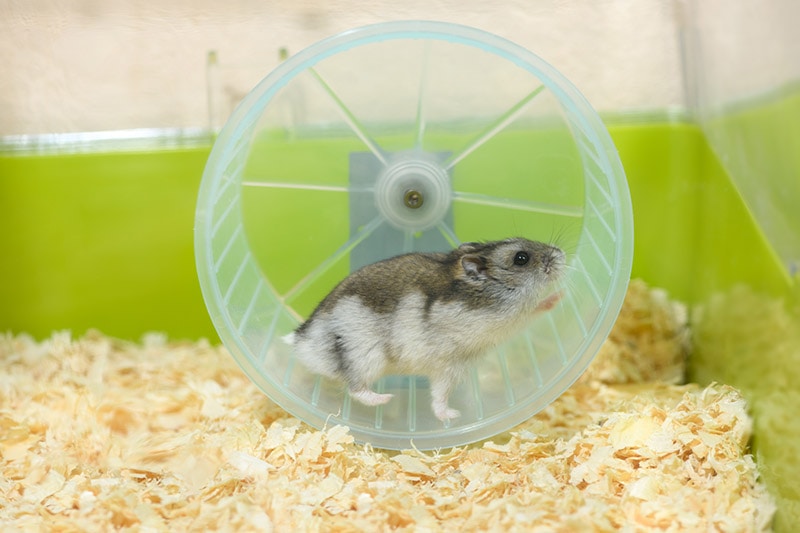
Besides stuffing their cheek pouches full of food, hamsters are famous for running for ages on their hamster wheels. If you have ever watched a hamster race on a wheel, you know that their little legs are nothing but a blur when they really get going.
So, have you ever wondered how fast these little animals can run? Prepare yourself: Hamsters have been known to run 3 km per hour! With many anecdotal reports of their top speed being even higher.
If you’re interested in learning more about hamster speed, read on for those details, along with why hamsters need to move so fast and the importance of those running wheels!

How Fast Are Hamsters?
All breeds of hamsters can run quite fast, from the largest domestic hamster, the Syrian hamster, to the tiny Roborovski dwarf hamster. Compared to their small size, hamsters can reach some impressive speeds. One study showed them reaching speeds of 3 km/hour, with many online anecdotal reports of speeds of 5 km/hour or even faster1.
How fast a hamster runs depends on their breed, age, weight, health, and the individual hamster themselves.
To put things in perspective, the following chart compares the running or top speed of a few different sized mammals, from fastest to slowest.
Speed Chart
| Animal | Speed |
| Cheetah | 111–121 km/h (69–75 mph) |
| Brown Hare | 77 km/h (45 mph) |
| Pig | 18 km/h (11 mph) |
| Hamster | 3 km/h (1.86 mph) |
| Slow Loris | 1.9 km/h (1.18 mph) |
| Three-Toed Sloth | 0.27 km/h (0.17 mph) |
Why Do Hamsters Need to Run Fast?
Evade Predators
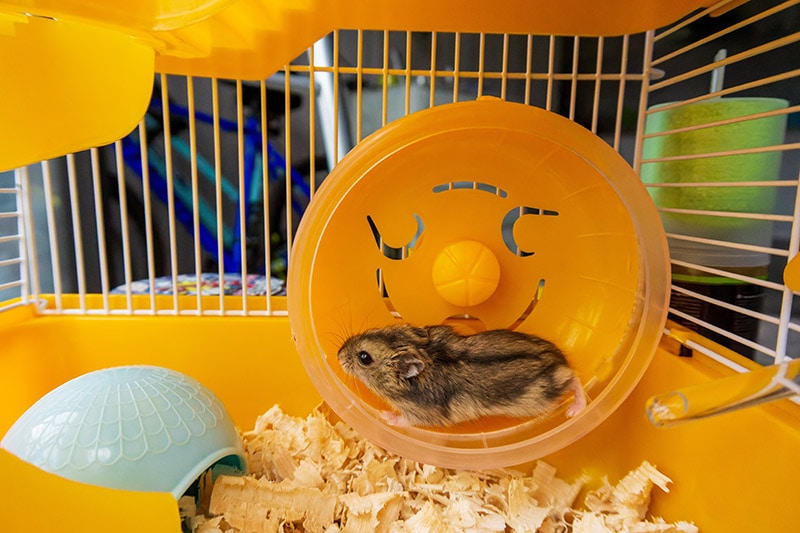
Hamsters in the wild are natural prey, so running fast helps them evade predators. Being quick and agile can lead to fancy outmaneuvering! They can change direction and stop suddenly in an instant, which allows for speedy escapes from most dangers.
If you’re a hamster owner, you’ll know from firsthand experience how fast they are and how good they are at evading your hand!
Cover Territory
Wild hamsters are nocturnal and must run through a large amount of territory to find the food that they need to survive. This is where those ginormous cheek pouches come in handy, which can hold up to around 20% of their body weight in food. Wild hamsters also create a stash of food in their burrow, but they must find new food every night to bring back to eat and store.
There’s also the question of mating, and for most breeds, hamsters need to find a mate in the spring and summer, which also requires a fair amount of exploring and running around in their territory.
Let Off Steam
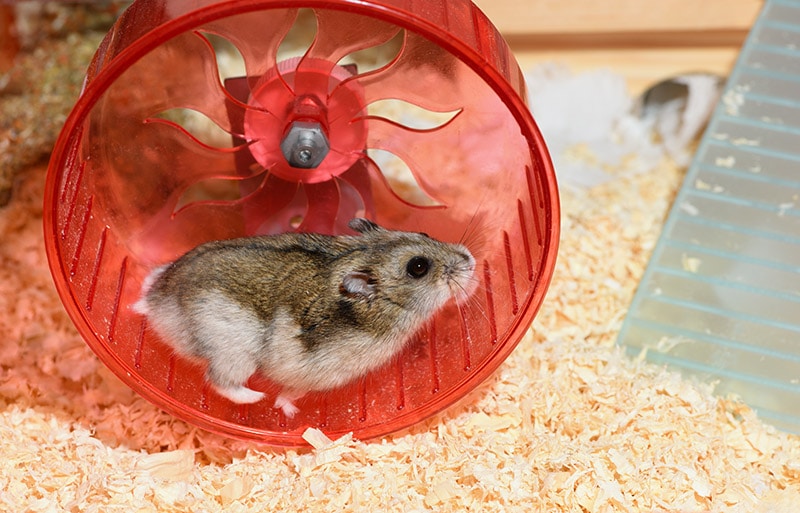
Hamsters are full of energy, and running can help release a large amount of that energy. Behavioral problems can become an issue without an outlet for them to let off steam.
You may have also noticed that your hamster doesn’t do anything slowly—they tend to scurry and move with quick movements, which just highlights how high energy they are.
Why Do Hamsters Use Running Wheels?
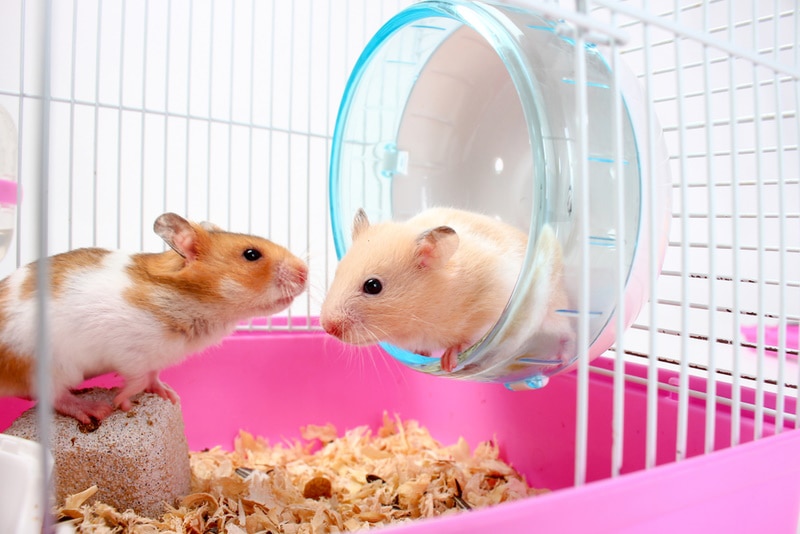
Many hamsters love running on their wheel! While running away from predators and searching for food isn’t necessary for pet hamsters, the instincts remain. That energy needs somewhere to go!
For Distance
Since wild hamsters typically cover a large amount of ground overnight, domestic hamsters also feel the urge to run. In fact, a hamster can run the equivalent of 5.6 miles (9 kilometers) in one night! Running on a wheel helps expend energy, reduce boredom, and keep them healthy.
For Health
A running wheel can help prevent obesity and provide mental and physical stimulation. A lack of exercise can lead to a stressed hamster. You may notice signs such as bar chewing, and a stressed hamster is more likely to bite when handled.
For Fun
If you’re worried that a hamster running on a wheel might be a sign of a bored hamster, a study was conducted in which a running wheel was placed outdoors.
Video caught frogs using it (not exactly running on it, but using it nonetheless), along with wild mice (one ran for 18 minutes on the wheel)! Over 200,000 animals used the running wheel over a 3-year period. Clearly, a wheel is a great way for many animals, including your hamster, to exercise and have fun!
Helping Your Hamster to Exercise
Now that you’ve seen how essential running is for your hamster, you need to ensure that they get enough exercise. The hamster wheel is the most commonly used piece of equipment, but you need to get the right type.
Your hamster’s cage should be as large as possible but no smaller than 40 x 20 x 20 inches. Large is better because it will give you room for a running wheel and space for your hamster to explore and burrow into.
The Hamster Wheel
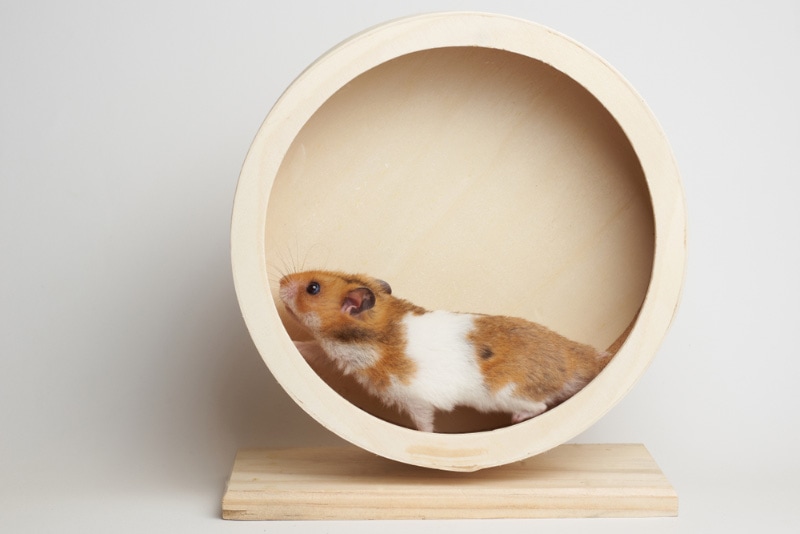
You need to take into consideration a few factors when purchasing a hamster wheel. First, it should be large enough that your hamster doesn’t have to drastically arch their back while running. This is uncomfortable for the hamster and will likely lead to medical issues. According to the Veterinary Association of Animal Welfare, dwarf hamsters should do well on a small to medium-sized wheel ( of at least 8 inches), while a Syrian should have a medium to large wheel (of at least 12 inches).
Second, the wheel should have a solid track. One with a wire or mesh track can catch the hamster’s foot and cause serious injuries.
Finally, look for a silent wheel if the cage is in your bedroom. Some wheels can be noisy, and since they will run most of the night, you’ll definitely want a quiet wheel. But if the cage is not in anyone’s bedroom, you probably don’t have to worry so much about this point.
Cage Enrichment
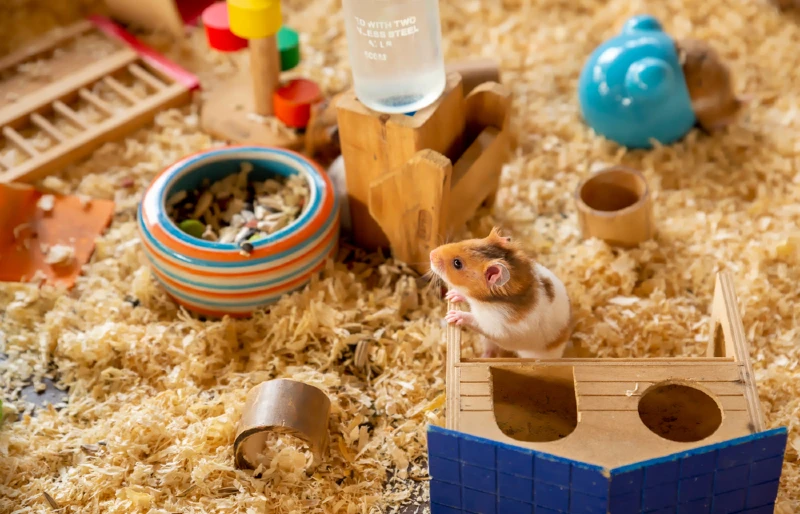
As well as providing a large cage space to explore, hamsters also need lots of toys and activities to stop them getting bored and keep them active. Your pet will love tunnels and cardboard boxes to crawl through and low shelves to climb on. Giving them a deep layer of bedding (approximately 10 inches) means they can burrow into it as they would do in the wild.
The Trouble with Hamster Balls
There’s a certain amount of controversy about using a hamster ball, and we would recommend avoiding their use. A hamster's eyesight is poor and when enclosed in an exercise ball they are unable to use their other senses of touch, smell, and hearing which can cause stress. They are also unable to access resources such as food or water when in the ball and ventilation is often poor.
It is also hard for hamsters to stop the ball from rolling once they gain momentum, and they regularly collide with objects in the environment such as furniture. Lastly, there is a risk of trauma to a hamster's paws or legs when being enclosed in the ball or if caught in air slots.
Conclusion
Hamsters are probably faster than you expected, especially because they are such little critters. They could easily run a hamster-sized marathon! This means it’s doubly important that your pet does not escape, as they are notoriously difficult to catch or even find again.
You should get your hamster an appropriate running wheel and keep an eye on them for any distress. Exercise and mental stimulation are essential for the well-being of your pet.
Sources
Featured Image Credit By: IRINA ORLOVA, Shutterstock
Get Hepper In Your Inbox


Pet care tips from our vets and experts, straight to your inbox.
You may opt-out at any time. View our Privacy Policy for more information.
Kathryn was a librarian in a previous lifetime and is currently a writer about all things animals. When she was a child, she hoped to work in zoos or with wildlife in some way, thanks to her strong love for animals. Unfortunately, she's not strong in the sciences, so she fills her days with researching and writing about all kinds of animals and spends time playing with her adorable but terribly mischievous tabby cat, Bella. Kathryn is hoping to add to her family in the near future – maybe another cat and a dog.
Join the conversation
Ask a question, share your story, or send private feedback.