Hepper blog

Search our database of over 9,984 posts with up-to-date information from our experts and veterinarians.

Hepper is reader-supported. When you buy via links on our site, we may earn an affiliate commission at no cost to you. Learn more.

Do Cats Like Sweet Things & Can They Taste It? Vet-Approved Facts & Safety Tips

By Nicole Cosgrove · Reviewed & fact-checked by Dr. Paola CuevasVet Approved
Dr. Paola Cuevas
Reviewed & Fact-Checked byDr. Paola CuevasMVZ (Veterinarian)
Paola Cuevas is a veterinarian and animal behaviorist, with over 18 years of experience working with a variety of species. Her passion is animal welfare and focuses on the importance of preventive medicine. Paola has skills in the fields of nutrition, microscopy, clinical pathology, diagnostic imaging, and endoscopy as well as extensive experience in animal training through positive reinforcement. As our in-house veterinarian, Paola is very happy to share her knowledge and experience with our readers and hopes to be helpful with any issue presented by your non-human family members.View authorThe information is current and up-to-date in accordance with the latest veterinarian research. Read about our vets
Share
Ask us a question in the comments
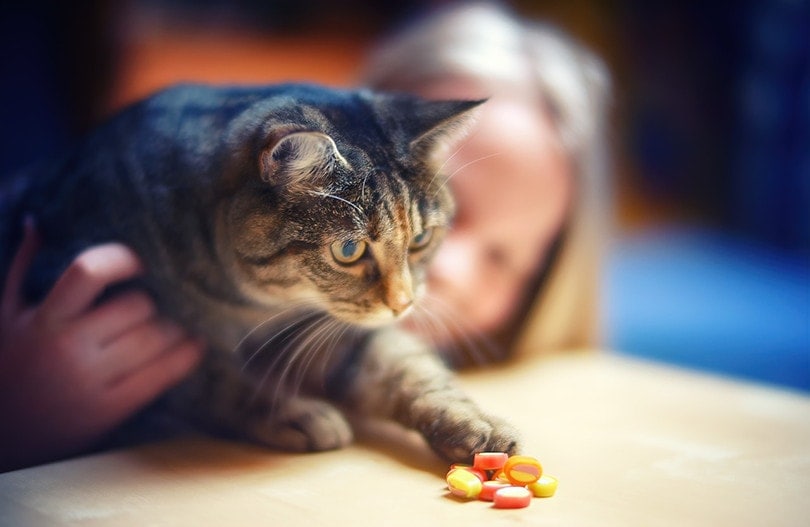
Cat Touching Candy

Most people know that humans have five basic tastes: sweet, salty, sour, bitter, and the difficult-to-define umami flavor. But cats, with fewer than 500 taste buds compared to the 9,000 of humans, experience different tastes. It is believed that cats can taste sour, bitter, salty, and umami, like humans. But they cannot taste sweet and may be able to taste fatty.

While cats cannot taste sweet, many owners report that their cats are attracted to sweet things, so how can this be? Read on to find out more about cats’ tastes and whether they really do like sweet things.

Cat Tastes
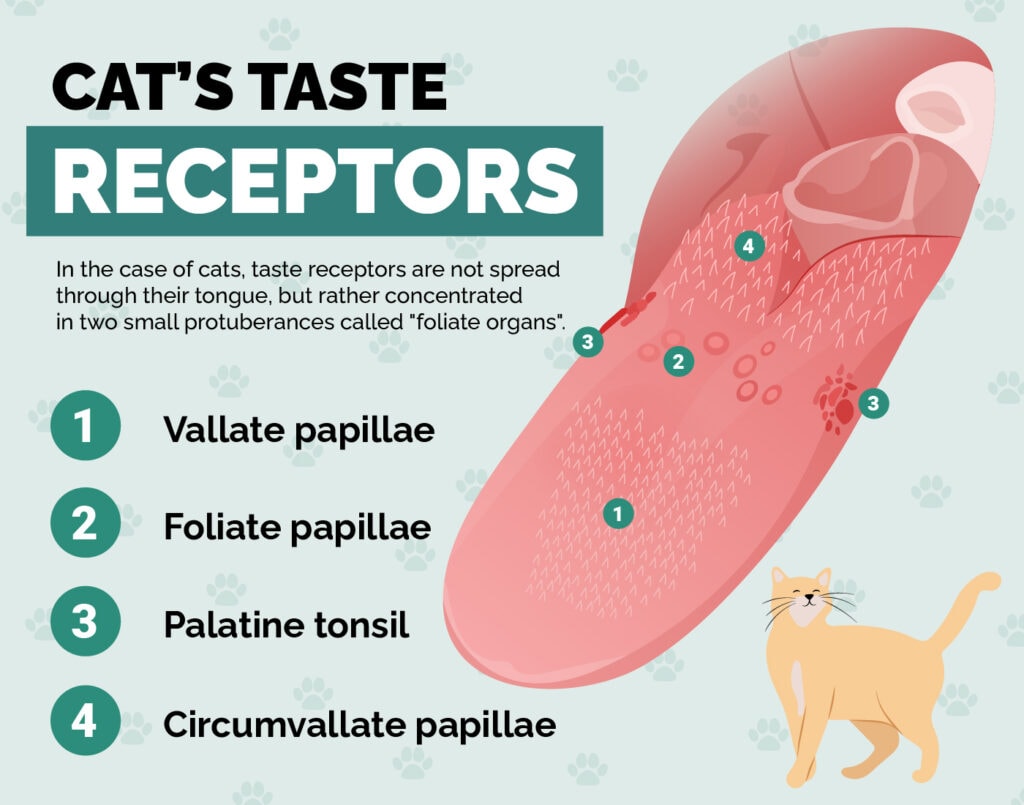
Cat tongue, cat taste receptors
You are free to use this image but you are required to link articles.hepper.com for credits

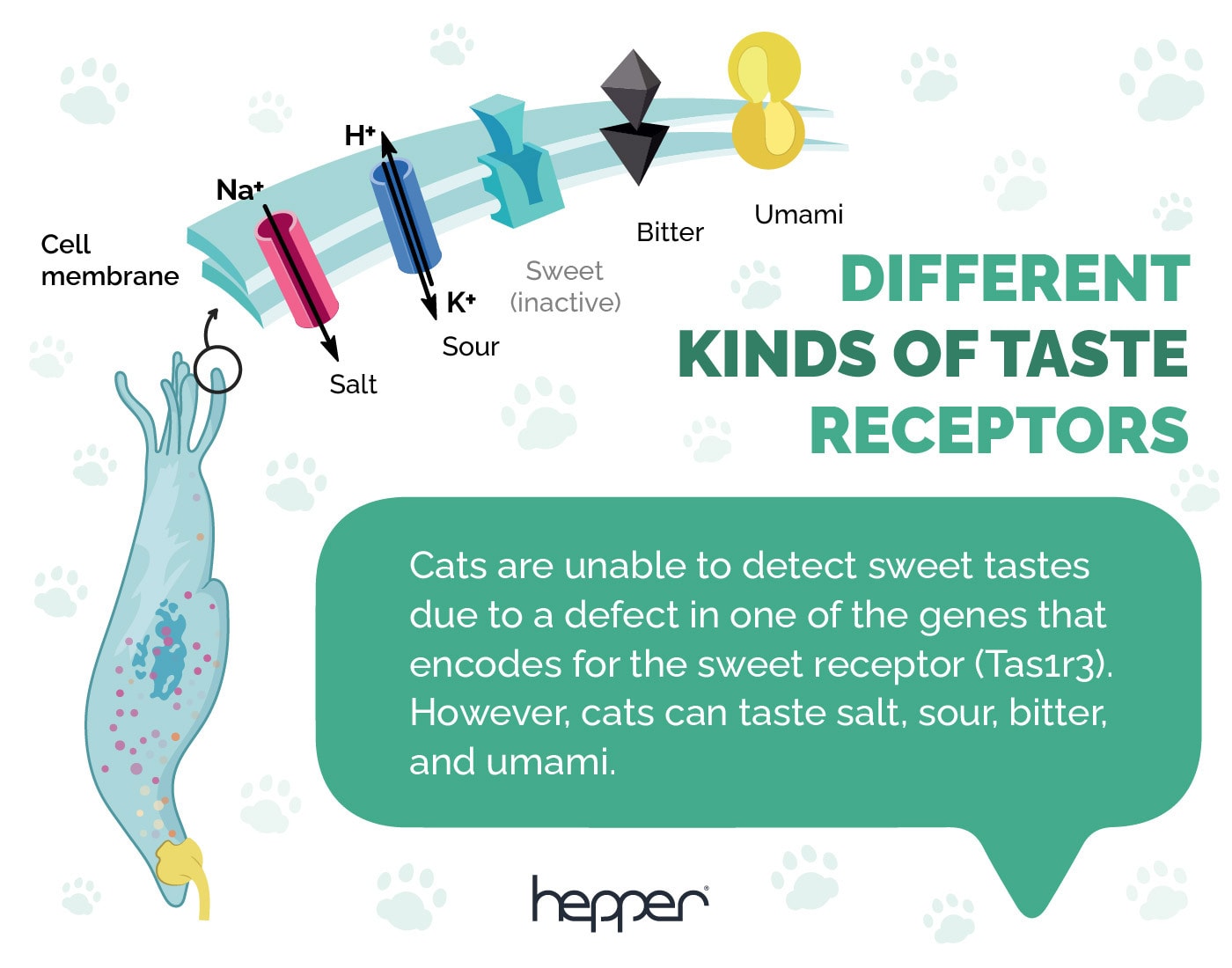
Taste buds are essentially tiny little papillae on the tongue and these receptors detect food and send messages to the brain about how food tastes. The more tastebuds, the more taste sensations are sent to the brain and the more complex food tastes. Humans, on average, have 9,000 to 10,000 taste buds. Dogs, by comparison, have just over 1,500 taste buds, and cats have just 470 taste buds. In the case of cats, their taste receptors are not spread over their tongue, but rather are concentrated in two small protuberances called "foliate organs." Besides the fact that cats have fewer taste receptors, the reason that cats cannot taste sweet is related to a defect in one of the genes that encode for the sweet receptor. With a defective (Tas1r3) pseudogene, cats' ability to taste sweets is basically deactivated.

Despite having so few tastebuds, at least compared to humans, cats can still taste the differences between sour, bitter, salty, and umami flavors. However, while cats can enjoy these different tastes, they cannot taste sweet things.
You are free to use this image but we do require you to link back to Hepper.com for credit

Why Do Cats Like Sweets?

Because cats cannot taste sweet, it means that they neither like nor dislike sweet flavors. They simply can’t taste it. As such, if your cat comes running when you’re eating vanilla ice cream or opening a candy, it isn’t because they crave the sweet flavor on offer.

The Rustle of the Wrapper

Cats are inquisitive animals that like to know what is going on at all times—unless they’re asleep, of course. If your cat comes running when it hears the rustle of a sweet wrapper being opened, it is likely just responding to the noise. It wants to know what is inside the wrapper.

Mistaken Identity

Another reason your cat might pester for the sweet you have is that they look, smell, or sound like something else. The rustling wrapper could sound similar to the noise of their treats being unwrapped. The tasty morsel you’re tucking into might look like their favorite food. The mint in the chocolate that you’re eating may have an interesting smell, similar to that of catnip, which is a member of the mint family. Remember that both chocolate and mint are toxic to cats, so please do not let your cat try your chocolate mint candy.

Other Ingredients

While cats cannot taste sweet things, they can taste fatty foods and salty foods. And some cats do crave these flavors. The ice cream you're eating contains fat, and a lot of sweets are made using lard which, once you strip away the sweet flavoring, has an umami, meaty flavor to it. It could be that your cat recognizes these other flavors and wants these, rather than the sweet flavor that attracted you.

a black polydactyl cat licking its mouth
Image Credit: Casey Elise Christopher, Shutterstock

Sweet Ingredients to Completely Avoid

Cats are obligate carnivores, which means that they should be getting all of their nutrition from meat and animal-based ingredients. While natural sugar is not toxic to cats, their bodies cannot digest or use it properly, and too much sugar can cause problems like vomiting and diarrhea. Therefore, even if your cat does like the taste of something in your sweets, you should avoid offering them to your feline buddy.

Other sweet ingredients that should be avoided include:

  • Xylitol – Xylitol is an artificial sweetener that might be toxic to cats. Avoid any artificial sweeteners. While natural sugar is not good for your cat, it is safer than artificial alternatives.
  • Chocolate – Chocolate is toxic to dogs and cats and dark chocolate is the worst of all. It can cause stomach problems and may lead to abnormal heart rate and even death.
  • Grapes – It isn’t clear exactly what in grapes causes problems for cats but it is known that grapes can lead to kidney failure. This is another ingredient that is unsafe for dogs, too, and because raisins are essentially just dried grapes, they should also be avoided.
  • Caffeine – Caffeine is a very similar ingredient to chocolate and it leads to the same problems if ingested in cats. Make sure your cat doesn’t drink your coffee while your back is turned. While it is unlikely, your feline friend might be attracted to the milk and may be intrigued by what you enjoy so much.

Conclusion

Cats have far fewer tastebuds than humans, which means that they have a different range of tastes. They also have a defective gene that deactivates the sweet taste receptor. Cats cannot taste sweet, which means if your cat is pestering you to eat the chocolate you’re consuming or drink the sweet drink you have, they are likely after one of the other ingredients it contains or are simply intrigued by what you are enjoying so much.

However, sugar isn’t good for cats so you should avoid feeding your cat sweet treats. Even worse for your cat are the artificial alternatives, especially xylitol, which can cause seizures and death, so these should not be considered an alternative.


Featured Image Credit: jplenio, Pixabay

Get Hepper In Your Inbox

Pet care tips from our vets and experts, straight to your inbox.

List

Select all that apply.

You may opt-out at any time. View our Privacy Policy for more information.

Nicole Cosgrove
Authored by

Nicole Cosgrove

Join the conversation

Ask a question, share your story, or send private feedback.
Rate this post
Required to post. Only our editors see your rating.
Who should see this?

A human reviews every comment before it appears. Your email is never published.

Picked to go with this article

Do Cats Have Taste Buds? Vet-Approved Smell & Taste Explanation

Do Cats Have Taste Buds? Vet-Approved Smell & Taste Explanation

When we think about cats, their amazing senses come to mind. These amazing creatures have acute hearing, great eyesight, and a sensitive sense of smell. These…

Nicole Cosgrove
By Nicole Cosgrove ·
Can Cats Eat Sugar? Vet-Verified Facts & Safety Guide

Can Cats Eat Sugar? Vet-Verified Facts & Safety Guide

Whether it’s granulated, brown, or powdered, sugar is one of the fundamental ingredients in so many of our favorite treats and desserts. If your cat steals a b…

Elizabeth Gray
By Elizabeth Gray ·
Can Cats Eat Lollipops? Vet-Approved Facts & Potential Health Hazards

Can Cats Eat Lollipops? Vet-Approved Facts & Potential Health Hazards

Humans have a sweet tooth—and sharing sweets is one way we show love. So, if you’re eating a lollipop and your kitty comes sniffing around, you might be tempte…

Chelsea Mortensen
By Chelsea Mortensen ·
Can Cats Eat Candy? Vet-Approved Facts & FAQ

Can Cats Eat Candy? Vet-Approved Facts & FAQ

Chocolate and toffee and gummies oh my! No matter what your sweet tooth craves you will surely find a candy that suits your fancy. If you’re enjoying your favo…

Elizabeth Gray
By Elizabeth Gray ·

Keep reading

More stories you might like

Do Cats Like Salt? Vet Reviewed Facts

Salt is a necessary nutrient for all living things, including our sweet feline family members. Although cats need a small amount of salt in their diets to stay…

Chantelle Fowler
By Chantelle Fowler ·
Do Cats Like Salt? Vet Reviewed Facts

Can Cats Drink Syrup? Vet-Reviewed Facts & Important Considerations

Cats can eat and drink some pretty weird things. If your cat just made a meal of your pancake buffet this morning, you might be wondering if the syrup is okay…

Ashley Bates
By Ashley Bates ·
Can Cats Drink Syrup? Vet-Reviewed Facts & Important Considerations

Can Cats Eat Mint Ice Cream? Vet Approved Facts, Safety Guide & FAQ

Every cat lover wants to treat their furry friend, but some of the things that we think of as treats are actually threats. In the case of mint ice cream, it is…

Jordyn Alger
By Jordyn Alger ·
Can Cats Eat Mint Ice Cream? Vet Approved Facts, Safety Guide & FAQ

Can Cats Eat Cool Whip? What You Need to Know!

Cats can eat some pretty crazy things. Whipped cream might not strike you as a huge problem factor when it comes to feline consumption—and you'd be right. Asid…

Ashley Bates
By Ashley Bates ·
Can Cats Eat Cool Whip? What You Need to Know!

Why Do Cats Like Bread So Much? 5 Likely Reasons

Cats are known for their unusual quirks and behaviors, but one that might interest you is your cat's unexplained attraction toward bread. Whether it is the sme…

Sarah Psaradelis
By Sarah Psaradelis ·
Why Do Cats Like Bread So Much? 5 Likely Reasons

Can Cats Eat Whipped Cream? Vet-Reviewed Nutrition Facts & FAQ

Our cats sometimes eat all sorts of weird things but then turn their noses up at a seafood feast—we have no explanations! So, if your cat has taken a new inter…

Ashley Bates
By Ashley Bates ·
Can Cats Eat Whipped Cream? Vet-Reviewed Nutrition Facts & FAQ

Can Cats Eat Honey? Our Vet Answers!

Do you ever feel guilty enjoying a tasty treat while your cat glares at you, obviously wanting you to indulge it with a taste as well? It’s common for pet owne…

Dr. Paola Cuevas
By Dr. Paola Cuevas ·
Can Cats Eat Honey? Our Vet Answers!

Can Cats Eat Cotton Candy? Vet Approved Facts & Risks

While many human foods are considered safe for cats, others could potentially cause harm to our feline friends, so you should know which foods are safe and uns…

Visnja Radosavljevic
By Visnja Radosavljevic ·
Can Cats Eat Cotton Candy? Vet Approved Facts & Risks