Hepper blog

Search our database of over 9,984 posts with up-to-date information from our experts and veterinarians.

Hepper is reader-supported. When you buy via links on our site, we may earn an affiliate commission at no cost to you. Learn more.

How Long Can a Corn Cob Stay in a Dog’s Stomach? Vet-Verified Risks & Safety Guide

By Lorre Luther · Reviewed & fact-checked by Dr. Lorna WhittemoreVet Approved
Dr. Lorna Whittemore
Reviewed & Fact-Checked byDr. Lorna WhittemoreVeterinarian
Lorna is a Scottish vet who has lived, studied, and worked on three continents and has a love of travel. With 20 years of experience in small animal medicine andsurgery, both in the charity and private sector. Gaining a further qualification in feline medicine has given her a continued sense of amazement at the fabulous animals. Currently living in Cape Town, South Africa, with her family and expanding number of pets allows her to spend time in and around nature where she is at her happiest. With a love for learning, Lorna is enjoying researching, editing, and fact-checking for Hepper veterinary editorial team and truly feels that she has the best job in the world!View authorThe information is current and up-to-date in accordance with the latest veterinarian research. Read about our vets
Share
Ask us a question in the comments
corn cob

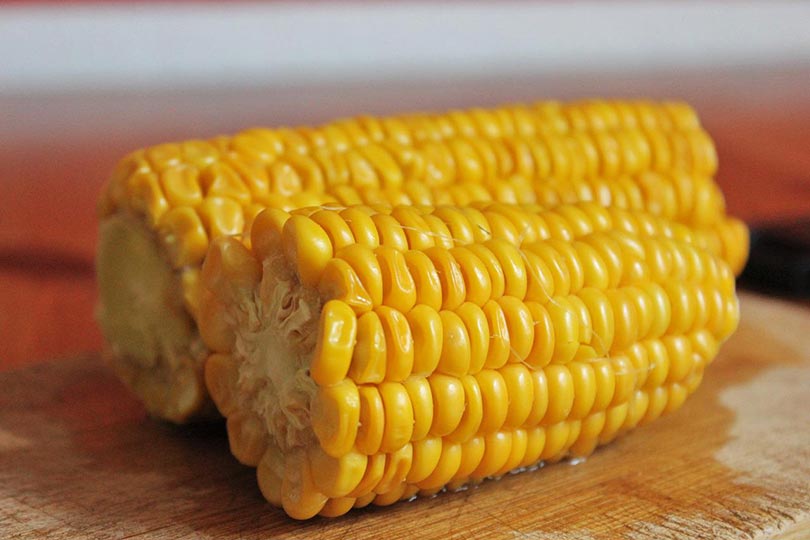
Dogs love human food, and corn on the cob seems to attract dogs like bees to their favorite flowers. If your beloved four-footer got wild at your neighbor's barbeque and scarfed down a helping of corn on the cob, you might be wondering what to do. Or, more precisely, you might want to know how long the corn cob your dog ate can stay in their stomach. Unfortunately, while loose corn is perfectly safe for dogs to eat in moderation, corn on the cob is a hazardous food for dogs.

While it can take up to 72 hours for dogs to eliminate food they've eaten, don't count on this happening with a corn cob. The cob's tough fibrous texture makes it virtually impossible for dogs to digest. If it is too big to pass into your pup's intestines, the cob will remain in your dog's stomach, where it will cause inflammation and irritation until it's surgically removed.

If your pup has managed to chew the cob into just the right size, it can pass from the stomach into the intestines, where it can cause a blockage that'll need surgery to relieve.1 If your dog has eaten a corn cob, reach out to your veterinarian immediately for further guidance and be ready to take your canine friend in for an emergency visit. If you start to see any signs of an intestinal blockage, such as lethargy, vomiting, or appetite loss and it is possible your dog ate a cob, let the vet know.

What Information Does My Veterinarian Need?

If your dog eats corn on the cob, the first thing you should do is make sure they can't get into anything else. Next, try to determine how much they ate. Call your veterinarian immediately and let them know when your dog ate the cob and approximately how much was ingested.

Your veterinarian will help you determine what to do next. While it may seem logical to do nothing in the hope that the corn cob will pass naturally on its own, waiting might actually cause more trouble by allowing the cob to move further down your dog's digestive tract. In many cases, the sooner you begin treatment, the better, but your veterinarian is in the best position to make this determination. Don't waste time trying to get your dog to vomit or engaging in home remedies this can be more dangerous.

dog lying on the floor
Image Credit: Dominik QN, Unsplash

Is It Safe for My Dog to Eat Corn?

Absolutely, as long as you remove it from the cob first. De-cobbed corn is totally safe for dogs to consume. It is a great source of protein, antioxidants, carbohydrates, fat, and vitamins. It also delivers fiber which is fantastic for your dog's digestive health. It's the cob that causes serious problems. It's fine if your dog takes a few bites of corn that have been removed from the cob.

close up pile of yellow corn
Image Credit: Wouter Supardi Salari, Unsplash

Final Thoughts

Remember that dogs need to eat a healthy balanced diet, and that usually involves limiting the amount of human food you let your dog eat. Giving your dog too much butter, which contains tons of saturated fat, and salt can lead to serious problems like obesity, arthritis, diabetes, and heart disease. So, while an occasional treat of human food is fine, it's best to stick with dog food, which is formulated to meet your canine’s nutritional needs.

Sources

Featured Image Credit: javallma, Pixabay

Get Hepper In Your Inbox

Pet care tips from our vets and experts, straight to your inbox.

List

Select all that apply.

You may opt-out at any time. View our Privacy Policy for more information.

Lorre Luther
Authored by

Lorre Luther

Join the conversation

Ask a question, share your story, or send private feedback.

Rate this post
Required to post. Only our editors see your rating.
Who should see this?

A human reviews every comment before it appears. Your email is never published.

Picked to go with this article

My Dog Ate Corn Cobs! Our Vet Explains What to Do

My Dog Ate Corn Cobs! Our Vet Explains What to Do

Whether your dog stole one from the bin when you weren’t looking or your well-meaning friend gave your dog a corn cob as a chew toy, you’re not alone. It’s qui…

Dr. Joanna Woodnutt
By Dr. Joanna Woodnutt ·
Can Dogs Eat Corn on the Cob? Vet-Reviewed Safety Guide

Can Dogs Eat Corn on the Cob? Vet-Reviewed Safety Guide

Along with the summer months comes the opportunity for barbecues, and if you own a dog you probably know firsthand that they are world-class beggars when it co…

Nicole Cosgrove
By Nicole Cosgrove ·
Intestinal Blockage in Dogs: Vet-Reviewed Signs, Causes, and Treatment

Intestinal Blockage in Dogs: Vet-Reviewed Signs, Causes, and Treatment

Dogs are curious creatures, and that curiosity can lead to dangers that all canine parents should be aware of. One such danger is an intestinal blockage. All d…

Rachael Gerkensmeyer
By Rachael Gerkensmeyer ·
How Long Does It Take a Dog to Digest Food? Vet-Reviewed Facts & FAQ

How Long Does It Take a Dog to Digest Food? Vet-Reviewed Facts & FAQ

As you likely know, dogs love chowing down on just about any food they can get their paws on. Some dogs can stomach just about any food, while others have a mu…

Nicole Cosgrove
By Nicole Cosgrove ·

Keep reading

More stories you might like

Dog Eating Sticks: Vet Reviewed Reasons of this Behavior, Risks & Care Tips

A dog playing with or eating a stick seems like a fitting image. Many dogs love sticks. They are fun and enticing to them, as well as natural, so they seem to…

Annaliese Morgan
By Annaliese Morgan ·
Dog Eating Sticks: Vet Reviewed Reasons of this Behavior, Risks & Care Tips

Foreign Body Ingestion in Dogs: Signs & Vet-Approved Next Steps

Foreign body ingestion is a common condition among dogs. It occurs when a dog swallows a non-food item, such as a toy, sock, or even a rock. If left untreated,…

Nicole Cosgrove
By Nicole Cosgrove ·
Foreign Body Ingestion in Dogs: Signs & Vet-Approved Next Steps

Can Dogs Eat Pine Cones? Health Concerns Reviewed

The weird things our dogs seem to fancy eating sometimes can be something of a surprise. As dog parents ourselves, we’ve witnessed our dogs attempt to hoover u…

Kit Copson
By Kit Copson ·
Can Dogs Eat Pine Cones? Health Concerns Reviewed

Can Dogs Eat Apple Cores? Vet-Approved Risks & Safety Tips

Dogs like to eat a variety of fruits, but not every part of every fruit is safe for dogs. Take apples (Malus silvestrus), for example. Dogs can freely eat appl…

Grant Piper
By Grant Piper ·
Can Dogs Eat Apple Cores? Vet-Approved Risks & Safety Tips

Can Dogs Eat Veggie Straws? Vet-Approved Facts & FAQ

Veggie straws are a multicolored snack food, and while they are a tasty snack for us, can dogs eat them? Dogs shouldn't eat veggie straws. A few pieces are unl…

Beth Crane
By Beth Crane ·
Can Dogs Eat Veggie Straws? Vet-Approved Facts & FAQ

Can Dogs Eat Tamales? What the Science Says

Tamales are a traditional Mexican food that is versatile and filled with various fillings, ranging from meat to fruit. The dough of a traditional tamale is cal…

Beth Crane
By Beth Crane ·
Can Dogs Eat Tamales? What the Science Says

My Dog Is Eating Birdseed: Vet Reviewed Risks Explained

We’re not sure about you, but we are the kind of people who find joy in observing wild animals as much as we do living with domesticated ones. Bird watching ha…

Nicole Cosgrove
By Nicole Cosgrove ·
My Dog Is Eating Birdseed: Vet Reviewed Risks Explained

Can Dogs Eat Baby Corn? Vet Reviewed Facts & Health Concerns

Corn can be found in many commercial dog foods as a source of protein and energy. However, giving your dog corn on the cob isn’t a good idea because the cob po…

Nicole Cosgrove
By Nicole Cosgrove ·
Can Dogs Eat Baby Corn? Vet Reviewed Facts & Health Concerns