Hepper is reader-supported. When you buy via links on our site, we may earn an affiliate commission at no cost to you. Learn more.
How Should I Introduce My Puppy to a Dominant Dog? 6 Vet Approved Tips


In this article
Getting a new puppy is exciting, but if you already have dogs at home, you might run into issues introducing the puppy—particularly if a current dog shows dominant behaviors. Dominant dogs may not always adapt well to new additions to the household, so if you don’t introduce the two correctly, you could end up with dogs that don’t get on. And no one wants that!
But how should you introduce a puppy to a dominant dog to ensure (as much as you can) that the two will get along? There are actually just a few steps you need to take, which we’ll share below. With these expert tips, you should have no problems bringing a puppy into a home with a dominant dog!

What Is a Dominant Dog?
Wait, but what exactly is a dominant dog? For a long time, people have linked aggression and willful behavior in dogs to dominance (aka the dominance theory). It was assumed that if a dog growls when someone approaches its food or if it tries to lead on walks, it was simply a dominant personality coming through. But that’s not true.
If a dog is aggressive or resource-guarding (growling when its food is approached, guarding a favorite toy), then this isn’t usually dominance but fear. Dogs that are aggressive towards others (animal or human) are typically expressing fear, anxiety, or frustration.
But a dominant dog is one that, within a group, is given priority access to resources because, in previous battles over these resources, it has been the clear winner more often than not. (Note that battles do not necessarily mean actual fighting.) Dominant dogs are generally confident and not aggressive, so they’re more on the other end of the spectrum from those that are fearful.
Knowing the difference between the two before introducing a puppy into your household is important!
Before You Begin
Before you get to the introduction stage with a new puppy, you need to pick out the right puppy. Wait, what?
If you want to bring a new canine into your home but keep everyone happy, consider a few factors before picking the dog out.
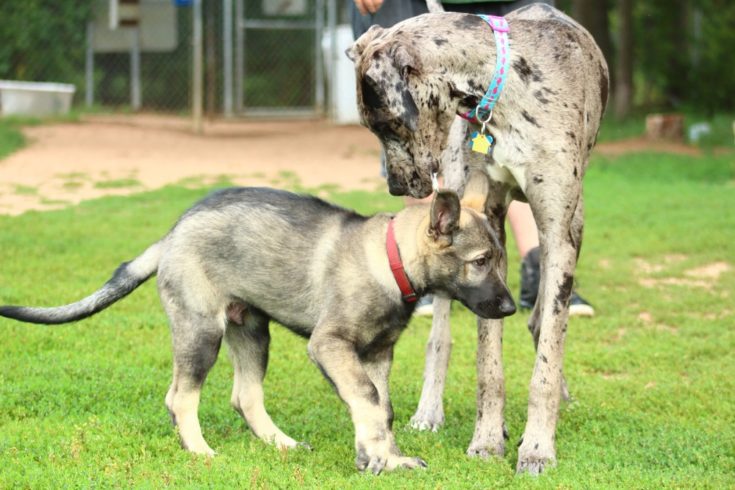
- The size of the puppy. Getting a puppy roughly the same size as your current dog can help prevent issues. Sometimes larger breeds see smaller breeds as prey, while small breeds don’t always realize they’re tiny and will pick a fight with a larger dog (which might not end well). So, having dogs of similar size can cut down on problems.
- The gender of the puppy. It’s usually recommended that if you already have a dog, you get the opposite gender when adopting a new one. This is because sometimes (but not always) two dogs of the same gender might become more territorial or possessive, leading to more fights.
- The personality of the puppy. To help everyone get along, learning about the puppy’s personality is helpful. You ideally want a puppy that will respect the current dog in the house rather than being too pushy and willful.
How to Introduce a Puppy to a Dominant Dog: A Step-By-Step Guide
Ready to learn how to introduce your new puppy to your current dominant dog? Of course, you are! Here’s a step-by-step guide that will get you through the introductions.
1. Prepare, prepare, prepare.
While you’re waiting to bring your puppy home, you need to prepare to accommodate two dogs in a way that will prevent fights, resource guarding, and jealousy. What does this entail? First, you want to have two of everything—food and water bowls, beds, crates, toys, etc. This way, everyone gets their own things and has separate personal spaces.
Next, when it comes to your current dog’s toys, bedding, etc., you want to keep it in a place where the puppy can’t get it to avoid conflict. Then, ensure both the puppy and your current dog are up to date on all vaccinations. Finally, when it's time, you’ll need help with the introduction, so ask a family member or friend for aid.

2. It’s time to introduce your pups to each other!
However, you do not want to introduce them at your home but rather on neutral ground. Why is that? Because your dominant dog considers your home its territory, they may get upset if they feel a new pet is encroaching. And wherever this neutral ground is, it should be enclosed to prevent either dog from running away and safe for your puppy (which will partly depend on their age and vaccination status).
3. Make the introduction slow.
You don’t want to just release your dogs into an enclosed space on their own; that can lead to negative consequences! Instead, both puppy and dog should be leashed and kept a few feet apart (this is where your family member or friend comes into play). Let the dogs see each other but distract them with toys and play. While you’re doing this, slowly start bringing them closer together. Once your pups are within sniffing distance, simply see how things play out. Hopefully, you’ll see some excitement and friendly barking.

4. Keep an eye on the dominant dog.
While the two dogs are being introduced, you need to keep an eye on your dominant dog’s body language to gauge how receptive it is to the puppy. Body language that indicates the dominant dog is relaxed includes their tail wagging slowly and a relaxed posture. However, if you see a stiff tail, rigid posture, growling, or snarling, you want to separate your pets and try introducing them again later.
5. Even if all is going well, you want this first introduction to remain short.
Let the dogs interact for a few minutes if they’re interested in each other, then separate them to bring them home.

6. Keep your dogs separated at home for a couple of weeks.
Even if the first introduction went splendidly, you don’t want to push your luck, so keep your pets apart as much as possible for the first couple of weeks the puppy is home. You want your pups to get used to each other without feeling overwhelmed by the other.
You also don’t want your dominant dog to feel as if the pup is taking over, so be sure you aren’t focusing all your attention on the puppy but giving your dominant dog plenty of attention as well (and giving it before you pay attention to the puppy). And as you gradually let your dogs spend a bit of time together, always supervise them!
Final Thoughts
And there you have it—six easy steps for introducing your new puppy to your current dominant dog! The process of your dogs getting used to each other will take a bit of time, but with these steps, it should be much easier. And hopefully, your dogs will learn to become good friends!
Featured Image Credit: Yuliia Gornostaieva, Shutterstock
Get Hepper In Your Inbox


Pet care tips from our vets and experts, straight to your inbox.
You may opt-out at any time. View our Privacy Policy for more information.
Misty Layne lives out in the woods in small-town Alabama with her two Siamese—Serafina and Jasper. She also has an array of stray cats, raccoons, and possums who like to call her front porch home. When she’s not writing about animals, you’ll find her writing poetry, stories, and film reviews (the animals are, by far, her favorite writing topic, though!). In her free time, Misty enjoys chilling with her cats, playing piano, watching indie and foreign films, photographing abandoned places, and catching up on her never-ending TBR list.
Join the conversation
Ask a question, share your story, or send private feedback.