Hepper is reader-supported. When you buy via links on our site, we may earn an affiliate commission at no cost to you. Learn more.
How Big Do Labradors Get? With Growth & Weight Chart



In this article
The Labrador is the epitome of the phrase “man’s best friend” with their kind and gentle nature and friendly disposition. These dogs are one of the most popular family dogs on the planet and for good reason: They are rarely, if ever, aggressive, are easy to train, and are as lovable and affectionate as they come.
When raising a Labrador puppy, there are several important milestones that your pooch will reach, and it’s a great idea to keep track of their progress and make sure they are growing at a steady rate. These milestones require specific care and training, as well as particular nutritional requirements.
In order to help you to keep track of your dog’s growth rate, we’ve created this growth and weight chart for quick reference. Keep in mind that all dogs are unique, and the following chart is a general overview only, as some dogs may progress slightly slower or quicker depending on their unique situation.

Facts About the Labrador Retriever
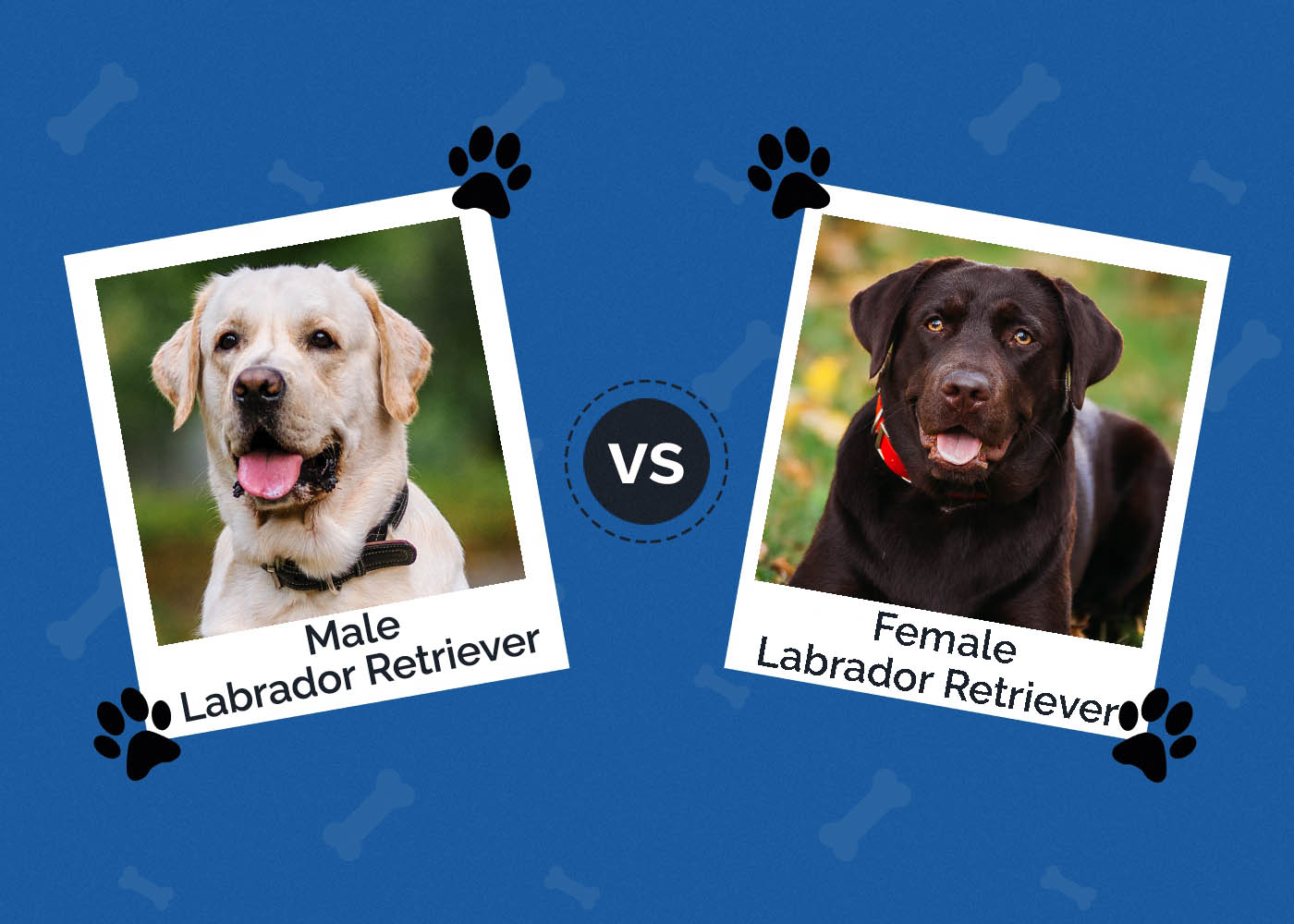
Labradors are a medium-sized breed with short, dense, and water-resistant coats and sturdy, muscular bodies. On average, an adult male Labrador will weigh between 60 and 80 pounds and measure 22 to 25 inches at the shoulder. Females are typically slightly smaller and lighter, weighing 55 to 70 pounds and reaching 21 to 23 inches in height. However, Labradors can easily fall under or over this range and still be at a healthy weight.
Labradors are energetic pooches with a unique lust for life. Your days are never bland or boring with a Labrador running around your home!

Labrador Puppy Growth and Weight Chart
Keep in mind that the following chart is only a guideline, and the heights and weights of your Labrador can vary quite a bit, depending on the individual. Labradors are fast-growing, and early-maturing dogs typically reach full maturity at around 9 to 10 months old. They typically gain weight and muscle mass after this point, but their height stays roughly the same.
Weekly & Monthly Labrador Growth & Weight Chart (Male)
| Weight Range | Height Range | |
| 8 weeks | 8–12 lbs. | 8–12” |
| 9 weeks | 10–14 lbs. | 8–12” |
| 10 weeks | 12–18 lbs. | 10–12” |
| 11 weeks | 14–19 lbs. | 10–12” |
| 3 months | 22–26 lbs. | 12–15” |
| 4 months | 25–31 lbs. | 12–15” |
| 5 months | 33–49 lbs. | 15–18” |
| 6 months | 40–50 lbs. | 15–18” |
| 7 months | 51–59 lbs. | 16–19” |
| 8 months | 55–60 lbs. | 18–20” |
| 9 months | 57–68 lbs. | 20–23” |
| 10 months | 55–58 lbs. | 22–25” |
| 11 months | 62–75 lbs. | 22–25” |
| 1 year | 64–77 lbs. | 22–25” |
| 2 years | 64–80 lbs. | 22–25” |

Weekly & Monthly Labrador Growth & Weight Chart (Female)
| Weight Range | Height Range | |
| 8 weeks | 8–12 lbs. | 7–10” |
| 9 weeks | 10–13 lbs. | 7–10” |
| 10 weeks | 12–17 lbs. | 8–12” |
| 11 weeks | 14–19 lbs. | 8–12” |
| 3 months | 20–26 lbs. | 10–14” |
| 4 months | 25–30 lbs. | 10–14” |
| 5 months | 35–49 lbs. | 12–15” |
| 6 months | 38–50 lbs. | 12–15” |
| 7 months | 40–55 lbs. | 15–18” |
| 8 months | 45–0 lbs. | 17–20” |
| 9 months | 48–62 lbs. | 20–22” |
| 10 months | 53–65 lbs. | 21–23” |
| 11 months | 53–66 lbs. | 21–23” |
| 1 year | 55–68 lbs. | 21–23” |
| 2 years | 55–70 lbs. | 21–23” |
You need to take good care of your pet while they are growing, so you can use our calculator tool to help you know how much to feed your pup and keep their well-being:
Dog Calorie Calculator
Recommended Daily Calories

The exact amount of calories an individual animal needs to maintain a healthy weight is variable and influenced by many factors including genetics, age, breed, and activity level. This tool is meant to be used only as a guideline for healthy individuals and does not substitute veterinary advice

Monthly Labrador Growth Pictures
While your Labrador puppy grows amazingly quickly from birth to 8 weeks, the growing doesn’t stop or even slow down when you bring them home! Between 8 weeks and 10 months, your puppy has a ton of growing to do, and they change drastically from month to month. Each stage of growth requires specific attention, exercise, and diet, so there is much to learn and pay attention to these different growth stages.
Let’s take a closer look at what you can expect during the various stages of growth.
8-Week-Old Labrador Retriever
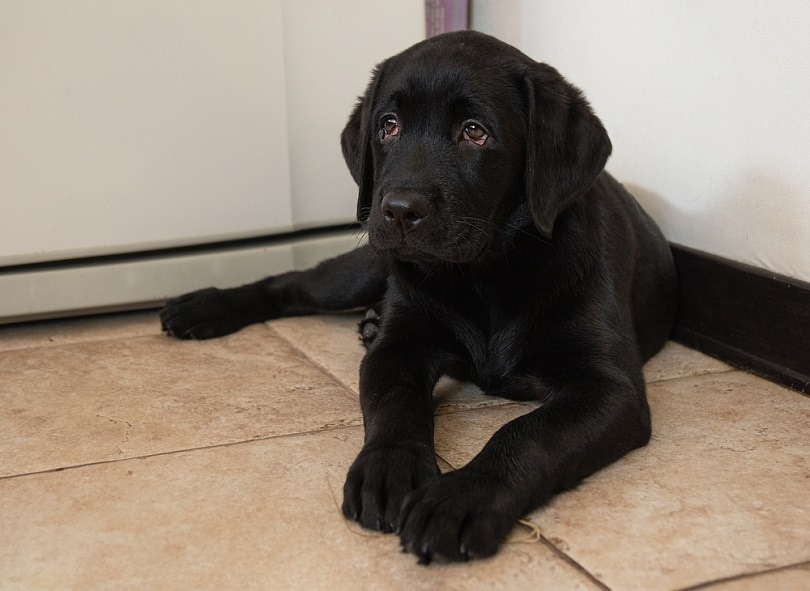
For most Labrador puppies, this is the first week in their new home. There may be behavioral challenges while your pup adjusts to its new life without its mother and siblings. This period of adjustment can sometimes lead to fearful and timid behavior, and your puppy will need as much attention and affection as possible. They should be eating three to four small meals a day at this stage.
If your puppy has not yet received their first round of vaccines, you’ll need to get this done ASAP and avoid any interaction with other strange dogs until your pooch is fully vaccinated. You can begin basic command, leash, and potty training at this point too.
12-Week-Old Labrador Retriever

Your puppy should have at least 2 boosters of the DAP vaccine and at least one shot of the Bordetella-Para influenza and the Leptospirosis, Lyme, and Canin Influenza vaccines. Although the schedule is not complete, this is a critical period to begin socialization and making sure they are calm and friendly with other dogs, but just make sure they are also vaccinated. We highly recommend making training a part of their daily activities at this age. Puppies will start to gain some independence and may begin testing boundaries, ignoring commands that they know well, and possibly going “backward” in terms of obedience. Consistency is key at this point, and you’ll need to keep reinforcing commands.
Biting can be an issue at this stage too, as they will begin teething, and they will start exploring and chewing whatever they can find. Chew toys and consistent command reinforcement are both vital for avoiding this behavior. The good news is that your puppy will grow out of this habit at around 6 months old.
16-Week-Old Labrador Retriever

Your lab should be fully vaccinated having received a third DAP booster and its rabies shot at this age. Your lab should also be house-trained by this point, but there may still be the occasional accident. Remember to be gentle but firm when this happens, and your pooch will likely move through it swiftly. They will begin losing their baby teeth at this point, and biting and chewing may reach their peak. Firm but gentle commands, chew toys, and loads of patience are essential at this stage.
Your puppy will be testing the limits and may start showing dominance, ignoring known commands, and asserting more independence. This can be a challenging period for owners due to your Labrador's newfound independence, but rest assured that it won’t last long with the correct training methods.
6-Month-Old Labrador Retriever

At 6 months, your Labrador puppy is swiftly approaching the final stages of development, but they will still display puppy-like enthusiasm and playfulness. You can now drop their meals down to two meals per day, but be sure that they are not eating too quickly. By now, their teething stage should be over, and they’ll likely stop chewing and biting, but chew toys are still essential.
Your puppy will start to closely resemble an adult at 6 months, but remember that mentally, they are still puppies and will need loads of direction and training. Females may enter their first heat at 6 to 7 months, so keep a careful watch for stray males.
9-Month-Old Labrador Retriever

By 9 months, your Labrador is an adult in size and fully grown for the most part. They will still display puppy tendencies and traits and have a ton of excitable energy, but they should be fairly obedient and well-trained by this stage. Training still needs to continue daily to cement all the hard work that you’ve invested thus far; otherwise, your pooch may slip backward in obedience. Be sure to give your Labrador plenty of exercise at this stage to help keep them from misbehaving. They will have reached their full height by now but may still gain weight and muscle mass in the coming months.
Unless you intend on breeding, you should consider neutering and spaying your puppy to avoid wandering and unwanted pregnancies. While some breeders recommend that you wait until a year old, this is a perfectly suitable time to perform the procedure.
12-Month-Old (1 Year) Labrador Retriever
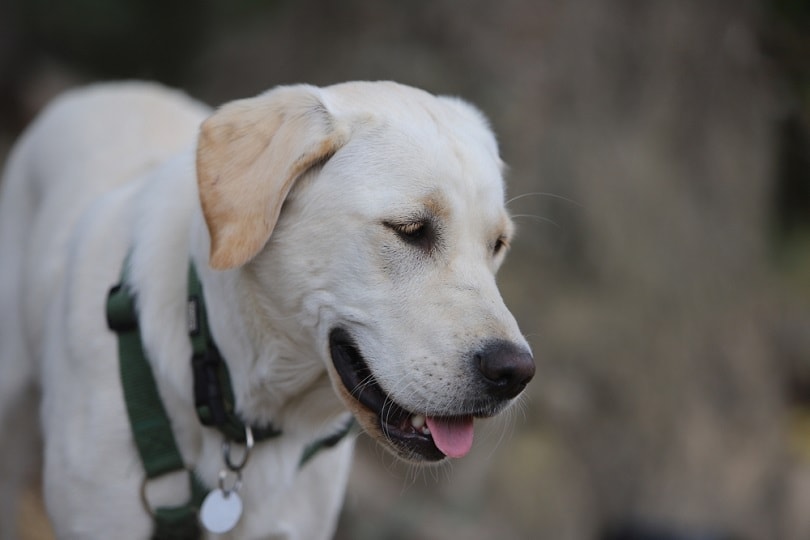
Your Labrador is pretty much fully grown and well on their way into adulthood at this stage. They may still gain weight and muscle mass but much slower than during the past few months. They will still display puppy characteristics and even test boundaries, but all in all, they should be obedient and well-trained by now. They will have a ton of energy and still enjoy playtimes and loads of exercise.
While they are at their full height at this age, some Labs may appear lanky and still weight to fill out in the coming months.

When Do Labradors Stop Growing?
All dogs are unique, and the question of when they stop growing is largely dependent on the individual. Anecdotally, your Lab should have reached its full weight by 18 months and full height by 9 to 12 months. Most breeders agree that your Lab will stop growing at some point during their second year. Even so, any weight gain during their second year will be minimal, and they will have done the majority of their growth by their first birthday.
Because all dogs are unique, there is no reason to worry if your Lab has not reached a certain “milestone” in height or weight. Much of their second year is more “filling out” than gaining any real weight, and so long as their weight gain is not rapid, there is usually no reason for concern.
Mentally, they are out of the puppyhood phase of testing boundaries and disobedience by their first year—if correctly trained. If you have been consistent in training thus far, your Lab should be friendly, obedient, and well-behaved from their first birthday and into adulthood.
How Does Neutering/Spaying Affect My Dog’s Growth?
In general, neutering and spaying should have little effect on your dog’s growth rate. In males, neutering can sometimes result in a calmer, more relaxed dog, and this, in turn, will slow down his need for exercise and may result in weight gain.
A study in 2017 showed that dogs neutered before 37 weeks may gain more weight, while dogs that had the procedure after 37 weeks had a slower growth trajectory. The difference was minimal, though, and there is no reason to assume that these procedures have much of an effect on growth rates in dogs.
Dangers of Growing Too Quickly or Stunted Growth
While some puppies may grow quicker or slower than the agreed-upon average, this is usually nothing to be concerned about due to the individual and unique nature of dogs. However, if your pooch is gaining weight rapidly or not gaining enough, there may be deeper issues to look into.
If your dog is from working or hunting stock, they may be smaller than average Labs and are usually lighter for work in the field. Size may also be genetic, and if your Lab comes from small parents, they will be smaller than average.
The same may be true of heavier-than-average Labs. If their parents are large, they will likely be similar in size. However, larger-than-average weights may also be due to overfeeding or a lack of exercise, or a combination of both, so be sure to keep your exercise and feeding habits consistent.
Growth Distinctions of Different Labradors
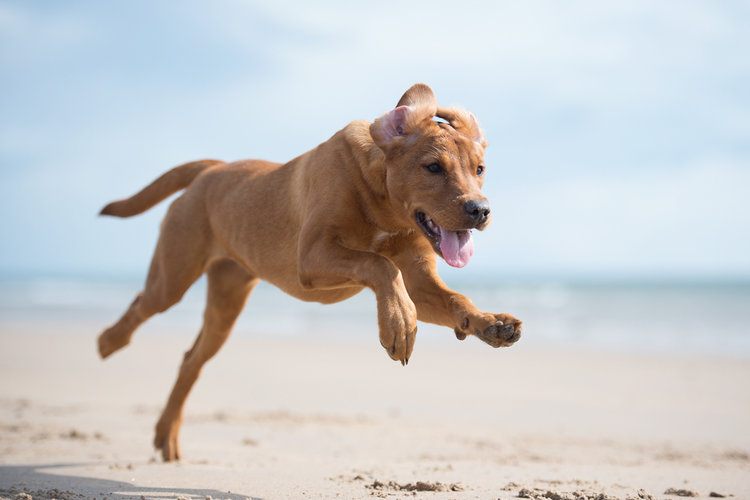
Although they are designated under the same breed, there are two different types of common Labradors: English and American.
English Labradors tend to be stockier and more muscular than their American counterparts and have a thick, waterproof coat, while American Labs have a slender build with a slightly finer coat.
English Labs are slightly shorter, topping out at around 22 inches, but their stocky and muscular build often makes them heavier than American Labs. English Labs have been known to weigh up to 20 pounds more than American Labs without being considered overweight.
American Labs are known to be slightly more active and energetic than English Labs, while English Labs tend to be less excitable and more laid back. English Labs are by no means lazy, though, and they still have plenty of energy and stamina to go around.
Conclusion
Hopefully, this guide has helped you understand the growth rate of your Labrador puppy and give you a better idea of what to expect during the different stages. While it’s great to have a general idea of what to expect, remember that all dogs are individuals, and their size and weight can vary widely depending on their unique genetics.
Related Reads:
Featured Image Credit: Pezibear, Pixabay
Get Hepper In Your Inbox


Pet care tips from our vets and experts, straight to your inbox.
You may opt-out at any time. View our Privacy Policy for more information.
Nicole is a lover of animals of all sizes but is especially fascinated with the feline variety. She’s the proud mom of Baby, a Burmese, and works every day so he can relax in the sunshine or by the fire. She’s always had a cat in her home and has spent countless days with others, observing behaviors and softening up even the grouchiest of the lot. Nicole wants to share her kitty expertise with you so you and your cat can live happy, healthy, and care-free.
Join the conversation
Ask a question, share your story, or send private feedback.