Hepper is reader-supported. When you buy via links on our site, we may earn an affiliate commission at no cost to you. Learn more.
Why Do Cats Love Lasers So Much? Vet-Reviewed Theories, Facts & FAQ


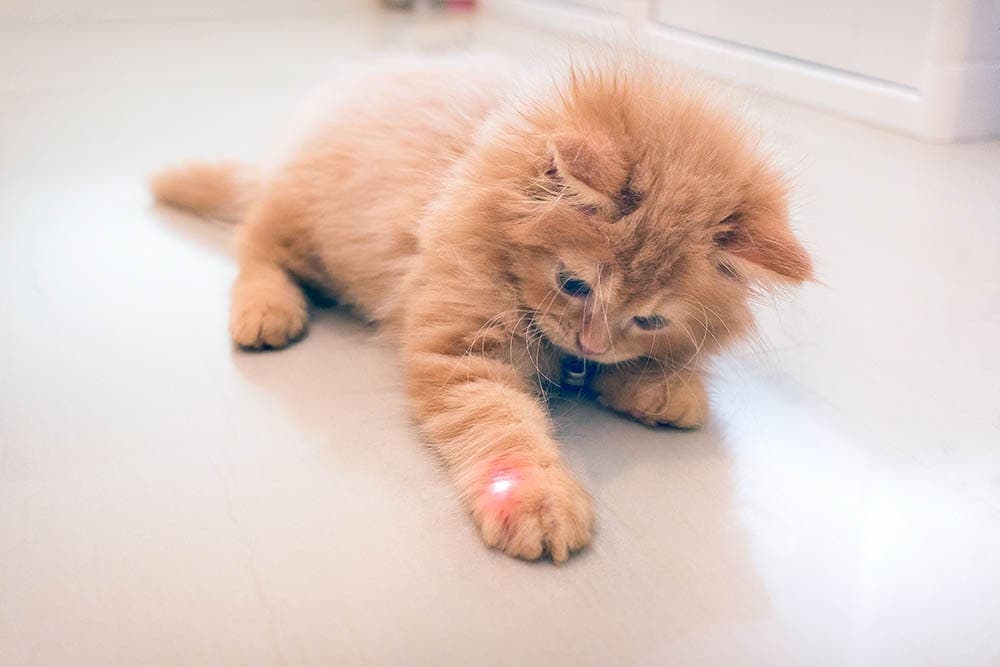
Some cats are simply obsessed with lasers. However, why they are obsessed with lasers is a bit of an issue.
The science is pretty sparse on this subject. There haven’t been any studies done on cats and lasers. Plus, you can’t exactly use science to figure out why animals enjoy something. It doesn’t tell us motives!
With that said, there are a lot of theories. Certain scientists have used the current knowledge we have regarding cats and lasers to try and figure out why they like them so much.
We’ll review some of the most popular theories below.

The 3 Reasons Cats Love Lasers
1. Lasers Mimic Prey Movement

The erratic, unknowable movements of a laser may mimic the movements of a cat’s natural prey, such as mice and birds. These animals tend to scurry in random directions when attacked. Therefore, it makes sense that the erratic movement of a laser may seem similar to a mouse.
Cats may have an innate instinct to chase things that move in this manner1. Therefore, when you show them a laser, your cat starts treating it like a prey animal.
Of course, not all cats chase lasers. Some may simply ignore them. How would you explain this if it’s innate?
Well, different cats have different natural drives. Some cats simply have higher prey drives. Maine Coons are known for their ability to be extreme hunters. However, other breeds are not. No one is going to ask a Persian to be a master hunter. Therefore, some cats may be more drawn to these movements than others.
2. Cats’ Reactions Could Be Learned
Cats seem to like anything that moves around erratically. They often enjoy chasing just about anything that will run from them, especially when they are kittens.
If you play with your kitten with a laser pointer when they are younger, they will likely chase it. It’s moving, after all.
After playing with it as a kitten, cats as adults may be more likely to continue chasing a laser.
On the other hand, cats who were never introduced to the idea of chasing lasers may not quite understand why you’re moving a little red light around them. They may not chase the laser simply because they aren’t as prone to chasing everything that moves as adults.
In other words, this behavior may be learned. When cats are introduced to lasers at a young age, they may be more likely to chase them. When they aren’t, they may be completely indifferent towards lasers later in life.
Of course, we don’t have any studies on this either. Furthermore, some cats may be more prone to chasing lasers in general, complicating this theory. Some cats may chase lasers no matter when they are introduced, while others may need to be introduced to them earlier.

3. Cat Eyes Are Different
A laser may look like a small, red light to us. However, it likely looks different for cats. Their eyes are structured differently, which affects how their eyes function.
Humans have more cones in their eyes than cats do. At the same time, cats have more rods than humans do. Cones help you determine colors. The more you have, the more colors hues, and shades in what we know as the visible light spectrum (for humans) you can see. Rods on the other side, are responsible for vision at low light levels and detecting movement.
Based on this information, cats aren’t quite as good at seeing color as we are. We don’t know exactly what they see. We can’t just adopt the eyes of a cat! However, colors are likely a bit more subdued. They may also see fewer shades.
They can likely see better movement, though. Their ability to detect moving objects at night is likely better than ours. After all, they have more rod cells in their eyes.
This setup works much better for a predator like a cat. They don’t need to see differences in colors. However, they do need to detect movement in low light conditions while hunting for their prey at dawn and dusk.
What a laser pointer looks like to them is probably much different than what it looks like to us! We suspect that the brightness of the laser makes the movement stand out much more. The color probably doesn’t matter so much. They might not be attracted to the color – they see the movement.

Are Laser Pointers Bad for Cats?
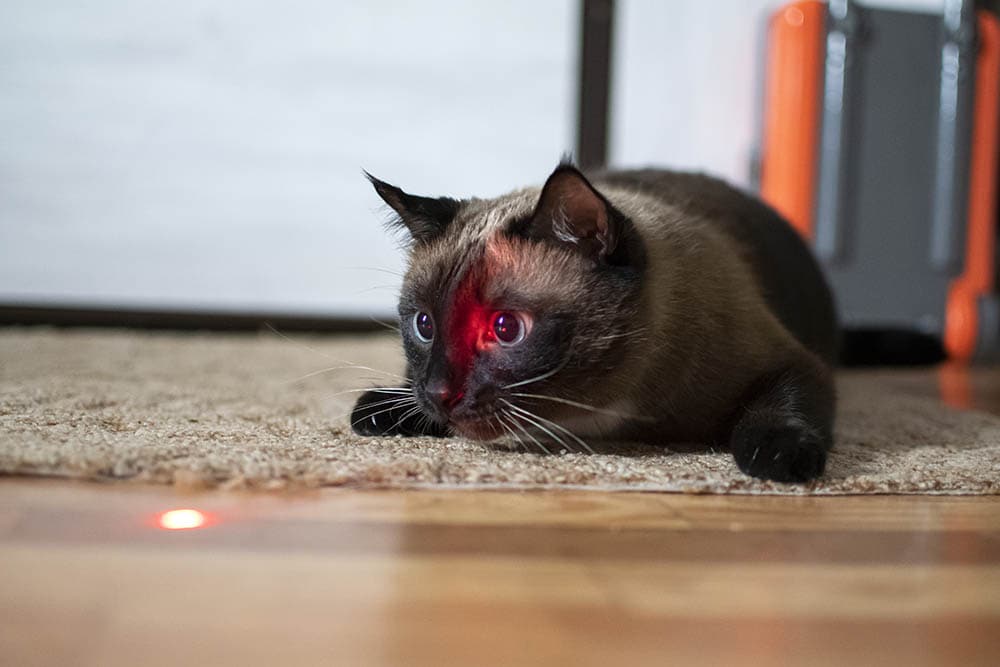
Obviously, you don’t want to point a laser pointer directly at your cats’ eyes. The bright light can damage their eyes – just like it can damage ours. While you’re playing, you should be fairly careful about accidentally pointing it in their eyes.
Stand behind your feline. That way, if they move their head between the laser pointer and the dot, the light will go on the back of their head, not in their eyes.
Some people claim that the futility of the laser game frustrates felines. They can’t actually catch the laser, of course. This fact may cause frustration.
However, there isn’t evidence that this fact actually causes distress for your feline. We don’t have any studies on whether or not your feline will experience disappointment after a game of laser. Therefore, these are just theories. What correlation studies do suggest is that playing with the laser pointer might result in abnormal repetitive behaviors often linked to the diagnosis of feline compulsive disorders.1 However, this leads mostly to behaviors like chasing lights and shadows and not concerning behaviors like overgrooming.
Many owners find that their cats are quite happy and tired after playing with a laser, though. This is the reason why many love them: it can help them exercise. It’s hard to find a cat owner who finds their cat frustrated after a game of laser tag! Some owners have learned to let them win sometimes by tossing them a toy or a treat as they pounce into the dot.
Is It Cruel to Use a Laser to Play With a Cat?

Some people wonder if it’s cruel to use a laser with a cat since the cat can’t actually catch it.
However, a cat can’t actually catch many of the toys they play with. They can’t actually catch and eat a toy mouse, for instance.
Furthermore, cats aren't always trying to catch something they’re chasing. The point is the chase itself. They like chasing things! Many cats could care less if they actually catch it. And none of them are actually aiming to eat the light once they catch it.
That just isn’t how their brains work.
Cats will chase prey animals in the wild without actually being hungry. For instance, domestic cats don't always eat the birds they catch outside. In fact, many of them don’t. It seems that many cats are simply chasing things to play hunt, not to ingest them.
While some cats may be frustrated after playing with a laser, we expect that most don’t feel anything but stimulation, which is a good thing. Still, the compulsive behaviors correlation study may be something to keep in mind. So, using laser tags in rotation with other play and move options rather than as a daily routine might be the healthiest approach.
Also, remember, when playing with a laser pointer, you must keep it away from your cat’s eyes, of course. Blinding a cat with a laser pointer would be quite cruel.
Do Lasers Make Cats Crazy?
No. Cats like to chase lasers just like any other toy. However, they don’t make them go crazy in any real sense of the word. Abusing this enrichment device might be correlated to them being more likely to play with light and shadows, fixating on playing with a specific toy, or staring at light and reflections; does not mean that the cat is crazy.
The cat may seem to be a bit obsessed with the laser point while they are playing with them. The correlated behaviors to chasing laser pointers are something to keep in mind, but the physical exercise benefits of moving around outweigh the potential risks: after all, a cat that is chasing lights and shadows is less likely to be bored, destroying your furniture (unless the shadow and lights reflect to it), or overweight.
Conclusion
Cats like lasers for the same reason they like other toys. The erratic movements make the cat’s chase instinct kick in, which causes them to chase the laser. It’s important to understand that this is a natural behavior for cats. They simply like to chase things! And lasers give them that opportunity.
Some learned behavior may go into this as well. Kittens are likely to chase anything that moves. That’s just how their eyes and brains work. Therefore, they are very likely to chase a laser pointer. When they get older, these cats may continue to recognize the laser as a toy and chase it.
Some adult cats without any experience with lasers may not recognize it as a toy – and, therefore, may completely ignore it.
Cat’s eyes are also different than ours. This may cause them to see the laser differently than we do. Generally speaking, their eyes pick up movement better than ours. Therefore, the movement of the laser is much more enticing to them. They may not be able to see the exact laser color as we see it. They see the movement of the laser.
They may even be able to see the light flashing off the laser. Some lasers may be more enticing due to their fast-blinking nature.
Featured Image Credit: Seika Chujo, Shutterstock
Get Hepper In Your Inbox


Pet care tips from our vets and experts, straight to your inbox.
You may opt-out at any time. View our Privacy Policy for more information.
Kristin is passionate about helping pet parents create a fulfilling life with their pets by informing them on the latest scientific research and helping them choose the best products for their pets. She currently resides in Tennessee with four dogs, three cats, two fish, and a lizard, though she has dreams of owning chickens one-day!
Join the conversation
Ask a question, share your story, or send private feedback.