


Click to Skip Ahead
Some dogs like sticks because they are natural outlets for chewing, playing, and chasing, which dogs are instinctually wired for. Many dogs particularly like sticks because their humans use them to play with them. Dogs often associate sticks with playtime.
Sticks may also have a rather appealing texture for some dogs. They like the hard yet breakable texture, which typically encourages more chewing.
Some dogs particularly like sticks, and it may not be odd to see them carrying sticks home on their walks. However, others may not have the same enjoyment of sticks.

Risks Associated with Dogs Playing with Sticks
Sticks are often considered to be harmless for most dogs, but they can actually pose several health risks. One of the most common concerns is splintering. Sharp fragments can become lodged in a dog’s mouth, particularly under the tongue or at the back of the throat. Because a dog’s mouth contains a high number of bacteria, these injuries can quickly become infected.
In some cases, small splinters may work their way out on their own without causing noticeable signs. However, deeper or larger fragments can travel and get embedded in soft tissues. In rare cases, they may even migrate further into areas such as the neck. This is very painful and can lead to swelling, infection, bad breath, or difficulty eating.
If a splinter is suspected, especially if your dog shows signs like drooling, pawing at the mouth, swelling, bleeding, bad breath, or reluctance to eat, reach out to a vet urgently. Minor cases are often resolved quickly, but more complex ones may require an anesthetic, diagnostic imaging such as an X-ray, or, in rare cases, a CT scan, followed by surgical removal.
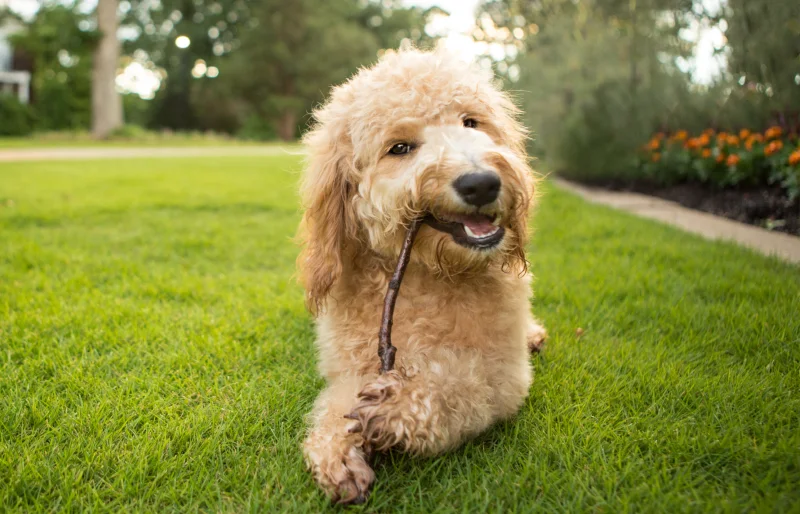
Splinters can also travel down your dog’s digestive tract if swallowed, causing more serious issues. Again, small splinters usually are not as troublesome. However, larger splinters can irritate and damage the intestinal walls, causing severe side effects. Surgery may be necessary in some cases to remove the splinters, especially if they get stuck in the intestines or cause a blockage.
You can mitigate these risks by supervising your dog and removing the stick once it starts splintering. If the stick starts crumbling, it’s time to remove it and let your dog find another.
Of course, heavy chewers that can break sticks easily may be more prone to these issues. They are much more likely to end up with a splintered stick and all of the issues that go with that. Teach your dog the command drop or leave, so you can stop the game before they make any attempts to swallow any pieces. For dogs prone to chewing up and ingesting pieces of sticks, it’s best to find an alternative and sturdy safe toy instead.
Signs to Look for
There are several signs to look out for after your dog plays with sticks. Often, some of the signs associated with splinters inside your dog’s mouth and throat overlap.
For one, dogs may drool excessively if they have a splinter in their throat or mouth. If possible, this is a sign for you to examine their mouth for any obvious splinters. Of course, always be safe while doing this, as dogs in pain are more likely to bite inadvertently.
Dogs may also have difficulty swallowing or eating, there may be swelling on the face or neck, bleeding, or a bad breath. This can happen whether a dog has a splinter in their mouth or throat. They may refuse to eat or drink, or they may simply not eat as much as usual.
If swallowed, splinters may irritate the digestive tract and sometimes cause an obstruction. This can present as reduced appetite, lethargy, abdominal pain, vomiting, and diarrhea.
Any changes in behavior can also be troublesome. Unexpected aggression when the mouth or neck is being touched or reluctance to play may all indicate that your dog is in pain, even if they aren’t showing any other signs of illness. If a dog has a splinter in their mouth or throat, they may paw at the mouth in an attempt to remove it. Sometimes, this can be successful. However, it usually isn’t and may make things worse. Be very cautious if you notice your dog pawing at their mouth or rubbing their head on things.
Bleeding, reduced appetite, retching, pawing at the mouth, and swelling are often signs of an underlying problem. In this case, it may be because a rather large splinter has jammed itself into your dog’s mouth or throat. As you might guess, swelling in your dog’s airway can be very problematic.
You should also look for lethargy, which is simply when your dog is not as active or alert as they usually are. Often, this is a sign of a range of illnesses, including just about anything alongside stick splinters.

Safer Alternatives
Some dog owners may decide that letting their dog play with sticks just isn’t worth it. You can train your dog not to play with sticks, though they’ll still need supervision wherever sticks are lying around, if it were one of their favorite toys. You may also consider offering safer alternatives and encouraging your dog to play with them.
For dogs that like to chew on sticks, consider offering tough, safe chew toys for them to play with. Choose a toy that is suitable for your dog’s size and chewing strength. Smaller dogs may not need a super durable toy, but you may have to invest quite a bit of money to purchase a chew toy that will stand up to a Mastiff or another strong chewer, regardless of the size and breed. Still, the added cost is worth it, as it’s often these dogs that are most at risk of splintering a stick. Always supervise your dog while chewing, and make sure to remove any chewed-off toy pieces as well as replace the toy when it gets to a size that may tempt the dog to swallow it whole.
Regularly inspect any chew toys your dog has. While chew toys are often safer than sticks, they are not 100% safe. Whenever they start breaking apart, it’s time to replace them.
For dogs that use sticks for fetch, consider purchasing a few longer toys that you can throw. Frisbees are a popular option that is generally safer than sticks, usually. (Some larger dogs may tear through a plastic Frisbee, which can be dangerous, as the edges are sharp.) You can also invest in balls. Many are designed explicitly for tough chewers.

Dog Breeds That Love Sticks
Some dog breeds are more prone to playing with sticks than others, just due to their instincts and personality. For instance, retrieving breeds, including the Labrador Retriever and Poodles, often love to retrieve, and some will enjoy playing fetch. These breeds will likely use sticks to play fetch, and they may benefit from having extra throwing toys lying around.
Terriers often love to play with just about anything. They’ll happily play fetch with a stick, but they may also just chew on it. Terriers are often small, but they can still have a strong and determined bite. They may still benefit from a collection of smaller toys of all sorts, especially since they tend to be incredibly playful.
Of course, there is a lot of individual variety between dogs. Some terriers or retrievers may not even like sticks, while some hounds may be obsessed with them.
Therefore, it isn’t necessarily unusual for dogs outside of these breeds to like sticks, and it is not odd for dogs within these breeds to not like them.

Conclusion
Dogs play with sticks simply because they’re fun to play with. They’re a versatile toy, allowing dogs to chew and play fetch. Some dogs may adore sticks, while others may never touch them. Both are completely normal.
While sticks can be relatively low-risk when the game is supervised, they are not entirely safe. They can cause serious injuries if they splinter or get swallowed. These splinters can get stuck in your dog’s mouth, throat, or digestive tract, causing all sorts of different problems.
Therefore, you may want to provide your dog with a safer alternative, such as a durable chew toy. This switch may be especially important for powerful chewers who have the jaw strength to splinter sticks with ease.
Featured Image Credit: birg, Pixabay