Hepper is reader-supported. When you buy via links on our site, we may earn an affiliate commission at no cost to you. Learn more.
My Dog Ate a Stick: Our Vet Explains What to Do

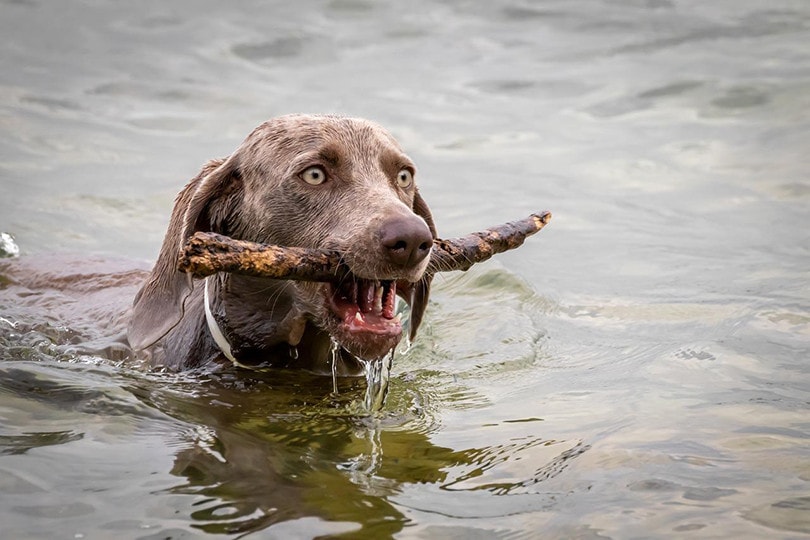
Dogs often eat things without realizing the dangers of doing so. While some sticks may be small enough to pass through your dog without causing harm, others can become lodged in the throat and airways and cause a foreign body obstruction along the gastrointestinal tract or perforate tissues. This can lead to choking or an infection or inhibit the movement and function of the GI tract. These are serious issues that can compromise the health of your dog.
If your dog ate a stick, contact your veterinarian right away.

What to Do If Your Dog Ate a Stick
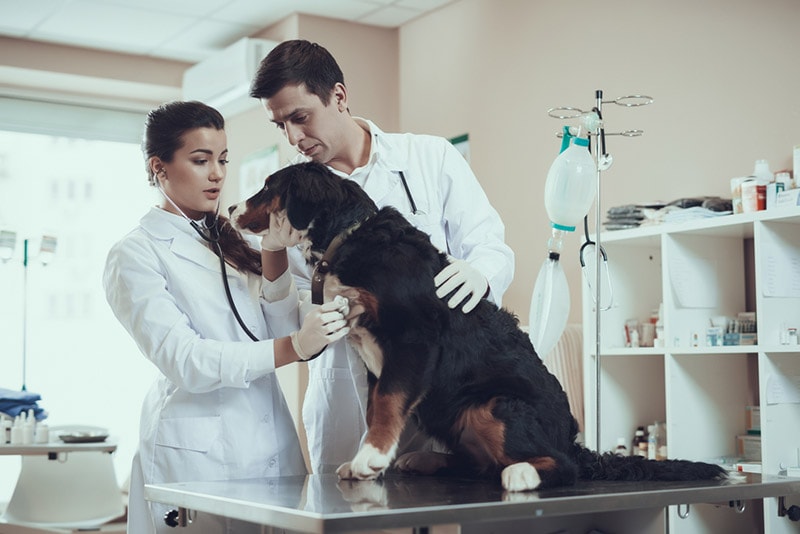
Always err on the side of caution and call your veterinarian for advice. They may have you bring your dog in for an exam and X-rays to determine where the stick is located. The stick may need to be retrieved endoscopically before it advances through the GI tract. This is usually performed while your dog is sedated or under anesthesia. Do not induce vomiting at home without consulting with a veterinarian first. Sharp splinters can be dangerous if vomited, or they can become stuck in your dog’s throat on the way out.
1. If Your Dog Is Choking or Having Difficulty Breathing and Their Gums and Tongue Are Blue or Purple
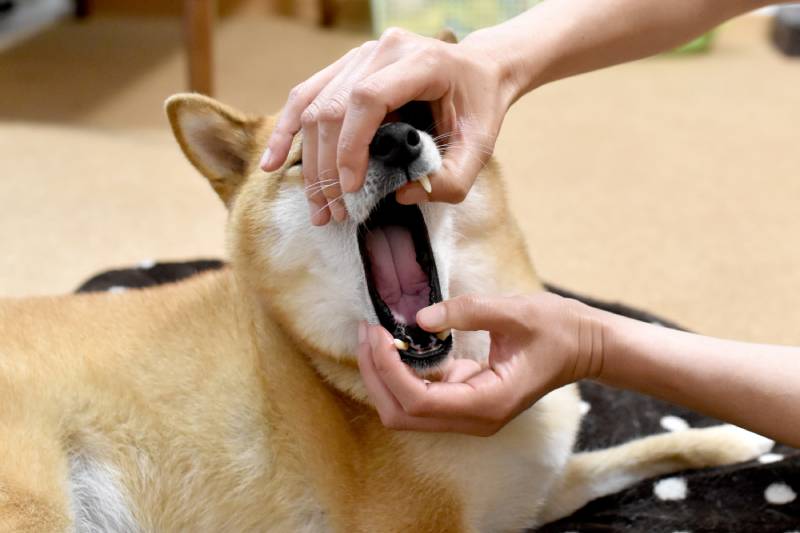
Check their mouth and throat for a stick that may be lodged there. Only try to remove the stick if it can be done easily without injuring yourself or your dog. You can accomplish this by sweeping your fingers or hand from the back of your dog’s mouth forward to try to dislodge it. If the stick is deep in your dog’s throat or you cannot safely remove it, seek assistance from an emergency veterinarian immediately, as sedation may be required to remove it safely.
2. If You Cannot See the Stick and Your Dog Loses Consciousness
Perform the Heimlich maneuver to help dislodge the obstruction:
Hold small dogs vertically so their back is against your abdomen. Place a closed fist under your dog’s ribcage with your other hand on top of your fist. Then, push up and in. Do this several times.
Large dogs should not be picked up.
If your large dog is standing, clasp your hands around their abdomen just behind the ribcage. Make a fist and rapidly push up and forward several times behind the sternum (breast bone).
If your dog is lying on the floor, place one hand flat on their back, and push up and forward several times with the other hand just behind the sternum.
Check your dog’s mouth after performing the Heimlich maneuver for the dislodged stick and remove it if it is safe to do so. See if your dog is breathing. If not, wrap a hand around their closed muzzle, cover their nose with your mouth, and give two breaths into their nostrils. Call your veterinarian immediately!
If you cannot remove the stick and/or your dog is not breathing or responsive, transport your dog to your nearest emergency veterinarian right away for immediate treatment.

Tips for Keeping Your Dog Happy and Healthy
- Keep sticks away from your dog if they tend to eat them.
- Diligently monitor and remove sticks from your yard to prevent accidental ingestion.
- Offer appropriately sized toys and treats instead.
- Always supervise your dog with toys and treats.
- Train your dog to wear a basket muzzle in areas where sticks are readily available.
In Conclusion
Contacting your veterinarian immediately after your dog eats a stick is highly recommended. Sticks can be dangerous for several reasons. Your veterinarian may perform a physical examination and may use X-rays, ultrasound, or an endoscope to locate it.
Time is of the essence if you think that your dog consumed a stick. Removing the stick may only require sedating your dog to retrieve it if you seek help right away. However, as time passes, more damage may ensue, resulting in extensive surgery and recovery time for your dog.
Sources
Featured Image Credit: Lucie1985, Shutterstock
Get Hepper In Your Inbox


Pet care tips from our vets and experts, straight to your inbox.
You may opt-out at any time. View our Privacy Policy for more information.
Dr. Stacie Grannum, born and raised in Arizona, was inspired to pursue veterinary medicine at the age of five after attempting to care for a baby bird that had fallen from its nest. Although the bird did not survive, the experience ignited her passion for animal care. Determined to become a veterinarian, she worked tirelessly and, in 2014, received her Doctor of Veterinary Medicine degree from Colorado State University.
Today, Dr. Grannum specializes in companion animal health, emphasizing wellness and preventive care. She also has a passion for writing about pet health and is enthusiastic about educating and sharing her expertise with other pet owners.
Dr. Stacie Grannum was born and raised in Arizona, and from the age of five, she knew that she wanted to pursue a career in veterinary medicine. An encounter with a baby bird that fell from its nest changed her life forever. Dr. Grannum diligently cared for it, but despite her attempts to save it, the little bird did not survive. From this devastating loss came her new ambition, which carved the path that Dr. Grannum followed. She worked hard toward that goal and dedicated her time to becoming a veterinarian.
Education
Dr. Grannum earned her Doctor of Veterinary Medicine Degree from Colorado State University in 2014.
Experience
Today, Dr. Grannum's focus is on companion animal health, particularly wellness and preventive medicine. She also enjoys writing about pet health and is eager to share her knowledge with other pet lovers.
Join the conversation
Ask a question, share your story, or send private feedback.