Hepper is reader-supported. When you buy via links on our site, we may earn an affiliate commission at no cost to you. Learn more.
6 Common Airedale Terrier Health Issues (Vet Answer)

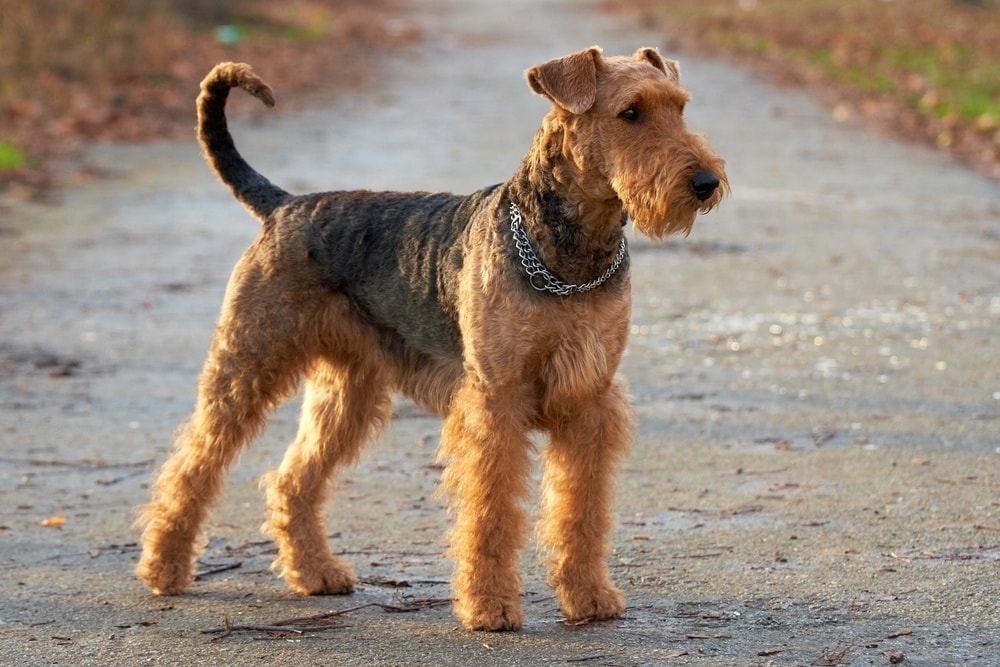
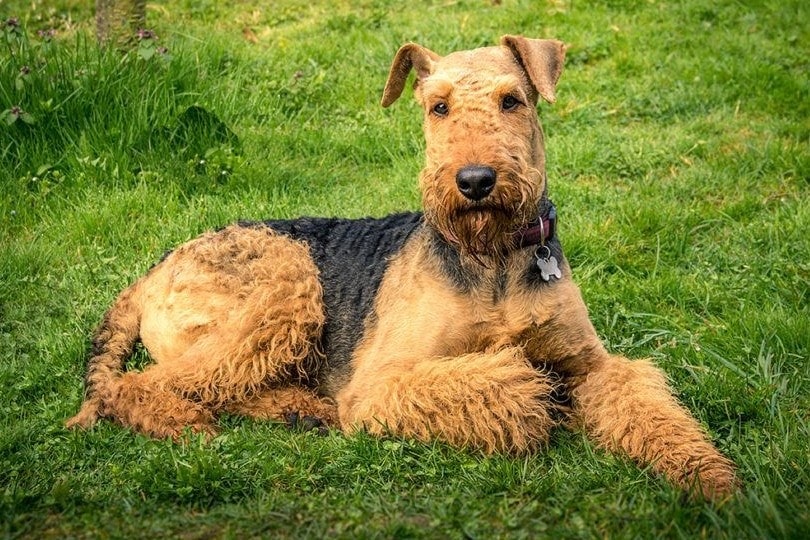
The Airedale Terrier is often referred to by admirers and canine enthusiasts as “the King of Terriers”. Why? These dogs are, generally speaking, steadfast, intelligent, and handsome. They are intensely loyal and always loving, but they are also high-energy dogs with a tendency for stubbornness. When made a member of the family, and provided with lots of stimulation, Airedale Terriers make superb pets.
But what about their health? Like many purebred dogs, there are certain conditions that Airedales are more prone to developing than other breeds. Of these, the six most common ones are hip dysplasia, heart disease, cerebellar (brain) disease, hypothyroidism, bloat, and dental disease, which will be explored in more detail below.

Airedale Terriers at a Glance

The 6 Common Airedale Terrier Health Issues
1. Hip Dysplasia
Hip dysplasia is a genetic and developmental disease of the hip joint. The regular hip joint is a ball and socket joint, in which the ball of the femur (thigh bone) should sit neatly in the dish of the hip bone. With hip dysplasia, the bones are misshapen and the ball of the thigh bone will sit slightly outside of the socket. This instability makes the joint more likely to develop arthritis, and this causes pain when standing up, walking, running, or jumping.
Airedale Terriers are prone to hip dysplasia, but so too are a number of large and giant breed dogs, including Border Collies, Labradors, and German Shepherds. Mild cases of hip dysplasia can often be managed with painkillers, joint supplements, and physiotherapy; more severe cases may require corrective surgery, such as a total hip replacement.
2. Dilated Cardiomyopathy
Dilated Cardiomyopathy (DCM) is a heart disease in which the chambers of the heart enlarge, and the muscular walls of the heart become thin. This reduced the ability of the heart to pump blood to the rest of the body. Research suggests that Airedales may be more likely to develop DCM than other breeds; however, similar to hip dysplasia, many large breed dogs can be affected, including Dobermans, Poodles, and Newfoundlands.
Mild cases of DCM may be asymptomatic, while more severe cases can cause heart failure. Heart medications are often prescribed to improve the function of the heart.
3. Cerebellar Abiotrophy
Cerebellar abiotrophy, also known as “cerebellar degeneration”, is a rare but challenging neurological problem seen in some purebred dogs, including the Airedale Terrier. The cerebellum is a small but vital part of the brain responsible for fine motor control, balance, and muscle tone. Dogs affected by cerebellar abiotrophy will usually show an overall lack of coordination.
Wobbliness, swaying, wide-based stance, overstepping, and tremors are also fairly common. Unfortunately, there is no treatment for this condition and genetic tests are not available for Airedale Terriers.
4. Hypothyroidism
Hypothyroidism occurs when a dog’s thyroid gland is not producing enough thyroid hormone. This results in a drop in metabolic rate, and many other body functions. While the condition is not fully understood, it is believed that most cases are auto-immune. Dogs with hypothyroidism will often be lethargic; they tend to gain weight and develop a poor, thin coat; skin infections are also fairly common.
Thankfully, treatment for hypothyroidism is fairly straightforward—thyroid supplementation (tablets) are very effective.
5. Bloat
Bloat is a colloquial term for “gastric dilatation and volvulus” (GDV). This is a spontaneous and life-threatening condition seen in any large, deep-chested breed of dog, including Airedale Terriers. In this condition, the stomach fills up with gas and fluid and then twists on itself; this cuts off the blood supply to the stomach, causing shock.
Dogs affected by GDV will be completely fine one minute, and severely ill the next. Signs of GDV include lethargy, vomiting, retching, collapse, and “ballooning” of the abdomen. The only fix for GDV is emergency stabilization and surgery. It's possible to have an elective procedure performed, often at the time of de-sexing, in which the stomach is “tacked” to the body wall. This virtually eliminates the risk of the dog developing bloat.
6. Dental Disease
Dental disease is very common in dogs. Indeed, at least 80% of adult dogs have some degree of dental disease, and Airedale Terriers are no exception. Many vets will agree that Airedales appear (for some reason) particularly prone to dental disease. More specifically, we are referring to periodontal disease. With this condition, plaque and calculus accumulate on the teeth. This causes inflammation of the gums (gingivitis) and, further down the line, destruction of the jaw bone that houses the teeth.
Daily brushing and regular dental chews are the best way to prevent plaque accumulation. If this is not possible, or not effective, a “scale and polish” procedure under anesthetic is always a good way to maintain dental hygiene. When periodontal disease becomes advanced, teeth may need to be removed.
Summary
With plenty of training, affection, and energy, Airedale Terriers make a great addition to any family. The above list of health issues should not deter anyone from taking on an Airedale terrier. Not every Airedale terrier is affected by these conditions—they are just more likely to develop them than other breeds.
As always, a good diet, sufficient exercise, adequate dental care, and regular grooming are the cornerstone of canine health. We recommend finding dogs from reputable breeders who have performed the appropriate genetic tests and working closely with your vet to stay on top of any concerns you may have for your Airedale.
See also:
Sources
Featured Image Credit: otsphoto, Shutterstock
Get Hepper In Your Inbox


Pet care tips from our vets and experts, straight to your inbox.
You may opt-out at any time. View our Privacy Policy for more information.
Joe is a veterinarian from Sydney, Australia and has two beautiful Golden Retrievers who love the ocean as much as he does. Joe completed his Bachelor of Veterinary Biology and Doctor of Veterinary Medicine at the University of Sydney in 2020, and his areas of particular interest include internal medicine, wound management and oncology. His passion for veterinary medicine comes not only from helping pets, but also from helping their owners and working with wonderful teams of people. When he's not working, you can find Joe exercising, cooking, and exploring Australia’s wilderness. He has worked for 2 years at a busy mixed practice on New South Wales’ mid-north coast, treating animals of all sizes.
Join the conversation
Ask a question, share your story, or send private feedback.