Hepper blog

Search our database of over 9,984 posts with up-to-date information from our experts and veterinarians.

Hepper is reader-supported. When you buy via links on our site, we may earn an affiliate commission at no cost to you. Learn more.

Are Sunflowers Toxic to Cats? Vet-Approved Facts

By Kathryn Copeland · Reviewed & fact-checked by Dr. Marta Vidal-AbarcaVet Approved
Dr. Marta Vidal-Abarca
Reviewed & Fact-Checked byDr. Marta Vidal-AbarcaVeterinarian
Marta has been a veterinarian for over sixteen years working across the UK and Spain and as a remote veterinary consultant. She has wide experience in small animal internal medicine and surgery with a soft spot for cats.View authorThe information is current and up-to-date in accordance with the latest veterinarian research. Read about our vets
Share
Ask us a question in the comments
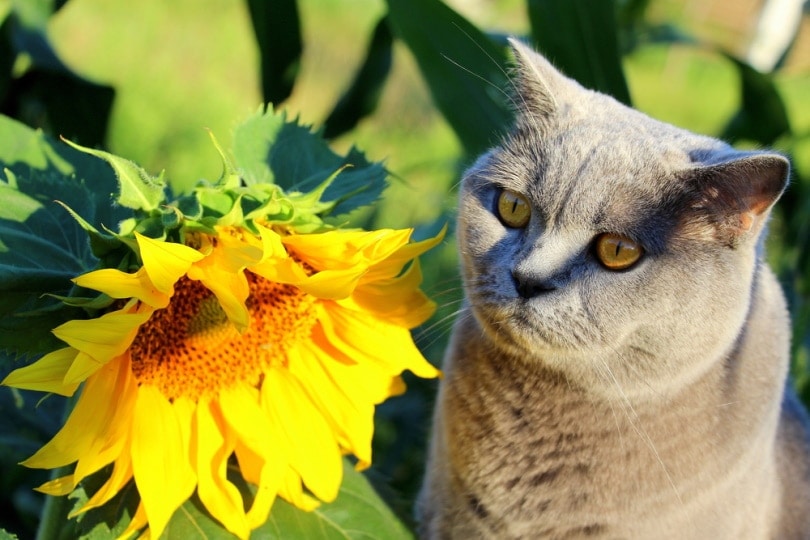
Cute cat beside a sunflower

We are all quite familiar with the grand and glorious sunflower! It's a welcome sight in many gardens worldwide and can even be kept indoors as a potted plant or cut flower. However, is it safe to have these flowers inside or in your garden when you have a cat?

The good news is that sunflowers are not toxic to cats. But your cat might experience some digestive issues if they nibble on them.

We go into more detail about the sunflower here and what might happen if your cat eats some of its leaves or petals.

A Little About the Sunflower

Sunflowers are grown naturally in North America and were initially cultivated by First Nations people for a wide variety of uses:  medicinal, food, cosmetics, and the plant itself for building material.1 You can find sunflowers all over North America and Europe; they are pretty much grown around the world.

They are heliotropic flowers, which means they follow the sun as it moves across the sky from the east to the west. Even at night, the flower repositions itself toward the east in time to meet the sun in the morning.

Of course, in addition to their sunny beauty, sunflowers are famous for their seeds and oil. Both are known to be healthy additions to the human diet.
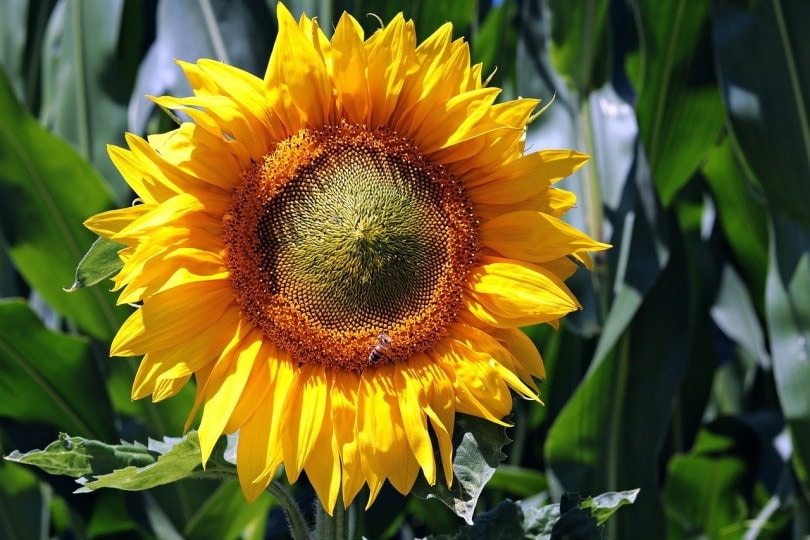
Closeup shot of a sunflower
Image By: pixel2013, Pixabay

Sunflowers and Cats

The ASPCA has sunflowers listed as non-toxic for cats, dogs, and horses.2 This is good news if you have sunflowers in your garden or home! Essentially, if your cat nibbles on some petals or leaves, nothing terrible will happen.

Having said that, vets warn that some cats might end up with an upset stomach after eating sunflowers. Cats are obligate carnivores, which means that a very high proportion of their diet needs to be made up of meat, and plant matter is something they just don’t need.3

Too much vegetation and plant matter in your cat’s diet can lead to digestive issues, including nausea, vomiting, and diarrhea. Obviously, the more sunflowers your cat eats, the worse the digestive issues will get.

How About Sunflower Seeds?
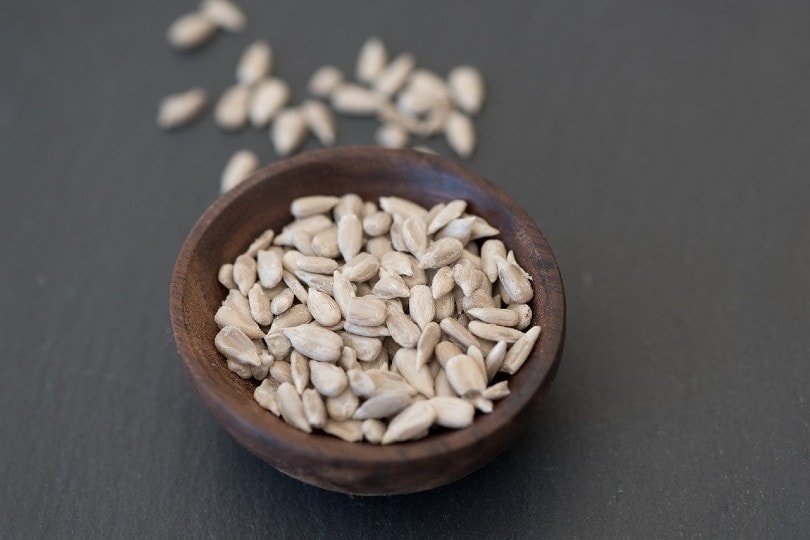
sunflower seeds
Image By: Pezibear, Pixabay

Most sunflower seeds tend to be salted, which is a huge no-no for cats. The Pet Poison Helpline considers salt to be potentially toxic for cats. The most common sources of salt poisoning are attempts to induce vomiting at home and the ingestion of homemade play dough. Salt poisoning can lead to some of the following issues:

  • Decreased appetite
  • Vomiting
  • Diarrhea
  • Incoordination
  • Lethargy
  • Excessive urination and thirst
  • Coma
  • Tremors
  • Seizures

If your cat has eaten anything with extra salt and exhibits any or some of these signs, bring your cat to the veterinarian immediately. You should also avoid the shells, as they can be sharp and might prove dangerous for your cat in addition to the salt.

So, if the sunflower seeds are unsalted, unseasoned, and without the shell, a few will be fine if your cat happens to eat some. The good news is that most cats aren’t particularly interested in eating sunflower seeds, so it’s something you don’t generally have to worry about.

And Sunflower Oil?
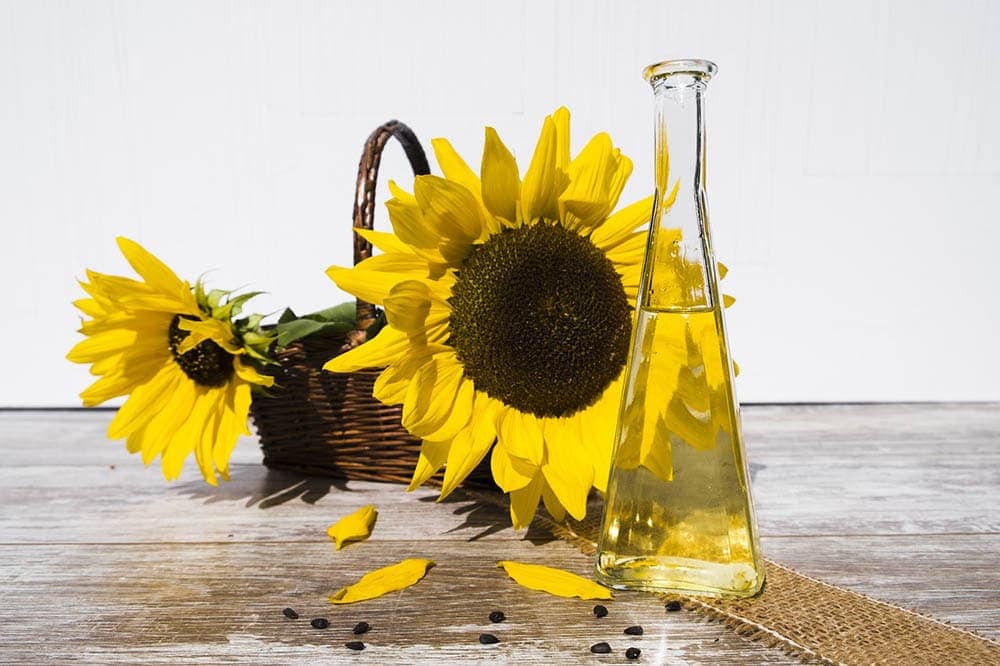
sunflower oil in a bottle
Image By: Pixabay

Sunflower oil is usually pretty safe for cats but only in that it’s not toxic. However, excess oil, of course, means excess fat, which can cause some digestive upset and diarrhea if consumed sporadically. When too much sunflower oil is consumed regularly, it can lead to weight gain and obesity for your cat. If your cat happens to lap up some sunflower oil, it’s absolutely fine.

It’s just something that you shouldn’t give to your cat on a regular basis if they are already fed a complete and balanced diet. 

Other Flowers That Are Safe for Cats

If you’re wondering what other flowers are safe to be around your cat, you can bring any of these to your home:

While these flowers are all non-toxic for cats, like with the sunflowers, there’s always the risk of some stomach upset if your cat ingests any. You just don’t have to worry about your cat being poisoned by these flowers.

Common Flowers You Should Keep Away From Cats

The following are all flowers considered quite toxic for cats, some even deadly, and should always be kept away from them. Signs can range from serious stomach upset to kidney failure and death.

  • Autumn Crocus (Colchicum autumnale): This plant is very toxic and can lead to severe digestive problems, including bloody vomiting and diarrhea, liver and kidney damage, respiratory failure, seizures, and even death. The spring crocus (Crocus vernus) is also toxic and can cause digestive upset.
  • Azalea (Rhododendron species): Ingesting just a few leaves can cause severe digestive signs, abnormal heart rate and rhythm, weakness, low blood pressure, tremors, seizures, and coma. Without vet help, the cat can lapse into a coma and potentially die.
  • Sowbread (Cyclamen species): All parts of the plant are toxic, but the tubers or roots are the most dangerous. Signs can range from drooling, vomiting, and diarrhea to heart problems, seizures, and death with larger ingestions. 
  • Lily (Lilium species): Not all lilies are deadly to cats, as some might just make your cat feel a little sick or develop irritation around the mouth. But tiger, day, Easter, Japanese show, and Asiatic lilies are all seriously dangerous. Just a petal, a leaf, or the water from the vase holding the lilies can cause acute kidney failure and death. Even licking a small amount of pollen off the paws can cause poisoning.
  • Oleander (Nerium oleander): All parts of the plant are very toxic and can cause severe vomiting, drooling, diarrhea, abnormal heart rate and rhythm, tremors, seizures, and possible death.
  • Daffodil (Narcissus species): This can cause severe digestive problems, possible cardiac arrhythmia, low blood pressure, and respiratory depression. The bulbs are the most poisonous part. 
  • Lily of the Valley (Convallaria majalis): The signs can include vomiting, irregular heart rate, low blood pressure, disorientation, seizures, and possible coma.
  • Sago Palm (Cycas and Zamia species): The seeds and leaves of this palm can cause vomiting, bloody stools, acute liver failure, clotting problems, and possibly death.
  • Tulip (Tulipa species): The tulip bulb is the most poisonous part. Diarrhea, vomiting, drooling, and irritation to the mouth and esophagus might occur. With larger ingestions, heart problems and difficulty breathing can be seen.
  • Hyacinth (Hyacinthus species): The same type of toxicity can occur from the hyacinth as from the tulip.

This list is not all the toxic flowers out there. Check the Pet Poison Helpline for a more comprehensive list of poisonous flowers for cats.

If you believe your cat has touched or ingested any of these flowers (including the petals, stems, leaves, roots, or water from the vase), take them to your vet immediately, and be sure to bring the plant with you for proper identification. This helps with the treatment.

In Conclusion

If you’re at all worried about having sunflowers around your cat, you don’t need to be. The occasional small snack won’t hurt your cat, and the possibility of an upset stomach will usually be the only result.

While sunflowers are generally safe for cats, you certainly shouldn’t encourage your cat to eat them. Cats don’t need to eat vegetation as a part of their regular diet, and you won’t want to risk having a sick cat on your hands. But otherwise, go ahead and enjoy your sunflowers risk-free!

Sources

Featured Image Credit: Sagittarius_13, Shutterstock

Get Hepper In Your Inbox

Pet care tips from our vets and experts, straight to your inbox.

List

Select all that apply.

You may opt-out at any time. View our Privacy Policy for more information.

Kathryn Copeland
Authored by

Kathryn Copeland

Join the conversation

Ask a question, share your story, or send private feedback.

Rate this post
Required to post. Only our editors see your rating.
Who should see this?

A human reviews every comment before it appears. Your email is never published.

Picked to go with this article

Can Cats Eat Tulips? Important Safety Facts (Vet Reviewed)

Can Cats Eat Tulips? Important Safety Facts (Vet Reviewed)

Biting objects that they're curious about is one of the ways that our cats learn about the world, especially since they don’t have hands. However, not everythi…

Nicole Cosgrove
By Nicole Cosgrove ·
Are Marigolds Poisonous to Cats? Vet-Reviewed Info to Keep Your Cat Safe

Are Marigolds Poisonous to Cats? Vet-Reviewed Info to Keep Your Cat Safe

Marigolds are beautiful, sunny annual flowers used to brighten a garden. These flowers have a musky scent like wet hay or straw that bugs dislike. Home gardene…

Cassidy Sutton
By Cassidy Sutton ·
Why Do Cats Like Eating Flowers? 4 Vet-Reviewed Reasons

Why Do Cats Like Eating Flowers? 4 Vet-Reviewed Reasons

Have you ever seen your cat nibble on a flower petal or two? It’s an odd behavior, to be sure, but at the same time, it can be considered “normal.” Here are fo…

Nicole Cosgrove
By Nicole Cosgrove ·
Can Cats Eat Lilies? Vet-Approved Risks & Poison Prevention

Can Cats Eat Lilies? Vet-Approved Risks & Poison Prevention

Cats are curious creatures. Some of them get into things they shouldn’t when they’re investigating their surroundings. But if you keep lilies in the house, you…

Nicole Cosgrove
By Nicole Cosgrove ·

Keep reading

More stories you might like

Are Dahlias Poisonous to Cats? Vet-Verified Facts & Info

Dahlias are absolutely beautiful flowers and a common choice for those looking to spruce up their home with some freshness. However, dahlias are unfortunately…

Kristin Hitchcock
By Kristin Hitchcock ·
Are Dahlias Poisonous to Cats? Vet-Verified Facts & Info

Is Cyclamen Toxic to Cats? Vet-Reviewed Risks & FAQ

We all love to brighten our homes with fresh flowers every now and then. As a winter bloomer, cyclamen is the perfect way to keep your house cheerful even in t…

Nicole Cosgrove
By Nicole Cosgrove ·
Is Cyclamen Toxic to Cats? Vet-Reviewed Risks & FAQ

Can Cats Drink Sunflower Oil? Vet-Reviewed Benefits & Potential Dangers

Cats are pretty good about shunning foods that they should not eat and focusing on foods they should. Most cats will not touch a piece of an apple offered to t…

Rachael Gerkensmeyer
By Rachael Gerkensmeyer ·
Can Cats Drink Sunflower Oil? Vet-Reviewed Benefits & Potential Dangers

Can Cats Eat Carnations? Vet-Reviewed Facts & Alternatives

Commonly gifted for every occasion from graduations to Mother’s Day, carnations are one of the most popular flowers found in bouquets. Before you buy this flow…

Elizabeth Gray
By Elizabeth Gray ·
Can Cats Eat Carnations? Vet-Reviewed Facts & Alternatives

Can Cats Eat Daisies? Nutritional Facts & Safety Guide

Whether you have lots of flowers in your garden or you love bringing cut flowers inside to decorate with, you have to be careful if you have cats. Some plants…

Savanna Stanfield
By Savanna Stanfield ·
Can Cats Eat Daisies? Nutritional Facts & Safety Guide

Can Cats Eat Sunflower Seeds? Vet-Verified Facts & Safety Guide

Sunflower seeds are a yummy treat millions of people around the world love. For some of us, the fun of cracking the shells to get to the seed is an enjoyable a…

Nicole Cosgrove
By Nicole Cosgrove ·
Can Cats Eat Sunflower Seeds? Vet-Verified Facts & Safety Guide

Can Cats Eat Daffodils? Are They Poisonous to Cats? Vet Reviewed Info

Few flowers herald spring as beautifully as the daffodil. As soon as the snow melts, daffodils enchant the gardens with irresistible golden flowers. But the be…

Genevieve Dugal
By Genevieve Dugal ·
Can Cats Eat Daffodils? Are They Poisonous to Cats? Vet Reviewed Info

Why Are Cats Attracted to Roses? 8 Surprising Reasons

Cats seem like moths to a flame when it comes to plants. It’s practically a guarantee that if you have plants in your home, your cat has tried nibbling on them…

Kathryn Copeland
By Kathryn Copeland ·
Why Are Cats Attracted to Roses? 8 Surprising Reasons