Hepper blog

Search our database of over 9,984 posts with up-to-date information from our experts and veterinarians.

Hepper is reader-supported. When you buy via links on our site, we may earn an affiliate commission at no cost to you. Learn more.

What Type of Lights Do Bearded Dragons Need? Vet Reviewed Facts & FAQ

By Kristin Hitchcock · Reviewed & fact-checked by Dr. Amanda CharlesVet Approved
Dr. Amanda Charles
Reviewed & Fact-Checked byDr. Amanda CharlesVeterinarian
Dr. Amanda Charles qualified as a vet in 2002 after graduating from the University of Liverpool and has been in small animal practice ever since. She has a postgraduate Certificate in Dermatology. She loves empowering pet parents by giving them up-to-date and accurate information and thrives off the variety that being a vet brings.Outside of work, Amanda has two very active young sons and an equally active Cocker Spaniel and Ragdoll cat, all of whom keep her very busy!View authorThe information is current and up-to-date in accordance with the latest veterinarian research. Read about our vets
Share
Ask us a question in the comments
Bearded dragon

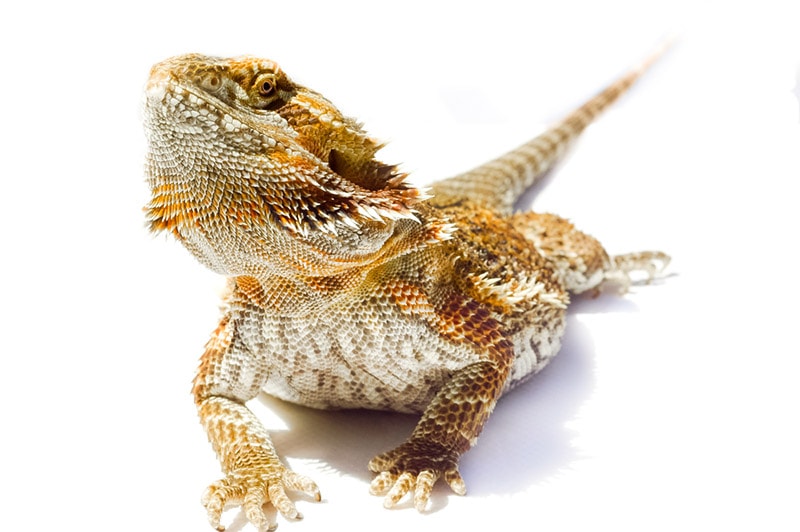
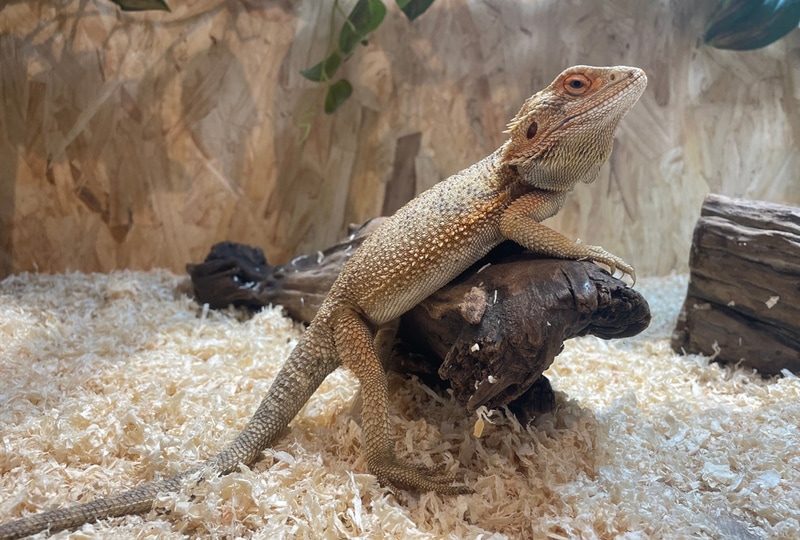
If you’re interested in buying a Bearded Dragon or you already have one, you need to set up a proper enclosure. The correct lighting is a very important part of keeping your Beardie happy and healthy as pet Bearded Dragons generally rely on artificial lighting to simulate sunlight. The enclosure needs a source of UVA rays, UVB rays, visible light and heat from a basking lamp.

Read on below to find out more.

Exactly What Kind of Light is Needed?

Bearded Dragons need a certain spectrum of ultraviolet light called UVB. When they don’t have access to bright sunlight ( as they would in the wild)  then special lights are needed to provide the UVB light. This is because UVB is necessary for them to make vitamin D. Vitamin D is responsible for how well your Bearded Dragon’s body is able to absorb and use calcium. When they don't make enough vitamin D, their calcium levels will drop and this can result in bone problems and other metabolic disorders. UV lights do not penetrate glass windows.

Bearded dragons can see part of UV light, UVA , which is essential for their color vision. Many UV bulbs will provide UVA and UVB.

Bearded Dragons are reptiles and so are ‘ectothermic’, meaning they use their environment to warm up and cool down. They need light to be able to detect heat. Heat or basking lamps are used to create more heat in certain areas of the enclosure and a temperature gradient within their cage.
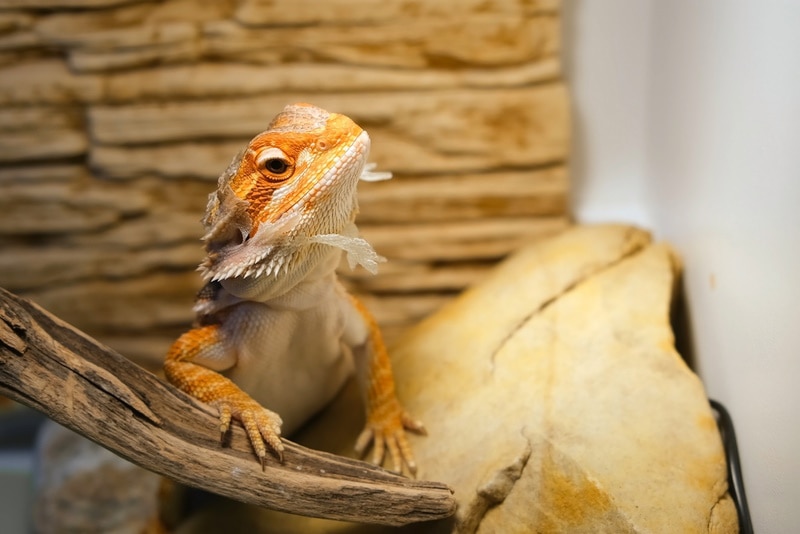
bearded dragon shedding
Image By: Vadim Zakharishchev, Shutterstock

Light Setup

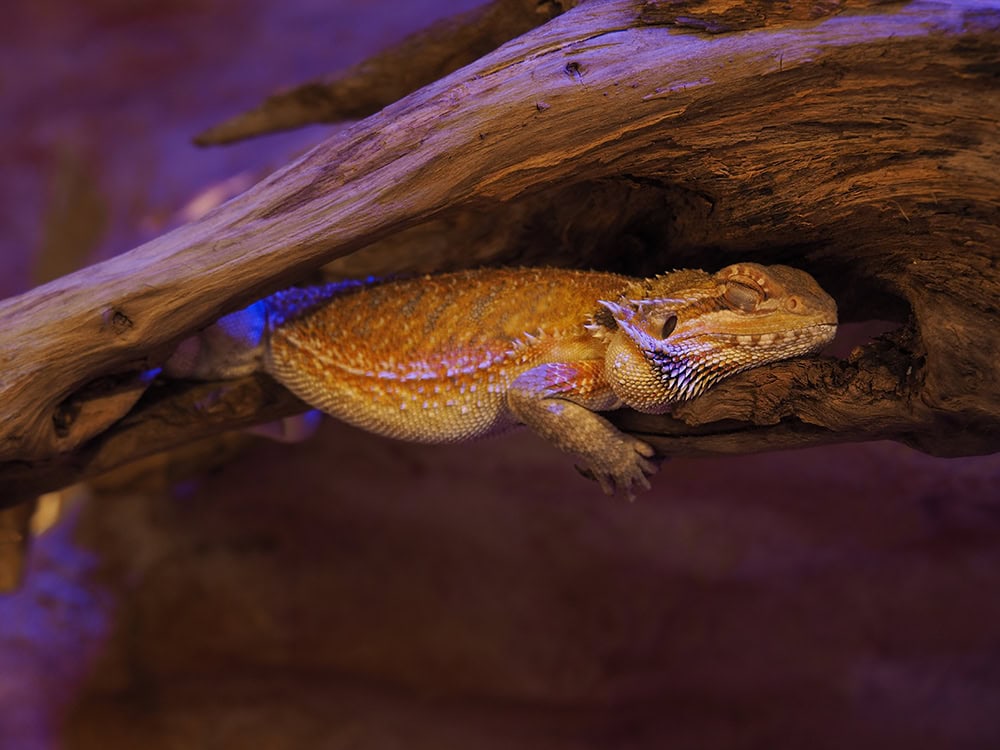
The enclosure should have a gradient from light to shade to try and emulate their environment in the wild. The light source should overlap with the basking area, while the cool end of the enclosure will be more shaded. Some points to note when setting up the lights:

  • All lights must be inaccessible to your Bearded Dragon and guarded to prevent burns or injuries.
  • Carefully follow the manufacturer’s guidelines for the UVB light regarding positioning and distance from you Beardie. You must not have glass between the UV light and your Beardie.
  • UVB output reduces over time so lights must always be replaced according to manufacturer's guidelines.
  • A thermostat must be used with all heat lamps and digital thermometers need to be monitored daily in different parts of the cage.
  • Turn off all lights at night. Lamps can be controlled using a simple plug in timer- on for 12 hours in the day and off for 12 hours at night.

Temperature

A Bearded Dragon needs to be able to move around its enclosure to regulate its body temperature. The basking zone should be around 38-42 degrees Celsuis and the cool end between 22 and 26 degrees Celsius. Generally a 60- 100 watt bulb provides the heat, which should be at one end of the enclosure pointing downwards.

Bearded Dragons should be provided with a natural stone in the basking area to give access to the heat. Follow the instructions for setting up the basking lamp, but generally their backs should not get closer than 10-11 inches from the heat lamp. The exact height , mount and your rooms’s average temperature will all affect the temperature of the enclosure. It’s important to have multiple thermometers in different parts of the enclosure and to record and monitor temperatures daily.

Conclusion

The lighting setup for your Beardie should try to replicate their natural environment in the wild as closely as possible. Indoors this means a UV light source for both UVA and UVB light. In addition, they need heat usually from a basking lamp, as they normally rely on the sun's heat to regulate their body temperature.

Sources

Featured Image Credit: Robert Keresztes, Shutterstock

Get Hepper In Your Inbox

Pet care tips from our vets and experts, straight to your inbox.

List

Select all that apply.

You may opt-out at any time. View our Privacy Policy for more information.

Kristin Hitchcock
Authored by

Kristin Hitchcock

Join the conversation

Ask a question, share your story, or send private feedback.
Rate this post
Required to post. Only our editors see your rating.
Who should see this?

A human reviews every comment before it appears. Your email is never published.

Picked to go with this article

Does a Bearded Dragon Need Heat at Night? Vet-Reviewed Facts and FAQs

Does a Bearded Dragon Need Heat at Night? Vet-Reviewed Facts and FAQs

Heat is incredibly important for this popular desert-dwelling reptile. Bearded Dragons rely on heat to survive, and although they should be getting most of the…

Sarah Psaradelis
By Sarah Psaradelis ·
How to Take Care of a Bearded Dragon: Vet Approved Tips

How to Take Care of a Bearded Dragon: Vet Approved Tips

Bearded dragons make fantastic pets as they are very docile and are considered relatively easy to care for among reptiles. But they’re only easy to care for on…

Chantelle Fowler
By Chantelle Fowler ·
Do Turtles Need a Heat Lamp? Vet-Reviewed Guide

Do Turtles Need a Heat Lamp? Vet-Reviewed Guide

Turtles are commonly kept in many homes around the world. People love these reptiles due to their docile personalities and low-maintenance needs, making them t…

Visnja Radosavljevic
By Visnja Radosavljevic ·
What Size Tank Does a Bearded Dragon Need? Our Vet's Advice & Care Tips

What Size Tank Does a Bearded Dragon Need? Our Vet's Advice & Care Tips

For the reptile enthusiast, a bearded dragon seems like an ideal pet. They’re relatively easy to care for, easily obtainable all over the world, often come wit…

Dr. Luqman Javed
By Dr. Luqman Javed ·

Keep reading

More stories you might like

How Long Can a Bearded Dragon Go Without Heat? Vet-Verified Facts & FAQ

Bearded Dragons come from arid and semi-arid areas of Australia, where they are used to living with high temperatures. While all pet Bearded Dragons are captiv…

Nicole Cosgrove
By Nicole Cosgrove ·
How Long Can a Bearded Dragon Go Without Heat? Vet-Verified Facts & FAQ

Are Bearded Dragons Nocturnal? Sleep Cycles, Habits & Care Tips (Vet Reviewed)

Bearded dragons, often affectionately known as “beardies,” have gained immense popularity as pet over the years. Among the many curiosities that surround these…

Nicole Cosgrove
By Nicole Cosgrove ·
Are Bearded Dragons Nocturnal? Sleep Cycles, Habits & Care Tips (Vet Reviewed)

Why Is My Bearded Dragon Lethargic? 6 Vet-Reviewed Reasons

When most of us think about pet reptiles, we think about bearded dragons because they're among the friendliest and most intelligent reptilian pets. Although th…

Jana Blagojevic
By Jana Blagojevic ·
Why Is My Bearded Dragon Lethargic? 6 Vet-Reviewed Reasons

Bearded Dragon Brumation: What Is It & What To Do (Vet Approved)

Bearded Dragons are one of the most popular pet lizard species. They are considered good first-time pets and are especially good for first-time lizard owners.…

Nicole Cosgrove
By Nicole Cosgrove ·
Bearded Dragon Brumation: What Is It & What To Do (Vet Approved)

White Bearded Dragon: Size, Pictures, Habitat & Care Guide

Bearded Dragons are one of the best-loved reptiles, and many are kept as pets in the United States. They are originally from Australia, and the most common typ…

Beth Crane
By Beth Crane ·
White Bearded Dragon: Size, Pictures, Habitat & Care Guide

Orange Bearded Dragon: Facts, Care, Diet & Health (with Pictures)

Orange bearded dragons are fascinating creatures that are known for their stunning appearance and unique characteristics. The orange bearded dragon is a beauti…

Nicole Cosgrove
By Nicole Cosgrove ·
Orange Bearded Dragon: Facts, Care, Diet & Health (with Pictures)

How Much Are Bearded Dragons at PetSmart? 2026 Price Update

Bearded Dragons make interesting pets and are very popular. These medium-sized lizards hail from Australia and live in warm, arid deserts, savannahs, and subtr…

Rachel Giordano
By Rachel Giordano ·
How Much Are Bearded Dragons at PetSmart? 2026 Price Update

Do Bearded Dragons Drink Water? Vet Approved Tips to Make Them Consume Fluid

Like every other animal in the world, bearded dragons need water to survive. They get their hydration in two ways: eating foods high in moisture, or drinking w…

Visnja Radosavljevic
By Visnja Radosavljevic ·
Do Bearded Dragons Drink Water? Vet Approved Tips to Make Them Consume Fluid