Hepper is reader-supported. When you buy via links on our site, we may earn an affiliate commission at no cost to you. Learn more.
Can Cats & Birds Live Together Safely? Our Vet Explains

In this article
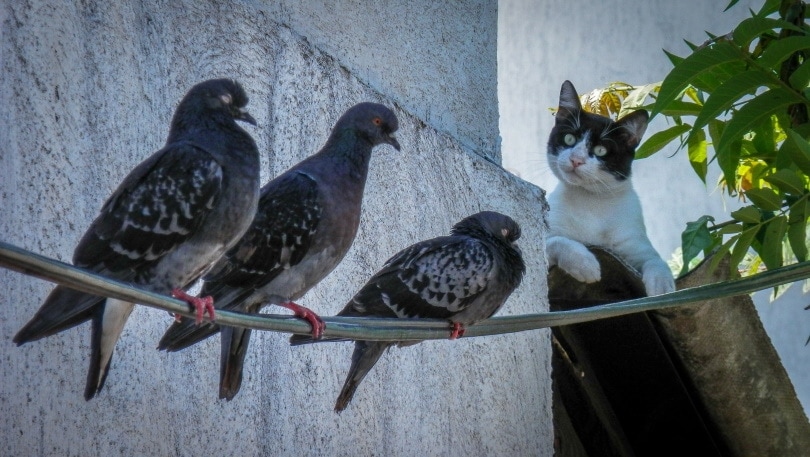
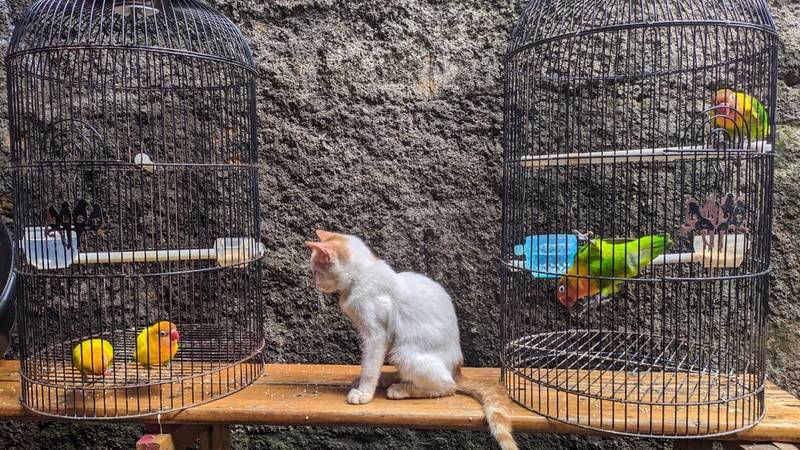
Is it safe for cats and birds to coexist in the same household? They certainly would not be sharing a tree house in the wild, however, there are circumstances where cats and birds do learn to accept each other and live peacefully together.
Read on to find out how.

Cat and Bird Coexistence
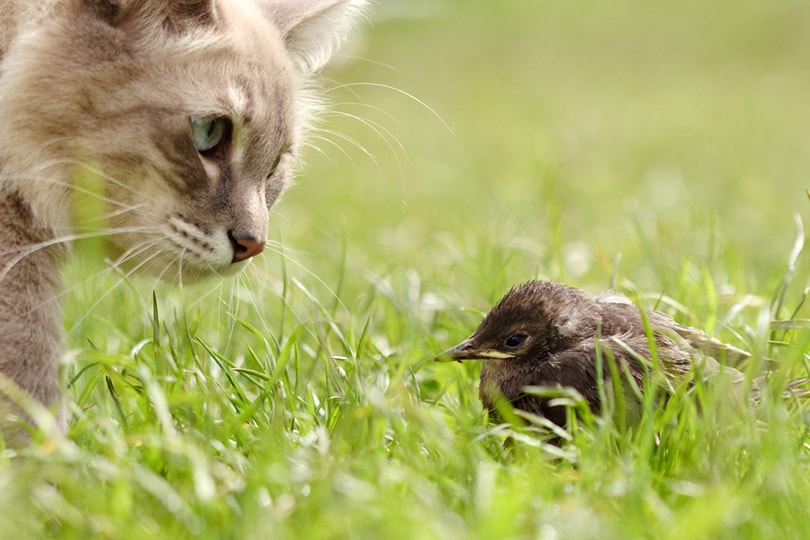
Historically, the natural dynamic between cats and birds is always that cats are the predator and birds are the prey. This is the only way they would interact in the wild and how their instincts lead them to behave. The problem with wanting them to coexist is that we are expecting to suppress these instincts, which for an animal, is very difficult. Cats will instinctively stalk, pounce, and either tease or eat birds they can get their paws on. Cats actively enjoy the thrill of the chase and hunt for pleasure as well as food. Cats will not be able to differentiate between a beloved family pet bird and a bird in the wild.
Birds will automatically try to fly away from a cat as they recognize them as a potential predator. Birds startle at the slightest noise or movement as they are fine-tuned to be very observant of everything in their environment. They will try to put as much distance as possible between them and anything that they perceive as a threat. If backed into a corner, some types of birds will attack or fight, but they usually choose to flee.
Placing cats and birds in a room together when they have these strong instincts guiding them, and not being able to fully act on them is unethical. For example, if the cat is continually trying to capture the bird but is unable to if the bird is out of reach, that will be incredibly confusing and frustrating for the cat. In the same vein, if the bird wants to fly away safely but can't as they are confined by a cage, yet the cat keeps stalking them, that is extremely stressful for the bird.
Some cats and birds, depending on their circumstances and background will be more tolerant of the other species and react less and be less led by their instincts. Some cats will not react or show interest in a bird at all. Some birds may be very relaxed and accepting of cats in close proximity.
What Are the Dangers for Cats?
Cats are usually bigger than most pet birds, however, some birds can be bigger and stronger than cats. A larger bird that is threatened can still cause damage to a cat. For example, large parrots have huge beaks that they crack nuts with, so if they get hold of a cat, they can hurt them badly. They also have large, strong claws that have a mighty grip so they can attack with these as well. Lots of birds would have a physical advantage over a kitten too, and kittens are very inquisitive so are likely to approach birds.
What Are the Dangers for Birds?
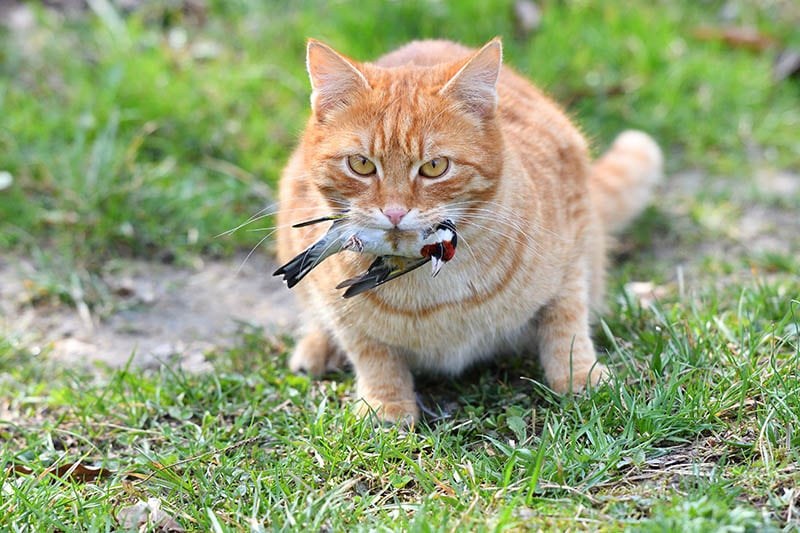
Cats are designed to hunt and kill birds with ease. They have evolved to do this over time. They have sharp claws and teeth and can do serious damage to a bird. Even if they don't succeed in killing the bird, they can inflict serious damage. If they bite, they can introduce infection from the bacteria in their mouths, and in a scuffle, they can pull out feathers which are required for warmth, balance, and flight.
How to Help Your Bird Stay Safe
- Secure the bird cage. Ensure that your bird is housed in a completely secure and appropriately sized aviary. Use a lock or carabiner on the door to prevent your cat from tampering with it. Ensure there is no way that your cat can enter the aviary or poke their paws through the bars. Make sure they cannot knock it or push it as this may cause the door to spring open.
- Ensure your bird has plenty of safe hiding places in their aviary that they can retreat to if they feel frightened and threatened.
- Separate your cat and bird in different rooms. Although this may not be allowing them to coexist, it may be the most sensible thing to do depending on the dynamic between your bird and cat. Even if the cage is completely out of reach and tamper-proof, it may cause your bird huge stress to be constantly stalked by your cat.
- If you allow your bird time outside of their aviary, never leave your cat and bird unsupervised together. Even if they seem to tolerate each other, any quick movements could trigger your cat’s instincts and end up in them going into attack mode.
- Do not allow your cat inside the aviary. Even if it is being cleaned and your bird is not in it. Your bird will be able to smell your cat and know that they have been inside, and this will potentially cause them a huge amount of stress. You also don't want your cat to think that the cage is part of their territory and mark it as their own or start spraying near it.
- Slowly introduce your bird and cat so that they can gradually get used to each other. This is a long and drawn-out process that needs to be done whilst gauging both your bird's and your cat’s reaction. You can start by letting them smell something with the other animal's scent on. Then allow them to see each other from a distance. Gradually reduce the distance if both animals will tolerate it without signs of distress. Some cats may not be interested in hunting birds if they have never had any previous experience or exposure and if they don't go outside. It really does depend on the individual animal.
- Ensure your cat and bird have lots of enrichment toys in their environment to keep them mentally stimulated and occupied.

How to Keep Your Cat Safe
If there is a circumstance where your bird is bigger and stronger than your cat, or you have just got a kitten, you might need to take precautions to protect your cat instead of your bird. The same sort of common sense applies:
- Ensure your aviary is securely locked with a tamper-proof latch. Birds are very good at learning how to open cage doors and they often escape this way.
- Do not let your bird fly freely when your cat is in the room. Never leave them together unsupervised.
Treat Both Animals as Individuals
Animals, much the same as humans, have very different personalities. This will partly be influenced by genetics and partly shaped by their past experiences. For example, if a cat has been living outdoors and hunting for themselves, they will have strong instincts to chase birds wherever they encounter them. It will be near impossible to train these sorts of instincts out of them.
Some birds will always startle easily and never be comfortable in the company of a cat. Pay close attention to how your animals behave and don't put them in a situation where they will be unduly stressed.
The Five Freedoms
An important consideration when housing any animal, but especially if you are putting two together that are naturally predator and prey, is the Five Freedoms of animal welfare. The Five Freedoms dictate a standard of care that is recommended for all animals. It addresses not only the physical needs of animals but their mental needs as well. The Five Freedoms are:
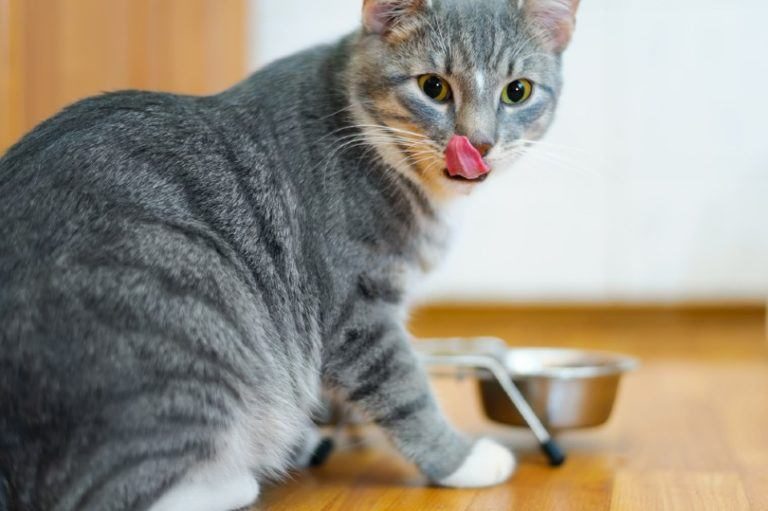
1. Freedom from Hunger and Thirst
All animals need easy access to fresh water and a suitable diet to keep them in good health.
2. Freedom from Discomfort
All animals should be in a safe environment, with appropriate shelter and a comfortable place for them to rest that is tailored to their size and shape with any species-specific requirements. They should be kept at the correct temperature, and disruptive or distressing noises kept to a minimum.
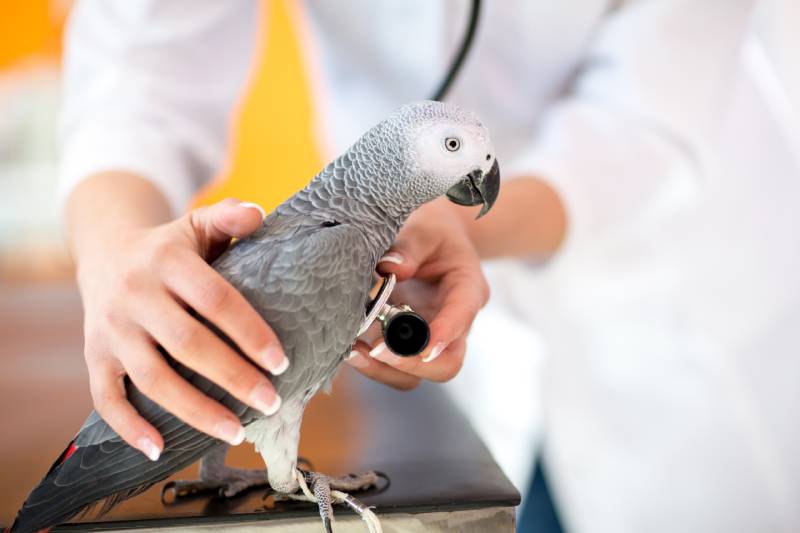
3. Freedom from Pain, Injury, or Disease
All animals should be constantly monitored for any signs of illness or injury. If any are noted, immediate veterinary attention must be sought. Preventative healthcare should be carried out wherever necessary.
4. Freedom to Express Normal Behavior
All animals should have ample space and a suitable area to thrive in. They should have companions if they are herd or pack animals.
5. Freedom from Fear and Distress
All animals should not be subjected to any sort of mental distress or suffering.
When considering mixing cats and birds, owners need to take into account these Five Freedoms, especially freedom from discomfort, freedom to express normal behavior, and freedom from fear and distress. If either the cat or the bird will suffer unduly by being in the company of the other animal, it is best to avoid letting them mix.
Conclusion
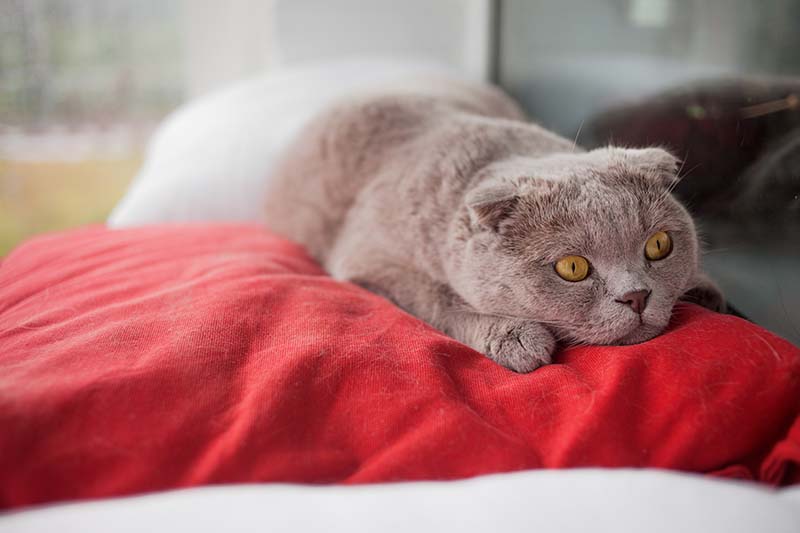
Although it is not commonly seen, it is certainly possible for cats and birds to live in harmony. It is not something that can be rushed or forced. There are a few important precautions that need to be taken. It also does depend on the individual animals and their past experiences. The main priority should always be the safety and welfare of both animals.
Featured Image Credit: Elena Golovko, Shutterstock
Get Hepper In Your Inbox


Pet care tips from our vets and experts, straight to your inbox.
You may opt-out at any time. View our Privacy Policy for more information.
Dr. Emma is an experienced vet who is always happy to share her knowledge and expertise with our readers. Her passion is surgery but she will happily talk about anything animal related. Dr. Chandley graduated from The Royal Vet College and since then she has worked in general practice in the UK. She has completed a postgraduate certificate in Small Animal Surgery and has also gained Advanced Practitioner status in the same discipline. She enjoys developing her skills in clinical pathology, animal behavior and nutrition as well.
Emma is an experienced veterinarian who is always happy to share her knowledge and expertise with our readers. She is passionate about surgery but will happily talk about anything animal related.
Experience
Since graduating, Dr. Emma has worked in general practice in the UK. She has completed a postgraduate certificate in Small Animal Surgery and has also gained Advanced Practitioner status in the same discipline. She also has expert knowledge in small animal medicine with a special interest in Endocrinology, although surgery is her passion. She enjoys developing her skills in clinical pathology, animal behavior, and nutrition as well.
Education
Emma received her degree from the Royal Vet College, University of London. She obtained her postgraduate certificate from the British Small Animal Veterinary Association and Nottingham Trent University.
She was granted Advanced Practitioner status by The Royal College of Veterinary Surgeons.
Join the conversation
Ask a question, share your story, or send private feedback.