Hepper is reader-supported. When you buy via links on our site, we may earn an affiliate commission at no cost to you. Learn more.
Can Stress Cause A Heart Murmur in Dogs? Vet Approved Science & Facts


In this article
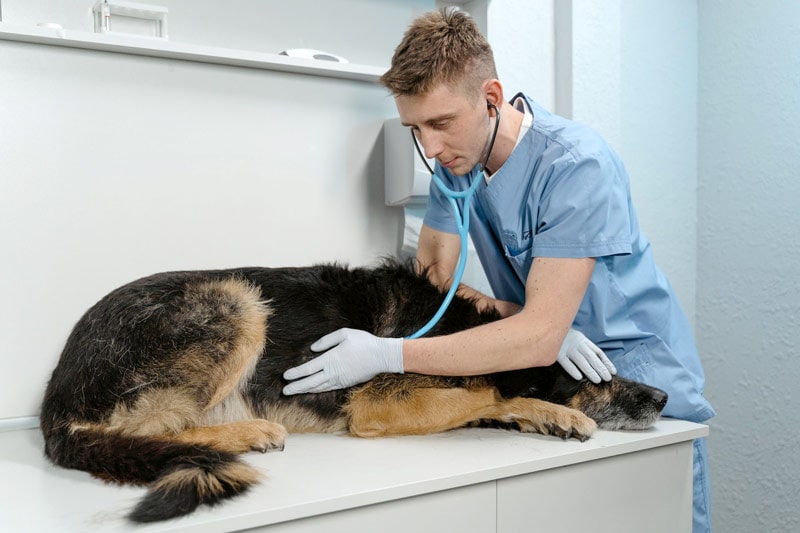
A heart murmur occurs when blood is flowing abnormally between the different chambers of the heart, creating a turbulence. Your vet then hears this by placing a medical device called a stethoscope on your dog’s chest. It can always be frightening to hear that something is wrong with your dog’s heart, especially if the cause is initially unknown.
There are many medical reasons why your dog might have a heart murmur, and all of them require veterinary attention and adequate treatment. In some rare instances of severe stress and excitement, dogs that previously didn’t have a heart murmur can temporarily develop low intensity murmurs. You may have taken your dog to the vet for some answers, only to be asked to come back later due to your dog’s elevated stress levels. Without further testing, it will be difficult for your vet to tell if the heart murmur is significant or is simply a result of your dog’s anxiety. However, if the murmur is of a medium or high intensity, your vet will recommend further investigations, as this is unlikely to be just stress related.
What else can cause a heart murmur? How are heart murmurs treated? To learn more, keep on reading.

Types of Heart Murmurs
Heart murmurs are evaluated based on a grade. The grades include levels (denoted by Roman numerals) I through VI (1 through 6), with VI (6) being the most prominent. The grade is determined by the loudness and intensity of the heart murmur as well as from how many locations your vet can hear the murmur.
To give you an idea of what this may look like, a grade I heart murmur is soft and difficult to hear, whereas a grade VI heart murmur is very loud and can even be felt as a vibration when you place your hand on your dog’s chest.
Generally, the higher the grade, the more concerning the heart murmur is. However, this is not always the case. The higher grade does not always indicate a more severe underlying heart or other medical condition. For example, a quiet heart murmur may result from significant heart disease, whereas a loud heart murmur might not impact the dog’s life long-term, depending on diagnosis.
Murmurs are also categorized by the time in which they occur during the heart cycle and by whether they are long or short. Most heart murmurs in dogs occur during systole phase, when the heart is contracting to pump blood out. Murmurs are also described by their location or where they are the loudest.

What Causes Heart Murmurs?
Heart murmurs may be caused by an abnormality in the structure or function of the heart itself or by factors unrelated to the heart.
Heart murmurs are most commonly caused by disease of the heart. This is either because your dog was born with it or the disease developed later in life. Defective structures of the heart can include malfunctioning valves, dilated chambers, irregular stretching of the heart muscles, holes in the wall and muscle of the heart, narrow heart vessels, or other structural or functional issues.
Heart murmurs unrelated to heart disease can be caused by general illness, fever, anemia (reduced red blood cells often due to bleeding), pregnancy, significant stress, excitement, or anxiety. Innocent or benign murmurs unrelated to heart disease can occur in puppies and generally disappear by 4-6 months of age. If the murmur persists after your puppy has reached 6 months of age, your vet will recommend further investigations. Benign murmurs can also sometimes be heard in very athletic dogs.
Common Signs Of Heart Disease In Dogs
One of the early signs of heart valve disease in dogs is a heart murmur, meaning that it can be an early warning. That is why it is important that your dog has regular vet check-ups. If a heart murmur is heard, it may still be nothing to worry about, but your vet can advise you on whether they believe further testing may be required.
Otherwise, the most common signs of heart disease in dogs include lack of energy and unwillingness to exercise, coughing, breathing difficulties, reduced appetite, weakness, fainting, collapse, and sometimes a distended belly.


Heart Murmur Testing and Treatment
If your vet detects a heart murmur in your dog, several tests will be recommended and performed to determine the severity and the underlying cause of your dog’s condition so that effective treatment can be offered.
Testing
Your vet will recommend an ultrasound examination of the heart (echocardiogram), X-rays, an electrocardiogram (ECG), and/or blood pressure measurement to check the health and function of your dog’s heart. Your dog might not need all of these tests, as it will depend on their specific case. If the vet suspects that the heart murmur is secondary to another disease, blood and urine tests will be performed. These are useful for checking your dog for infections, anemia, thyroid disease, liver disease, or kidney disease. In many cases, a referral to a cardiologist will be required, especially for congenital heart abnormalities in puppies that might require surgery.
Treatment
Treatment will be catered to the underlying cause of the heart murmur. If your dog has heart disease, treatment will focus on managing that particular issue. Treatment options can range from prescribed daily medications to surgery in cases of congenital heart disease. Dogs with heart disease will need frequent monitoring by a vet or cardiologist to make sure they are doing well on their meds and that the disease is kept under control. The treatment will need to be lifelong.

Conclusion
Heart issues are a frightening thing to deal with, especially when the cause remains unknown. Treatment and prognosis for heart murmurs rely heavily on the diagnosis, so you must stay in regular contact with your vet or veterinary cardiologist so that a diagnosis can be made about your dog’s heart issue. However, if your dog usually does not have a heart murmur and has suddenly developed a low intensity one during an unexpectedly stressful event or visit to your vet, without any other signs of heart disease, it might be worth rechecking your dog in a day or two to see if the murmur was related to stress.
Sources
https://www.harmonyanimalhospital.net/heart-murmurs-in-pets-to-be-concerned-or-not/
https://vcahospitals.com/know-your-pet/heart-murmurs-in-dogs
https://medium.com/creatures/help-my-dog-has-a-heart-murmur-ff13ab9fe185
https://vcahospitals.com/know-your-pet/heart-murmurs-in-dogs
https://www.pdsa.org.uk/pet-help-and-advice/pet-health-hub/conditions/heart-murmurs-in-dogs
https://www.rmvccolorado.com/site/blog/2021/11/30/heart-murmurs-in-dogs
https://www.medivet.co.uk/pet-care/pet-advice/heart-disease-in-dogs/
Featured Image Credit: Tima Miroshnichenko, Pexels
Get Hepper In Your Inbox


Pet care tips from our vets and experts, straight to your inbox.
You may opt-out at any time. View our Privacy Policy for more information.
Pets are Jordyn’s passion, cats especially. Whenever she has the opportunity, she loves to learn about them and share her knowledge with everyone. She is devoted to her tabby cat named Jack and works hard to buy him his favorite treats and toys. Discovering new ways to better care for her pet is always on her to-do list, and she is eager to help pet parents everywhere who have similar pursuits. In her spare time, she loves to read, write, and take long walks. She has a creative spirit, which often helps her to come up with funny cat names.
Join the conversation
Ask a question, share your story, or send private feedback.