Hepper is reader-supported. When you buy via links on our site, we may earn an affiliate commission at no cost to you. Learn more.
How Do Cats Purr? Exploring Feline Anatomy


In this article
Whether it’s a falcon’s incredible eyesight or a chameleon’s changing skin, we are fascinated by the amazing things animals can do. One cool (and seemingly useless) trick that we can’t copy is purring. Just listening to a cat’s constant purr is relaxing. Back in the day, people used to compare it to the whir of a spinning wheel. Today, you’re more likely to think of the rumble of a luxury car. But if you’ve ever wondered how cats can keep a purr going without running out of breath, you’re not alone.

Voice Box Anatomy
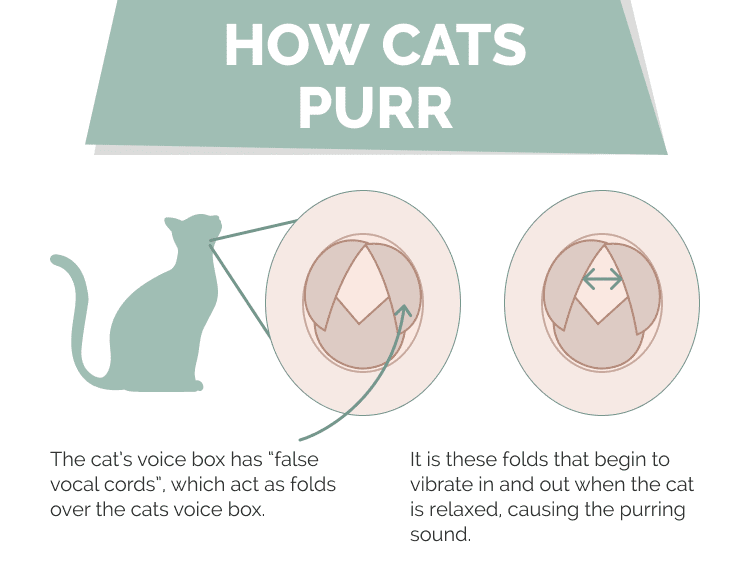
To understand how cats purr, we’ll start by looking at the voice box, also called the larynx. Most mammals—including humans and cats—have a similar organ in their neck that’s responsible for most sounds they make. This includes talking and singing in humans and meowing and purring in cats. When you breathe in, air goes from the throat down through the larynx into the trachea, or windpipe, and then to the lungs. Then you breathe out, and air goes back up through the trachea, larynx, and throat.
The larynx has an important job. Muscles in the larynx, called laryngeal muscles, expand and contract, opening and closing the trachea. This helps you breathe and make sure that food doesn’t end up going down the wrong pipe, but they also have another job. Certain laryngeal muscles are called vocal cords, and they give the voice box its “voice.”
Talking and Meowing vs Purring
Talking, meowing, singing, howling—all of these work the same way. When you want to say something, you breathe out at the same time that your larynx tightens in just the right way. Air blowing through the laryngeal muscles makes your vocal cords vibrate like the strings of a violin. The sound bounces off bones, muscles, and cartilage around your larynx to become louder. Small differences in muscle tightness or anatomy can cause different pitches and tones, leading to a big range of possible sounds.
You might have noticed something about talking, though: it only works when breathing out. When the vocal cords are tightened, it’s hard to breathe air in, and you can’t get the same beautiful noise. The best sound humans can get is a strangled gasp. Just like human voices, cats only meow when they’re breathing out too. That’s what makes purring so unique—it’s a constant hum that barely changes with your cat’s breath.
The Secret to Constant Purring
The reason why is that cats' vocal cords can also move in a different way—a soft, rhythmic fluttering. This movement causes vibrations in a bone called the hyoid bone, and that bone causes purring. Unlike most vocalizations, these fluttering muscles don’t get in the way of airflow, so your cat can keep breathing in and out the whole time. Lots of other cat species can purr too—including bobcats, lynxes, and mountain lions—but the big cats that roar can’t. That’s because roaring requires muscles too stiff to properly purr.
There’s another key ingredient to constant purring too, and that’s in the brain. There’s a neural oscillator—basically a repeating message center—in your cat’s brain that sends the signals to vibrate. This specialized message center lets your cat purr on autopilot, and even when asleep! Although cats don’t purr 24/7, this neural oscillator means that some cats can get pretty close, because they can purr without even thinking about it.
Why Do Cats Purr?
Now that we know how cats purr, we have to figure out why. Cats purr when they are happy and relaxed, but they also can purr when scared, stressed, or injured. There might be a communication component to it, but that’s probably not the main function. Instead, purring seems to have a soothing and even healing function for cats. Vibrations at the range of 25–100 hz—exactly the range of purring—have been shown to have big benefits. These ranges can increase bone growth and be healthy for muscles and soft tissues. Listening to a cat purring also has a positive effect on humans, lowering blood pressure and promoting relaxation. Right now, more research is needed to tell what health benefits purring actually has.

Last Thoughts
We still have lots of secrets to uncover about cats, but we’re just starting to unravel purring. Even if we don’t understand all the reasons why cats purr, we do have a pretty good idea of how they manage to make a beautiful purr. And this strange trick in anatomy might hold some secrets to health and healing for cats all over the world.
Sources
Featured Photo Credit: Karpova, Shutterstock
Get Hepper In Your Inbox


Pet care tips from our vets and experts, straight to your inbox.
You may opt-out at any time. View our Privacy Policy for more information.
Chelsea Flake Mortensen is a writer with a passion for pets. She grew up around everything from cats to chameleons and loves working with all kinds of animals. Chelsea has a BA in English and Creative Writing from Brigham Young University.
Chelsea loves reading, writing, sewing, and board games. She's lived in half a dozen US states and two countries. She is currently living in New England with her husband. Her articles have been featured in various magazines and literary journals for children and adults. Her writing has been translated into over 40 languages.
Join the conversation
Ask a question, share your story, or send private feedback.